WHMCS Email Deliverability Monitoring: Find SPF, DKIM and DMARC Problems
Explore PD Email Deliverability for WHMCS: domain checks, DKIM selectors, SPF and DMARC findings, record guidance and a practical staff review workflow.
A hosting customer’s website can be online while its email configuration drifts out of date. A sending service changes, somebody removes a TXT record or a mail platform uses a selector the team never added to its checklist. The first visible symptom may be a customer asking why an important message did not arrive.
PD Email Deliverability brings domain authentication checks and explained findings into WHMCS. It reads supported DNS information for domains drawn from your hosting and registration records, inspects SPF, configured DKIM selectors and DMARC, and presents the results as a staff work list with record guidance and re-check controls.
For a hosting business, that creates a proactive service workflow. Staff can review the domains they support and act on a specific configuration finding, instead of starting every email conversation from a blank external checker.
Put the domain portfolio beside the work that needs attention
The module can draw its scope from domains attached to hosting services and domains registered through the business. Those sources are configurable, so the monitoring list can reflect the customers and services your team intends to help.
The Domains view provides a compact picture of the checked names, observed records and grade. The Needs attention view turns supported observations into individual findings, with severity and an explanation.
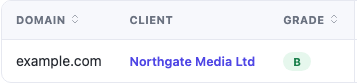
*Actual product-screen crop. The reserved example domain, account name and grade are demonstration data, not a real PD Hosting customer or evidence of measured inbox delivery. Record-value columns are excluded to avoid presenting sample DNS as a recipe.*
That placement matters for a hosting team. A technical colleague can see which domain needs a review and connect it to the customer relationship already managed in WHMCS. An account manager can understand the finding without needing to interpret an entire raw DNS response.
Coverage should still be reviewed during rollout. The module builds a bounded candidate list and checks in batches; it is not a promise that every possible sending subdomain is discovered automatically or that a large portfolio is refreshed simultaneously. The domain-scope guide explains that setup.
Inspect SPF with more context than “record present”
An SPF record can exist and still deserve attention. PD Email Deliverability inspects conditions such as multiple SPF records, permissive mechanisms and an estimated lookup burden. Findings explain why the observation is worth reviewing.
That is more useful than a single checkbox saying the domain has a TXT record. A host whose customer adds another sender can use the findings as a prompt to review the combined policy rather than assuming every additional include is harmless.
The lookup inspection is static analysis, not a complete simulation of every receiver evaluating every message. A finding should be considered with the actual record and sending arrangement. A valid redirected policy, for example, should not be rewritten merely to remove a generic warning about a missing all mechanism.
A practical example is a customer using one provider for staff mail and another for application notifications. Staff identify both legitimate senders, review the policy with the customer and then check the published result. The module helps locate the configuration work; it does not infer the full sender inventory from the business name.
The SPF findings guide gives the task-level explanation. Keep the current sending providers’ instructions alongside the finding when deciding which record is appropriate.
Configure DKIM selectors for the mail platform you support
DKIM public keys live at selector-specific names. A checker needs a selector to ask for; a result for a short list of common selectors is not an exhaustive search of every signing arrangement a domain could use.
PD Email Deliverability lets the host configure the selectors to inspect. That makes the workflow adaptable to the mail platforms and application senders your customers actually use, rather than assuming one generic selector covers the whole estate.
The module distinguishes not finding a key at the checked selectors from observing an empty, revoked public-key value. Those are different reasons to investigate and should lead to different next checks.
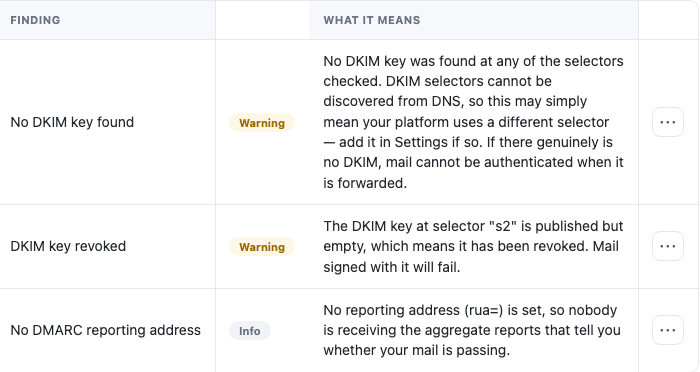
*Actual findings crop from demonstration data. The explanations show the kind of staff guidance available. The image does not demonstrate validation of a real message signature or a complete authentication audit.*
For example, a hosting company could review the selectors used by its own mail platform and add those used by a customer’s external sender where appropriate. When a finding appears, staff can check the expected selector and provider configuration rather than telling the customer to publish an invented key.
The DKIM selector guide covers the configuration. Finding a nonempty public value is useful DNS evidence, but it is not the same as cryptographically validating a sent message’s signature or proving that the application is signing correctly.
Make DMARC review a considered decision
DMARC gives the domain owner a way to express handling preferences around authenticated and aligned mail and request reports. The current protocol is described in RFC 9989.
PD Email Deliverability exposes observed policy information and related findings in the same domain workflow. Staff can therefore review authentication and reporting together instead of treating them as unrelated records scattered across several tools.
The module also has settings for the policy it recommends and the reporting destination. That makes the proposal deliberate, but the actual sending estate still needs to be understood. A restrictive record is not an appropriate automatic answer for every domain, especially while legitimate senders are still being identified.
Standards and product checkers also evolve at different speeds. The released grader includes legacy percentage-policy checks; do not change working DNS solely to clear that historical warning. Use the current DMARC findings guide alongside the finding when deciding what the policy should say.
This keeps the product useful for the real task: a hosting team can see the observed setup and organise the next review without pretending that a letter grade certifies every current DMARC rule or mailbox provider decision.
Turn findings into a record-review workflow
A useful finding should help staff decide what to inspect next. The module can explain the record name, type and proposed value where a suitable recommendation is available. When the correct content depends on the customer’s senders, the decision needs those sender details.
That gives the host a practical sequence: identify the domain, inspect the finding, compare the proposal with the actual sending arrangement and publish the intended change through the correct DNS administration path.
Compatible PD DNS integrations can also offer a publish action from a reviewed recommendation. This is an additional capability in the released implementation, despite older introductory copy describing the module as entirely non-writing. Staff still need to confirm the provider and authoritative zone and understand what the add operation will do.
A locally matching zone is not proof that it is the domain’s authoritative DNS, and an uncertain write should be reconciled before repeating it. The suggested-record guide is the appropriate procedural follow-through rather than a blanket instruction to click every proposed fix.
For a team already using PD DNS tools, this can connect discovery and an attended correction more closely. It does not require promising automatic remediation of every customer’s email setup or writing records without the operator’s decision.
Re-check the intended domain after a change
After publishing the intended record, staff can re-check the domain through the module instead of waiting for the next scheduled batch. That is a useful way to keep the observation and the work together.
Read the actual DNS result and its freshness, rather than treating a closed finding or a success label as a complete end-to-end test. A failed lookup or a change in classification can affect the work list without establishing that mail now passes authentication.
The final service check depends on the task. For a sender change, inspect a suitable message and its authentication results. For a DNS correction, confirm that the intended authoritative record is published. Neither needs to be confused with the other.
The module’s grade is a compact overview, not an inbox-placement prediction. Sender reputation, content, recipient systems and the actual message path remain outside what a DNS-only grade can establish.
Fit ongoing checks into the hosting team’s routine
Scheduled re-checks run through the WHMCS cron and process a configured batch. A team can use that routine to review newly observed configuration issues alongside its existing customer-care work.
The optional email digest provides another route to eligible new warning and critical findings. It complements the dashboard; it is not a guaranteed message for every changed record, and manual checks do not follow the same digest path.
Acceptance can quiet a known finding while retaining the record. Use that for an understood condition, with a team process for revisiting it when appropriate. Do not assume acceptance will automatically reset for every recurrence or change.
An effective rollout starts with a representative set of domains and the selectors your team knows. Compare the module’s observations with the actual service arrangements, then refine the scope and staff routine around what is useful.
A proactive service example
Imagine an agency-hosting business reviewing domains after a group of customers adopted a new application sender. The team checks scope, adds the relevant known selectors, reviews SPF and DKIM observations and separates the domains needing attention from those with an understood configuration.
For one domain, the issue may be a sender missing from the intended policy. For another, the common-selector list may simply not include the one the platform uses. Those are different tasks, and the explained finding helps staff start in the right place.
The team reviews the correct values, applies the agreed change to the authoritative DNS service and checks a suitable message from the affected sender. This is an illustrative workflow, not a fabricated customer success story or a measured reduction in rejected mail.
It shows the product’s business value: configuration review can become a repeatable part of hosting service delivery instead of a series of disconnected reactions to complaints.
Explore PD Email Deliverability for WHMCS
Explore PD Email Deliverability for WHMCS if you want a clearer view of the authentication records behind the domains your business supports.
The module brings domain scope, selector choices, explained findings, proposed records and re-checking into WHMCS. Use it to make staff reviews more specific, keep the customer’s real mail arrangement central and verify the outcome that the business actually needs.
Frequently asked questions
Does PD Email Deliverability check SPF, DKIM and DMARC in WHMCS?
Yes. It inspects supported domain DNS observations and produces findings and a grade. DKIM checks use configured selectors, while the grade is an overview rather than a complete validation of sent messages.
Will it discover every DKIM selector automatically?
No. Configure the selectors used by the relevant mail platforms. Not finding a key at the checked names does not prove the domain has no DKIM configuration elsewhere.
Does a high grade guarantee inbox delivery?
No. It summarises the module’s record checks. Actual authentication, message handling and placement depend on more than the DNS grade.
Can it suggest the records to publish?
Yes, where a suitable recommendation can be formed. Compare the proposed value with the real sender inventory and intended policy before publishing; generic values cannot identify every legitimate sender.
Can it publish through PD DNS integrations?
The released implementation includes a compatible-DNS publish route for supported recommendations. Review the actual target and operation first; do not treat a matching local zone as proof of authoritative DNS or blindly retry an uncertain write.
Does every domain get refreshed at once?
No. Scope and candidate limits apply, and scheduled cron work processes batches. Review actual coverage and check times rather than assuming simultaneous estate-wide checks.
Is a closed finding proof that the mail problem is solved?
No. Verify the intended record and relevant message journey. Lookup failures and classification changes can affect findings without proving successful authentication or delivery.
