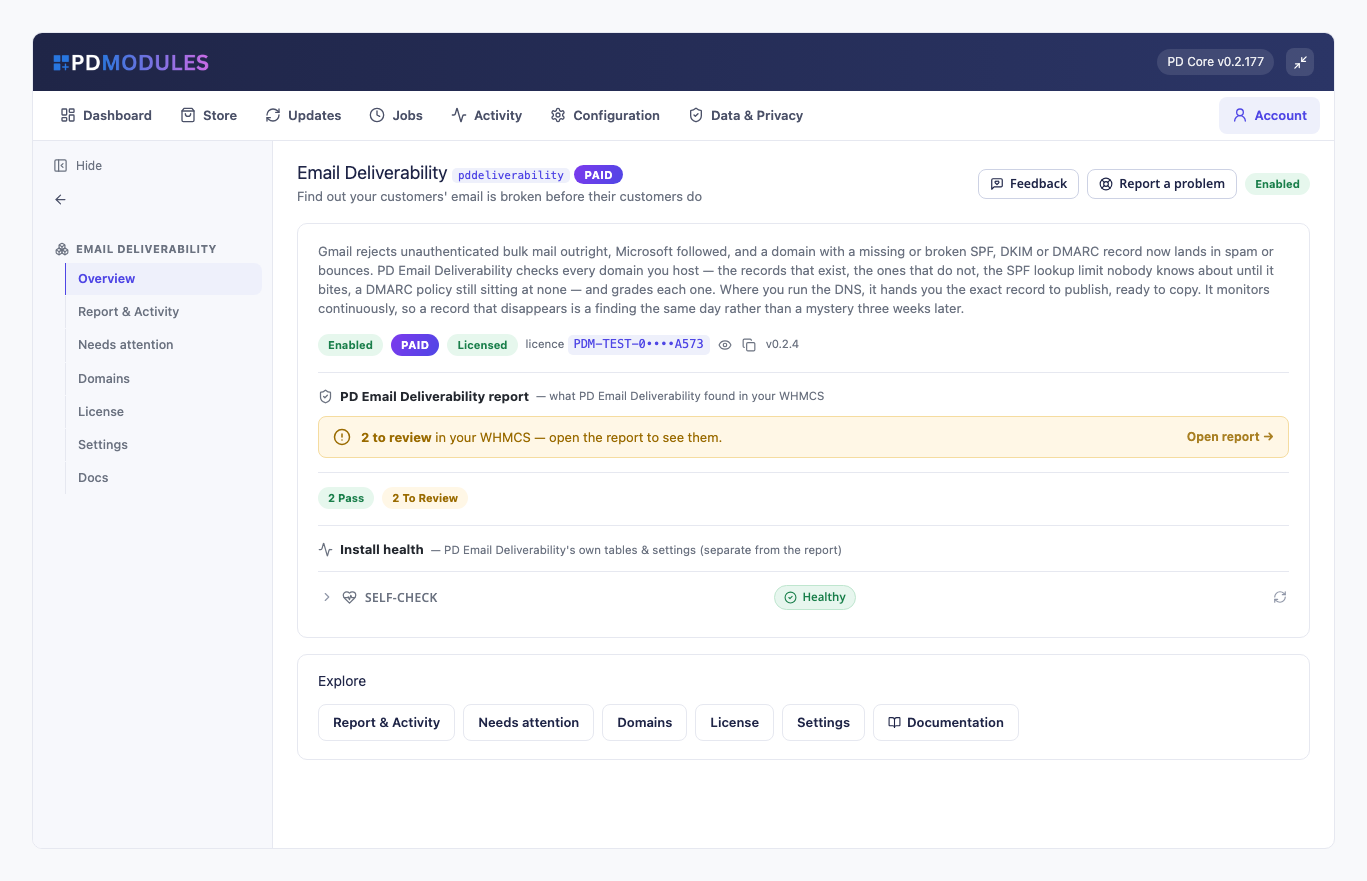
PD Email Deliverability checks the email authentication of every domain you host and tells you what is broken before your customers' mail starts bouncing. For each domain it reads SPF, DKIM and DMARC straight from DNS, gives it a grade from A to F, explains each problem in plain language and shows you the exact record to publish. Where one of the PD DNS modules manages the zone, you can publish the fix from the panel after you confirm.
It is built for hosting companies and email providers who are tired of finding out about a missing DMARC record from an angry customer. Gmail and Microsoft now expect authentication from anyone sending in volume, and this finds the domains that do not have it.
Why hosts choose PD Email Deliverability
Every domain, graded. It checks the domains on your hosting services and the domains registered through you, both on by default, and gives each an A to F grade. A domain with no records never grades well, so the list sorts itself into what to fix first.
Each finding comes with its fix. No finding ends at "SPF is wrong". Each shows the record to publish, built from the DMARC policy (p=none by default) and report address you set, with a Copy button.
It counts the SPF lookups you cannot see. SPF allows ten DNS lookups. The module follows includes and redirects and counts the lookups inside them. Over ten is critical, because receivers stop evaluating and SPF fails; nine or ten is a warning, because one more sender breaks it.
Honest about what DNS cannot tell it. DKIM selectors cannot be discovered from DNS, so it checks a list of common selectors that you can edit. When it finds nothing it says "no key at the selectors checked", not "no DKIM". A key published but empty is reported as revoked. A TXT lookup that fails on a domain that resolves is reported as "could not be read", never as a missing SPF record.
Rechecked without you. Domains are rechecked automatically in batches (300 by default), and a failure is reported as a failed run. An optional digest email tells you when something changes.
No account and no third-party service. Only DNS queries for the domains you host leave your server. No customer data goes anywhere.
How it works
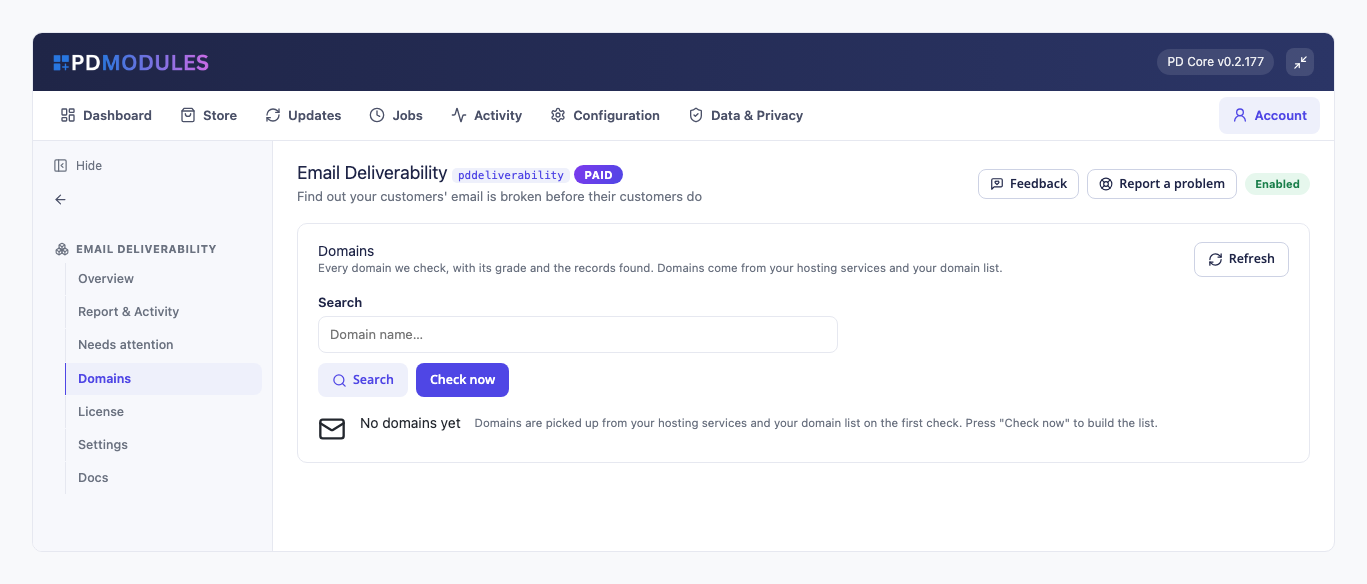
- Install it and run Check now. Domains are picked up from your hosting services and your domain list on the first check.
- Read the grades. The Domains list shows every domain with its SPF and DMARC records and its grade.
- Open a finding. It explains why the problem matters and gives the record to publish.
- Publish and recheck. Publish it yourself, or let the module write it where a PD DNS module manages the zone, then check the domain again to close the finding.
What you get in WHMCS
What it checks
- SPF: no record or more than one record is critical, +all is critical, ?all or a missing all is a warning, ptr is a warning, and the ten-lookup limit is counted through includes and redirects
- DKIM: looked for at the listed selectors, with revoked keys reported separately from missing ones
- DMARC: missing is flagged, a malformed record is critical, p=none is a warning (switchable with "treat none as a problem"), pct below 100 is a warning and no rua address is a note
- MTA-STS, TLS-RPT and BIMI are recorded when present, and their absence is never treated as a fault
Fixing it
- Every finding explains in plain words why it matters
- The exact record to publish, host name and value, built from your DMARC policy and report address
- Where a PD DNS module hosts the zone, a Publish this record now button writes it after you confirm. DNS is never changed on its own
Running it day to day
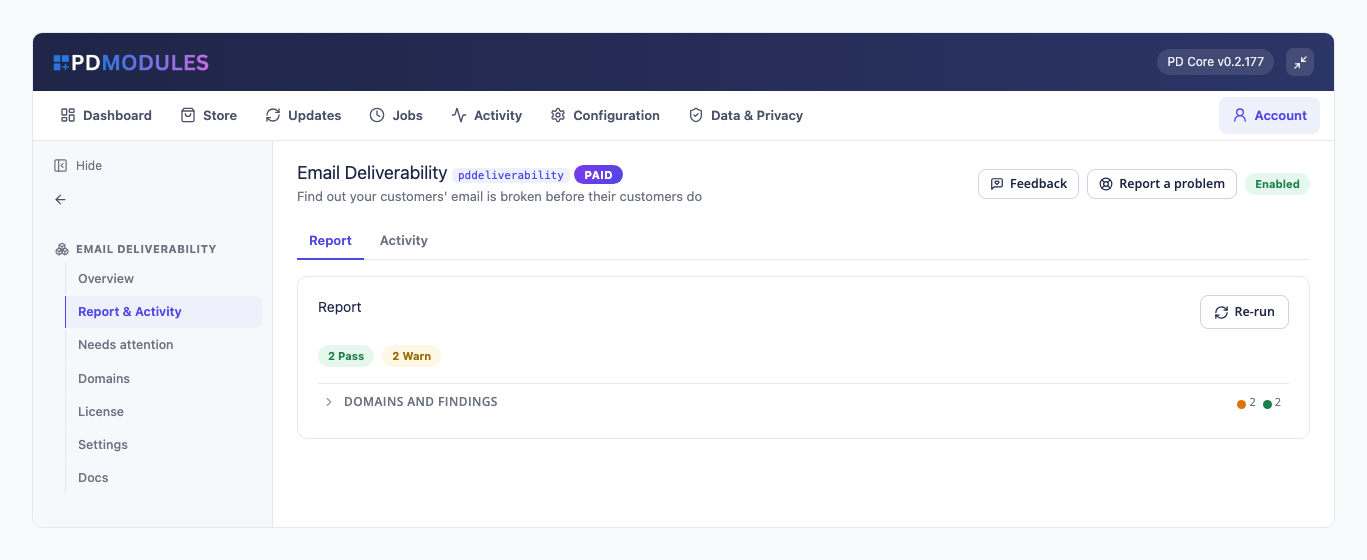
- A Needs attention list, worst first, with Check now
- A Domains list with search and the records found for each domain
- Domains that do not send mail are checked only when you ask. They are advised to publish a null SPF record, the cheapest protection against spoofing a domain that never sends
- A grade is a summary for scanning a long list; the findings are what you act on
- An optional digest email when something changes, to your chosen addresses or the system address
- The assistant tools can read grades and findings
Built to be trusted
A checker that cries wolf gets switched off, so the rules are deliberately careful. A parked domain with no mail records is not treated as a broken mail setup. A lookup that failed is never reported as a missing record.
Security built in
- It never changes DNS by itself. Publishing happens only when you press the button for a zone one of the PD DNS modules manages.
- Only DNS queries for your domains are made. No third-party service, no account and no customer data.
One product, every feature
PD Email Deliverability is one paid module with everything included, at £15 per month or £150 per year. There are no tiers to compare.
If your subscription lapses, the domain list and the results already collected stay readable. Checks and fixes pause until you renew, and no further DNS queries are made.
Requirements
- WHMCS 9 or later and PHP 8.2 or later
- PD Modules (free), which installs PD Email Deliverability
- The ionCube Loader

 Featured