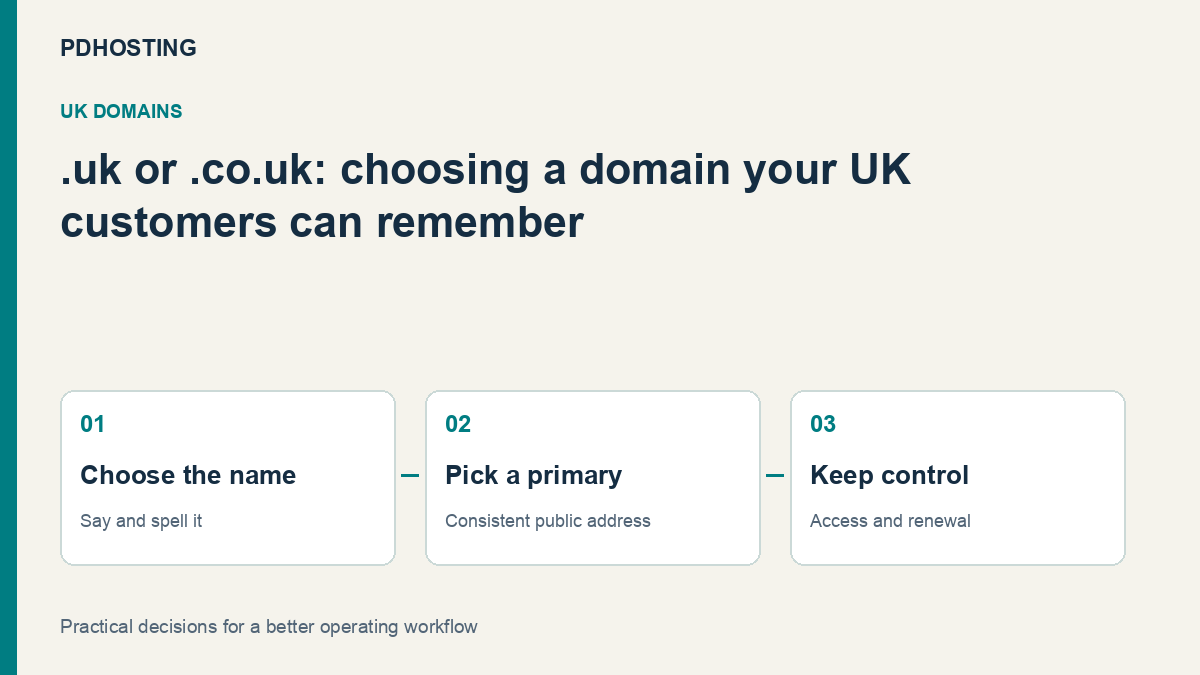
.uk or .co.uk for a Business? Choose a Clear UK Domain Strategy
Compare .uk and .co.uk for your UK business. Plan a primary website address, email identity and supporting domains with Nominet-accredited registrar PD Hosting.
Your domain is the name customers see on your website, in email and on the material your business hands out. Choosing between .uk and .co.uk is therefore a branding and operating decision as much as a registration decision.
Both are part of the UK domain family. Nominet describes .co.uk as an established choice for UK business and enterprise, while .uk offers a shorter name for businesses and individuals. The useful question is which address your customers can recognise and your team can use consistently—not which suffix sounds like an automatic shortcut to search rankings.
PD Hosting is a Nominet Accredited Channel Partner and domain registrar, listed under the PDHOSTING tag. We register and manage UK domains directly, alongside hosting and DNS services. This guide helps you decide what to register, which address should lead and how additional names can support the same business.
What is the difference between .uk and .co.uk?
A name ending in .co.uk sits within the commercial part of the UK namespace. A name registered directly under .uk uses the shorter form. Nominet’s UK namespace overview explains the domain family and the positioning of its different extensions.
In everyday business use, both can be used as a website address and as the domain part of an email address. Your hosting and email arrangements determine the services behind the name; the suffix does not itself supply a website or mailbox.
| Decision | .co.uk | .uk |
|---|---|---|
| How the address reads | The established UK commercial form | A shorter UK address |
| Typical brand consideration | Whether it matches what customers already expect or use | Whether the shorter presentation suits the brand |
| Website and email | Connect the domain to the required services | Connect the domain to the required services |
| If you also register the other form | Give each name a defined role | Give each name a defined role |
There is no need to treat the decision as a contest with one universal winner. An existing business already known at a .co.uk address faces a different choice from a new business selecting its first public identity.
Choose the name customers can recognise and repeat
Start with the complete address, not the extension in isolation. Say it aloud, type it into a message and imagine it appearing in an email signature. Consider whether someone hearing it once can distinguish the business name from any extra words, numbers or punctuation.
A shorter extension can help keep an address compact, but it does not rescue a confusing name. A clear business name with a consistent public address is generally easier to operate than a collection of similar names that staff use interchangeably.
For an illustrative local consultancy, the decision might come down to whether its established .co.uk identity is already printed on client documents and familiar in email. For a newly launched studio, the shorter .uk address might fit the intended brand presentation. Those are practical choices, not measured claims that either extension produces more sales.
You can also ask a few people to repeat the address after hearing it. That is an informal check of clarity, not a substitute for a domain availability search. Keep the assessment close to the way your actual audience will encounter the name.
Give one domain the primary role
If your business registers both versions, decide which one is the main address. Use it consistently in navigation, email signatures, invoices, listings and marketing material where it represents the business.
The other name can then have a supporting role, commonly directing visitors to the primary website. Registering another domain does not require building a second website with duplicate content, and it does not automatically configure a redirect or email service.
For example, a business might publish its website at its chosen .co.uk address and direct the matching .uk name to it. Another may choose the reverse. The useful outcome is that a visitor who uses either registered name reaches the intended business, while the team has one address to promote.
The technical arrangement should match that decision. A redirect and an alias are not identical concepts, and publishing duplicate websites is a separate choice. Ask for the configuration that supports the role you have assigned rather than assuming the registration alone handles it.
Plan email identity at the same time
Email is often the part of a domain decision that lasts longest. Staff addresses, customer contacts, account recovery and third-party logins may all depend on the domain your business uses.
Choose the primary email identity deliberately. If you register both extensions, decide whether the secondary domain needs mail forwarding or separate mailboxes, and understand which service will provide that behaviour. Website forwarding by itself is not an email setup.
An illustrative small agency could keep staff email on its established address while redirecting a newly registered alternative domain to the website. That can be a reasonable arrangement, provided the business knows how incoming messages to the alternative name should be handled—or that they are not being offered at all.
PD Hosting’s domain service includes DNS management, DNS backup/restore and mail forwarding as described on our service pages. Check the current arrangement for your chosen name and any separate mailbox requirement before assuming every address combination has been created.
Think about your UK audience without making SEO promises
A UK domain can communicate the market your business serves. Google’s guidance on regional websites explains how country-specific domains can contribute to geographic targeting.
That does not establish that changing .co.uk to .uk will improve your rankings. Search visibility also depends on the website, its relevance, accessibility and the information it provides. Choose a domain that fits the business and audience, then build a useful site behind it.
For a company already operating on a familiar address, a domain change is a larger decision than buying an additional name. It affects links, customer recognition and email identity as well as website configuration. An alternative registration can play a supporting role without requiring an immediate replacement of the primary address.
This keeps the discussion realistic. A registrar can help you register and operate a suitable domain; it should not promise a particular search position because you chose one suffix.
Should you register both versions?
Registering both may be useful when you have a clear role for each and the names are available. It can give the business control of the matching pair and let you direct visitors who remember the alternative form to the intended website.
Each registration also becomes something to administer and renew. The decision should follow a clear business purpose rather than a fear that every possible spelling must be purchased. Relevant supporting names can be useful; a large collection with no owner, renewal plan or destination can become confusing.
Consider these questions together:
- Which name will be the main website and public identity?
- What useful role would the matching alternative play?
- Who will configure the website and email behaviour for each?
- Who will maintain the registrations and renewal contact details?
- Are you changing an established identity or protecting a new one?
Those questions make the decision more concrete than a general recommendation to buy as many domains as possible.
Choose the registrar and hosting arrangement separately
The registrar manages the domain registration. A hosting provider runs the service that serves your website. DNS directs the relevant names to their intended services. One supplier may provide several of these, but they remain distinct responsibilities.
A business can register a domain with PD Hosting and use a separately managed website or email service. It can also use our WordPress or web hosting alongside the domain. The right arrangement is the one the business can understand and maintain.
PD Hosting’s accredited status can be checked in Nominet’s registrar list, where Projektif Digital Ltd t/a PD HOSTING appears under PDHOSTING. That identifies the registrar relationship; it is not a substitute for checking the current service details that matter to your business.
Keeping these roles clear also helps during a future move. A website migration does not necessarily require a registrar transfer, and changing registrar does not by itself mean moving the website or mailboxes.
Keep the account and renewal responsibility clear
A business domain deserves an identified owner inside the business’s operating processes. Know who can access its registrar account, who receives renewal messages and who approves changes to its DNS or contact information.
Avoid leaving the arrangement understood only by the person who originally built the website. If an agency manages the name for you, make the responsibilities and handover expectations clear. Keep the business’s contact information current so routine administration does not depend on an abandoned mailbox.
This is operational housekeeping rather than a prediction of a domain problem. A clear record is useful when staff change, the website moves or the business needs to adjust its email service.
A practical way to make the choice
For a new UK business, compare the available .uk and .co.uk forms as complete brand addresses. Choose the one you want customers and staff to use, then decide whether registering the matching alternative has a useful supporting purpose.
For an established business, start with the identity already in use. Ask what a change would achieve and whether an additional registration with a clear destination would meet that objective with less disruption.
PD Hosting provides domain registration and management as a Nominet Accredited Channel Partner, with related DNS and forwarding services. You can keep the domain decision separate from hosting, or bring them together in a service arrangement the business understands.
Explore domain registration with PD Hosting to check the current options. If the next step is a website, UK WordPress hosting explains the hosting service that can sit behind your chosen address.
Frequently asked questions
Is .uk better than .co.uk for a UK business?
Neither is a universal winner. .co.uk is the established commercial form, while .uk is shorter. Consider your brand, audience, existing use and the complete address rather than the extension alone.
Does registering .co.uk automatically include .uk?
Treat them as separate registrations. Check availability and the actual order details for each name rather than assuming the matching version is included.
Do I need two websites if I register both?
No. You can choose one primary website address and give the other a supporting role, such as directing visitors to it. That behaviour needs to be configured; registration alone does not create it.
Does the extension decide which email service I must use?
No. The domain and its DNS can connect to the email arrangement you choose. Plan mailboxes or forwarding explicitly, including what should happen for a secondary domain.
Will switching from .co.uk to .uk improve our SEO?
The suffix alone is not a basis for promising an improvement. A change also affects an established website and identity, so make it for a clear business reason rather than an assumed ranking advantage.
Is PD Hosting a Nominet-accredited registrar?
Yes. Nominet’s registrar list records Projektif Digital Ltd t/a PD HOSTING under the PDHOSTING tag as accredited. Our service pages describe the current registration, DNS and forwarding offering.