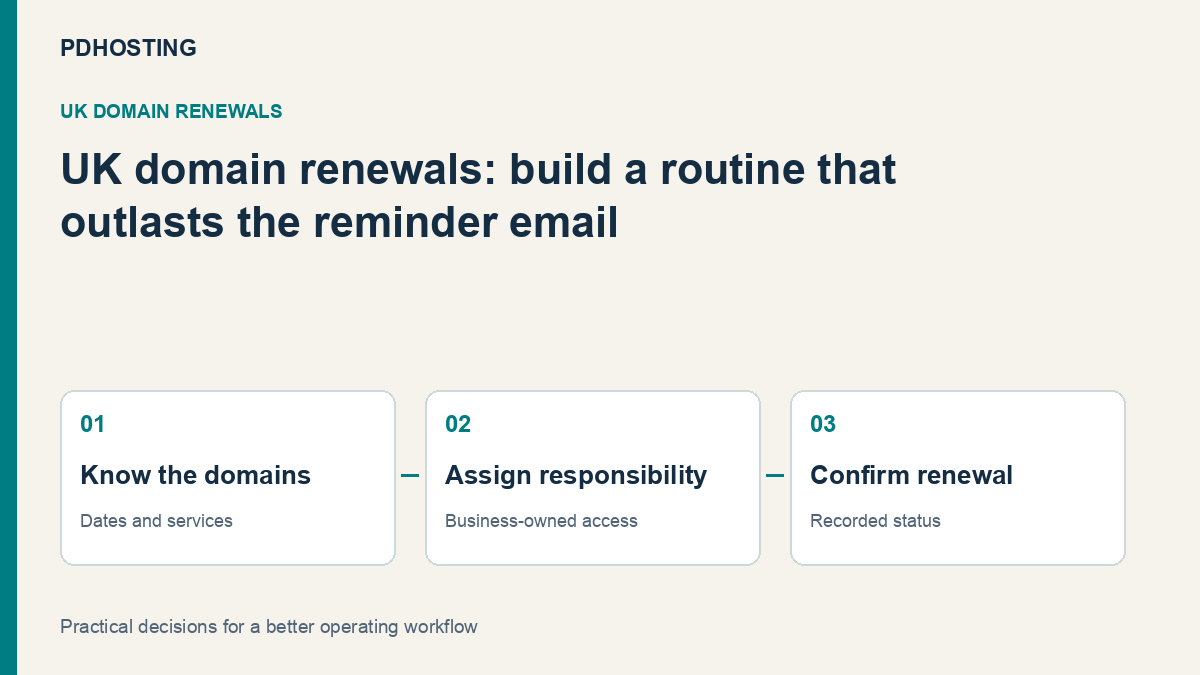
UK Domain Renewals: Keep Your Business Name, Website and Email Working
Keep UK domain renewals clear with the right registrar, account contact and service checks. Understand .uk renewal responsibility with Nominet-accredited PD Hosting.
Renewing a UK domain keeps the registration behind your business’s familiar web and email address in place. The website may be updated regularly and the hosting package may change, but the domain is often the part customers continue to recognise for years.
A useful renewal arrangement connects that continuity to a clear registrar account, an authorised business contact and a confirmed result. It should be understandable to the person responsible for the company, not dependent on one former developer remembering a date.
PD Hosting is a Nominet-accredited registrar, listed under Projektif Digital Ltd t/a PD HOSTING with tag PDHOSTING. This guide explains what to review for .uk and .co.uk renewals and how to keep registration management connected to the wider services your business uses.
Treat the domain as an ongoing business relationship
A domain is more than an item bought during the first website launch. Customers use it to reach the site, recognise staff email and return to a familiar service. Renewing it is therefore a continuing part of operating the business.
The registrar manages the registration relationship. Nominet’s UK domain renewal guidance explains that renewal is arranged with the registrar and should be completed before expiry. You can check registration information through the registry’s lookup route.
For a business owner, the practical question is who is responsible for that relationship now. The person who launched the first website may no longer be the right contact, and the account used at the time may not reflect how the business operates today.
A short periodic review can keep those facts current. Identify the registrar, the relevant account and the person authorised to handle the domain. Then make sure the renewal information reaches someone who will act on it.
This is ordinary business administration, not a reason to assume the domain must move every time the website changes. A good registrar relationship can support continuity while the site and services evolve around it.
Separate the domain from hosting and email renewals
Registration, website hosting, DNS and email may be supplied together or managed separately. Their renewal dates do not have to be the same, and paying for one does not automatically prove the others were renewed.
| Service | What continuing it preserves | What to confirm |
|---|---|---|
| Domain registration | The registered name | The registration and its updated expiry |
| Website hosting | The environment delivering the site | The hosting plan and its renewal arrangement |
| DNS service | The records directing the domain’s services | Who maintains the zone and its account dependency |
| Email service | The intended mailbox and mail platform | Its subscription and relevant domain/DNS relationship |
This distinction is useful when a business receives several notices around the same time. An invoice for a hosting package should not be mistaken for a confirmation that a separately managed domain has renewed.
It is also important when changing suppliers. A new WordPress host may handle the site migration while the domain remains with its registrar. Alternatively, the business may choose to move registration management as a separate task. Keep the intended arrangement explicit.
The aim is a clear record of what remains active and who manages it. That makes the business less reliant on interpreting an old welcome email whenever another renewal comes around.
Keep the receiving contact and account responsibility current
Renewal messages are useful only when they reach an appropriate person. Review the contact route associated with the domain and the account through which the registrar communicates with the business.
A role change, a supplier handover or a new office email address can make old information less useful. Updating the business’s internal contact list does not necessarily update the registrar’s records. Make the relevant changes through the provider’s authorised process.
Use a shared business record to identify who owns the renewal task and who can cover it when that person is unavailable. This does not mean sharing account credentials casually; it means the company should know its authorised route to managing the domain.
An illustrative consultancy might have its office manager responsible for renewal administration and its technical supplier responsible for DNS changes. Those responsibilities can coexist. The useful outcome is that both know which task is theirs and who to contact for the other one.
This is particularly valuable for small businesses whose website arrangements have grown over several years. A domain should not become an unexplained dependency attached to an account no current team member recognises.
Understand what automatic renewal actually covers
Automatic renewal can make routine domain management easier when configured appropriately with the registrar. The important point is to understand the service’s actual arrangement: when it acts, what payment method or account condition it relies on and how completion is confirmed.
A setting labelled automatic does not replace the need to notice a failed payment or a message requiring action. Keep the relevant account and payment arrangements current through the provider’s normal process.
Where a domain is important to the business, checking the renewed expiry is a useful completion step. It connects the intended payment and renewal operation to the registration result rather than stopping at an assumption about a selected checkbox.
Ask the registrar about the current renewal period and available options for the name. A longer registration horizon may suit some businesses, while another prefers a shorter routine. The decision should match the business’s plans and the actual service terms, rather than an invented rule that every UK company needs the same period.
Renew before expiry rather than planning around a grace period
Nominet describes a UK domain expiry lifecycle with stages after the expiry point. Its current expiry guide also distinguishes the registry process from a registrar’s service process. Linked services may have their own timing and arrangements.
For a working business domain, the useful objective is renewal before expiry. A registry recovery window is not a substitute for normal renewal planning and should not be advertised as a guaranteed period during which every website or email service remains unaffected.
If the domain is already expired, establish its actual status and follow the registrar’s current renewal route promptly. Do not infer the available action from an old article covering a different domain extension or a different provider.
This guide deliberately does not reproduce a generic countdown for every case. The practical task is to identify the domain and its current state, then use the applicable registry and registrar process. That gives the business an answer tied to the name it actually needs to manage.
An illustrative renewal handover for a UK business
Imagine a company moving its website maintenance to a new agency while keeping its existing domain registrar. This is a hypothetical business example, not a customer story.
The company first identifies the domain account and expiry information. It records that domain renewal remains the company’s task, while the agency handles the agreed website work. The DNS and email providers are listed separately so neither side assumes those services moved automatically.
Before the renewal date, the responsible person checks the registrar’s instructions and the intended account arrangement. After the renewal completes, the company confirms the updated registration information and keeps the next review visible in its own business routine.
If the company later transfers to PD Hosting, that move gets its own handover request and registrar-tag process. A transfer and a renewal are related administrative events, but a business should not assume one has completed the other without confirmation.
The benefit of the arrangement is clarity. The domain stays an understood business asset while website suppliers or hosting plans change around it. No special knowledge of the original website launch is required to find the person responsible.
Choose a registrar that can explain the arrangement
A useful registrar conversation should answer practical questions: which account manages the domain, when it expires, how renewal happens and which related services belong to the account. Those are matters a business can assess without becoming a registry specialist.
PD Hosting’s Nominet accreditation is independently verifiable in the registry’s registrar list. The domain service can be considered alongside UK hosting, or as a registration-management relationship where other services stay elsewhere.
If the business also wants to move an existing WordPress site, PD Hosting’s WordPress plans provide a separate hosting and migration conversation. Explain whether the aim is domain management, a website move or both.
Explore PD Hosting’s domain services and bring the current domain arrangement into that discussion. The useful result is a continuing service relationship your business understands, with renewal responsibility and the connected website and email services clearly identified.
UK domain renewal FAQ
Does renewing hosting also renew my .co.uk domain?
Not automatically. Hosting and registration can have separate arrangements and dates. Confirm the domain renewal through the registrar account rather than assuming a hosting payment completed it.
Should I renew a .uk domain before it expires?
Yes. Arrange renewal through the registrar in time for expiry. The registry’s later lifecycle stages should not be treated as the normal operating plan for an important business name.
Does automatic renewal remove every task for the business?
No. Understand the provider’s renewal process, keep the relevant account and payment arrangements current and respond to messages requiring action. Confirm the completed result for important names.
Can my website agency manage DNS while we handle registration?
Those responsibilities can be separate. Record the intended arrangement and authorised contacts so domain renewal, DNS work and website maintenance are not confused.
Is transferring a domain the same as renewing it?
No. Changing registrar and extending the registration are distinct actions. Establish which are included in the intended handover rather than assuming one completed the other.
Can I recover a domain after expiry?
The available route depends on its current state and the applicable process. Use the registrar and Nominet’s current guidance for the actual name; do not rely on a generic grace-period promise covering every service.
Is PD Hosting a Nominet-accredited registrar?
Yes. Nominet lists Projektif Digital Ltd t/a PD HOSTING as accredited, with registrar tag PDHOSTING. The registry list provides an independent way to verify that identity.