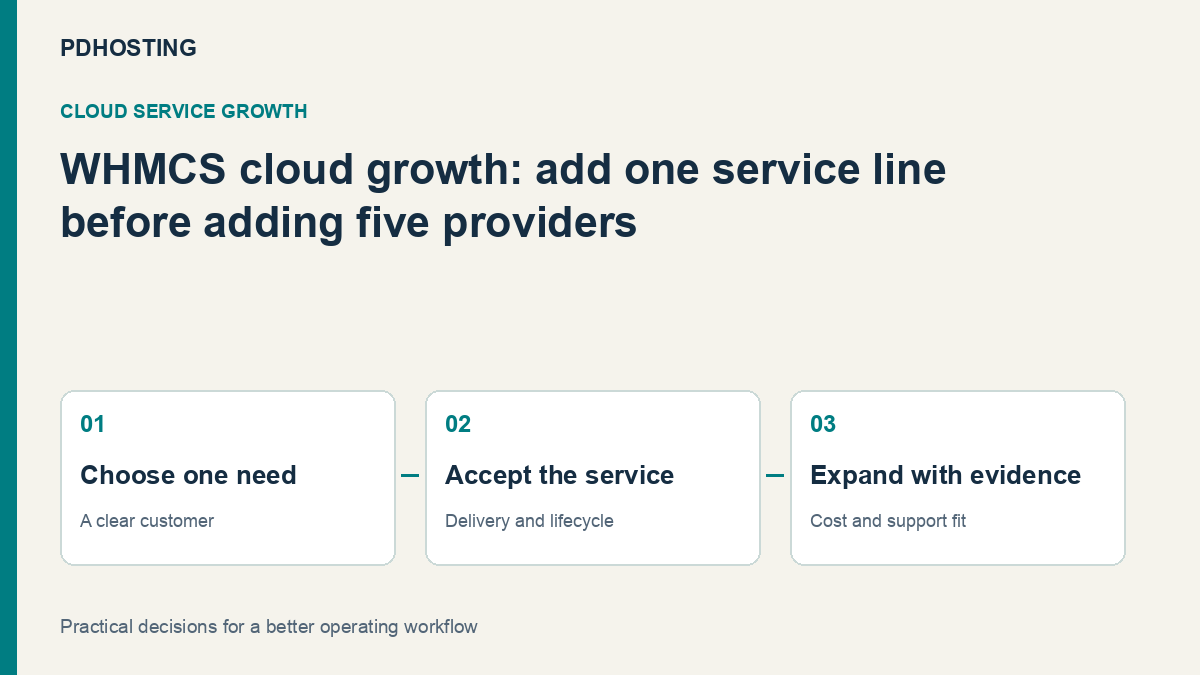
Build a WHMCS Cloud Reseller Business Around Provisioning, Self-Service and Margin
Build a cloud-service offering in WHMCS with PD Lightsail, DigitalOcean Droplets and Cloud Cost & Margin: provisioning, customer controls and cost review.
A hosting company does not need to become a cloud provider to offer a useful cloud service. It needs a clear product, a repeatable provisioning route and a customer experience that remains usable after the order is paid.
PD Modules connects those parts inside WHMCS. PD Lightsail and PD DigitalOcean Droplets turn supported provider resources into hosting products with customer controls. PD Cloud Cost & Margin adds a way to review represented resource spend against recurring service revenue.
Together, they support a practical expansion route: choose an audience, define a small offer, automate the supported service lifecycle and keep reviewing whether the product still works operationally and commercially.
Start with a customer job, then choose the resource
“Cloud hosting” is broad. A customer may actually need a development server, a small application environment or a VM with more control than a shared website plan provides.
Imagine a hypothetical agency that already trusts your hosting business and wants a separate application environment for a project. It may value a familiar account, a clear access handover and understandable server controls more than a huge catalogue of infrastructure options.
Start there. Define the workload, the expected operator and the management responsibilities. Then choose a supported provider and resource profile that fits the offer.
This gives the product a purpose beyond reselling a provider’s plan name. It also helps staff explain why a customer should choose the service and what happens after the initial order.
Use PD Lightsail for a defined AWS-backed VPS offer
PD Lightsail connects Amazon Lightsail instances to WHMCS products. Supported configurable options can expose selected resource choices, while fixed defaults keep a simpler package straightforward.
The customer gets a service experience with power actions, connection details and supported features such as snapshots, firewall controls, usage views and an optional browser console. The host decides which controls the product offers.
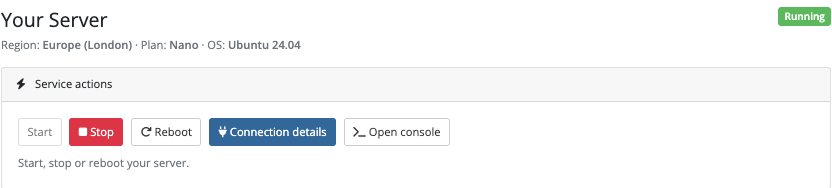
This genuine product crop shows the everyday controls behind the offer. It is not a simulated design or a claim that a server was provisioned for this article.
PD Lightsail also includes pricing analysis that relates supported provider plan costs to a chosen target margin. That can help staff review a new package, while the business still needs to account for its wider service costs and responsibilities.
An illustrative starter offer could fix the location and supported operating system, provide a small set of sizes and clearly describe who maintains the guest software. The module handles the supported integration; the host defines the service customers understand.
Use PD DigitalOcean Droplets for a different supported profile
PD DigitalOcean Droplets provides another route to a WHMCS cloud-server product. It supports dedicated Droplet provisioning and a customer panel with power operations, rebuild workflows, snapshots, firewall management, usage and networking information.
Product choices can include supported region, plan and operating-system options, with relevant storage, backup or dedicated-IP choices where configured. Review the installed catalogue and provider availability before exposing those dimensions.
The point is not that every customer needs both providers. It is that the host can choose an appropriate supported route and keep the commercial relationship in WHMCS rather than writing a separate integration for each service line.
For the hypothetical agency, one package could serve a simple project environment while another supports a different resource requirement. Make the difference explainable in customer terms, not just a change of provider logo.
Define the customer experience before adding more plans
A useful cloud product answers the first-day questions: where is my service, how do I connect, which controls can I use and what should I expect the host to manage?
The PD compute modules give the customer a service context rather than only an infrastructure identifier. That supports a more complete handover and makes routine operations available in the account.
Browser-console access can be helpful where the selected module, service and settings support it. It still has access and network prerequisites. SSH keys, connection details and guest operating-system responsibilities need the same clear treatment as the order form.
| Part of the offer | Customer question | Host’s decision |
|---|---|---|
| Resource profile | What am I buying? | Supported plan, location, image and storage |
| First access | How do I begin using it? | Key and connection handover, optional console |
| Routine controls | What can I do myself? | Power, firewall, snapshots and other supported features |
| Management | Who maintains the application? | Explicit service responsibilities |
| Expansion | How can it grow? | Supported upgrade path and maintenance expectations |
| Cancellation | What happens to resources and data? | Retention, removal and verification policy |
The table is a product-planning tool. Fill it for the first offer before multiplying the number of plans in the store.
Connect lifecycle automation to the commercial policy
WHMCS automation needs intentional configuration. Decide when a paid or accepted order should provision, what suspension means for the chosen module and how the team handles upgrades and cancellation.
Supported automation reduces repetitive provider work, but each lifecycle event still has a meaning. A stopped VM can retain billable resources. A rebuild is different from a reboot. A plan change can involve downtime or provider-specific replacement behaviour.
Resource retention also differs. For example, the DigitalOcean Droplets lifecycle can retain customer snapshots after server termination. Do not apply one blanket cleanup promise to every compute service.
Document the intended state and verify the provider outcome through the appropriate authorised operational process. A billing status alone is not a complete description of resource readiness, deletion or application health.
Add cost review after the service is working
A provider-plan estimate helps design an offer. Recorded cost review helps investigate what the represented service costs over time. PD Cloud Cost & Margin is the companion layer for that second task.
It supports provider cost data and comparisons against configured recurring service revenue, using the chosen comparison currency and rate. Recognised PD resource patterns support association with the corresponding service, while unmatched recorded spend can be reviewed separately.
That association has a scope. It is not universal proof of resource ownership, and the view is not a complete accounting statement or collected-cash report. Missing or unsupported cost data needs review rather than a healthy-margin assumption.
For a hypothetical host, a monthly routine could start with source coverage, then inspect low-margin services and unmatched records. The useful outcome is a question staff can act on: did the resource change, is the association correct or does the offer need a commercial review?
The module does not automatically reprice customers or delete resources. It helps the operator investigate, leaving those decisions with the business.
Expand by repeating a proven service pattern
The next product should earn its place. Add a provider or resource profile because it serves a customer need, not because the module catalogue makes it possible to create many similar cards.
A practical sequence is to define one offer, review checkout, verify the first authorised service journey and document routine management. Then confirm cost-data coverage and the lifecycle procedure before broadening the range.
That creates reusable operational knowledge. Staff understand how product settings become customer controls, how access is handed over and how a service is reviewed. New products can build on that pattern while retaining their provider-specific differences.
Explore PD Lightsail, PD DigitalOcean Droplets and PD Cloud Cost & Margin for WHMCS. For practical follow-through, use the Lightsail WHMCS guide and monthly cost comparison guide.
Frequently asked questions
Can a hosting business offer cloud servers through WHMCS?
Yes. PD Lightsail and PD DigitalOcean Droplets connect supported provider resources and customer controls to WHMCS products. The host configures the provider account, offering and automation policy.
Do I need to offer several providers from the beginning?
No. Start with a service that fits a clear audience and that your team can operate. Add another route when it serves a meaningful customer need.
Do provisioning modules include application management automatically?
No. Define who maintains the guest operating system and application as part of your service. Infrastructure controls and a managed application offer are different things.
Can customers manage their own servers?
The modules expose supported customer controls according to the product and service configuration. Explain which power, access, snapshot, firewall and other capabilities the offer includes.
Can I compare cloud costs with recurring service charges?
PD Cloud Cost & Margin supports a represented service comparison when suitable data and associations are available. It is a review tool, not a complete profit or collected-revenue statement.
Does cancellation remove every resource in the same way?
No. Lifecycle and retention behaviour differ by module and provider. Review the selected workflow, including retained snapshots or other resources, and verify the actual outcome.