PD Lightsail — Resell Amazon Lightsail as Your Own VPS in WHMCS
Resell Amazon Lightsail as your own VPS — provisioned, billed and managed in WHMCS
★★★★★5.0 · our rating, not customer reviews
Made and supported by Projektif Digital Ltd.
Runs inside PD Modules, the panel
every module installs into.
Servers & Compute
Map WHMCS products to Lightsail plans and see what each still needs to go live; one click generates the region, plan and OS options customers pick at checkout.Price Analysis: the live AWS monthly cost of every Lightsail plan beside a suggested price at your target margin.Give clients a full self-service VPS panel: start, stop, reboot and see their server details live, so they run their own server and you field fewer tickets.A browser SSH console: a real terminal to the server with no SSH client to install, switched on per product.Live CPU and network usage graphs in the client area, so customers see their server working without asking you.1 / 5
PD Lightsail lets a hosting company sell Amazon Lightsail cloud servers as its own VPS product. Your customer orders in your WHMCS cart, the server is built in your AWS account within minutes, and your customer manages it from your client area: a control panel that carries your brand and never mentions AWS. You set the price, AWS bills you the cost, and the difference is your margin.
It is built for hosts who want to offer cloud servers without building a control panel, without handing out AWS access, and without a support ticket every time a customer needs a reboot.
Why hosts choose PD Lightsail
Sell cloud servers under your own brand. Your customers see your company, your prices and your client area. Amazon is never named on their pages, and they never need an AWS login.
Every order sets itself up. The server is created the moment WHMCS sets the order up, with the region, plan and operating system the customer picked at checkout. Suspend, unsuspend and terminate follow your normal WHMCS billing, so a missed payment stops the server and a payment starts it again.
Customers help themselves. Power controls, connection details, snapshots, a firewall, static IPs, SSH keys, usage graphs and an optional in-browser terminal are all on the customer's own service page. That is most of the tickets a VPS product normally generates.
Products that stay current. Plans and operating system images are read live from your AWS account. A daily check tells you when AWS retires something your cart still offers, and one click of Sync hides it from new orders without touching existing customers or your prices.
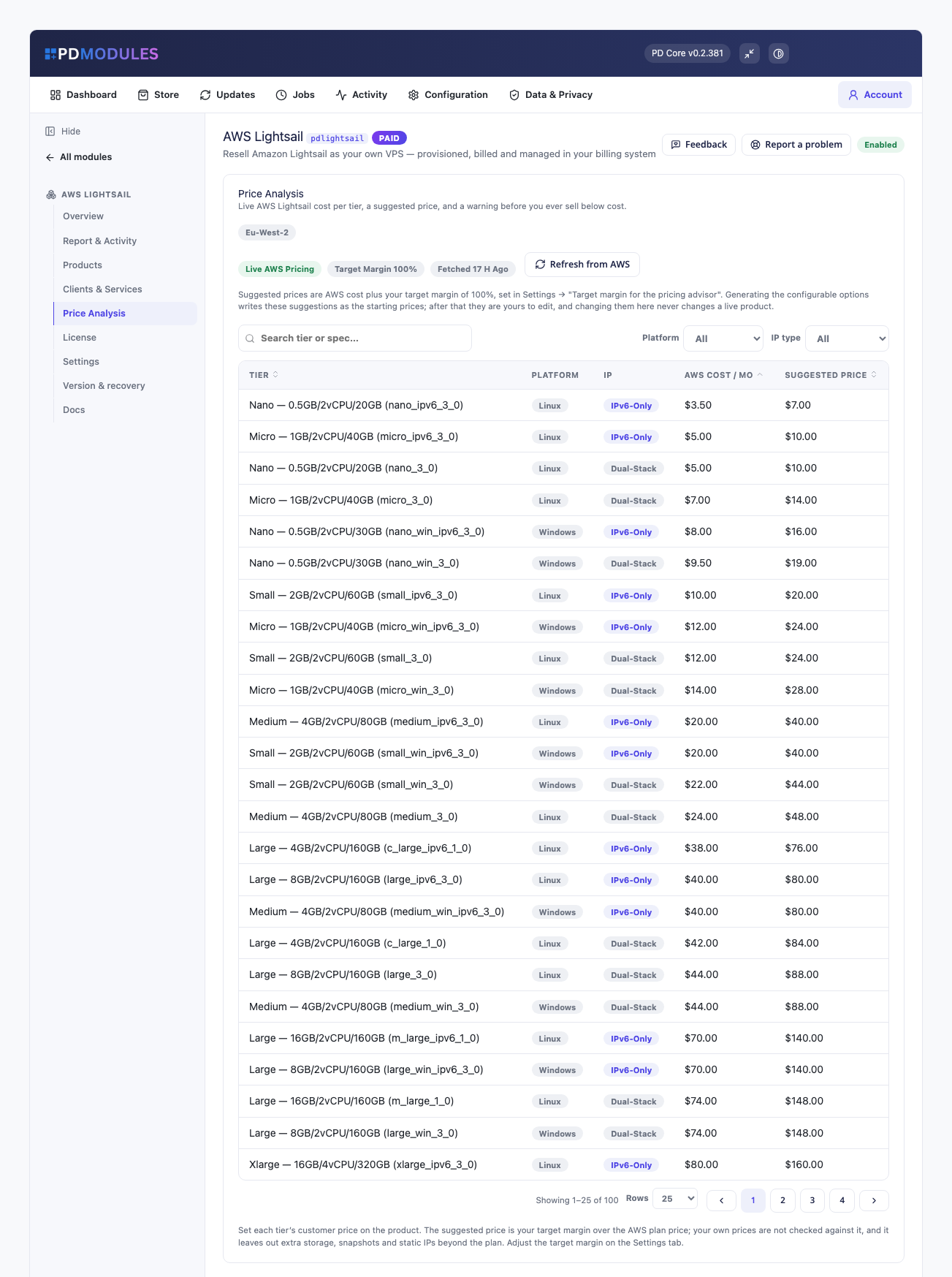
Pricing with the cost in view. Price Analysis shows the live AWS monthly cost of every Lightsail plan next to a suggested price at the margin you set, so you start from real numbers.
Nothing left billing. Terminating a service removes the server, its static IP, its extra disk, its snapshots and its key pair, then confirms at AWS that everything is really gone. No forgotten resources on your AWS bill.
How it works
Connect your AWS account. Add your AWS keys once on a WHMCS server record. Root keys work, and so does a least-privilege IAM user using the policy we ship. Test Connection checks the keys before you save them.
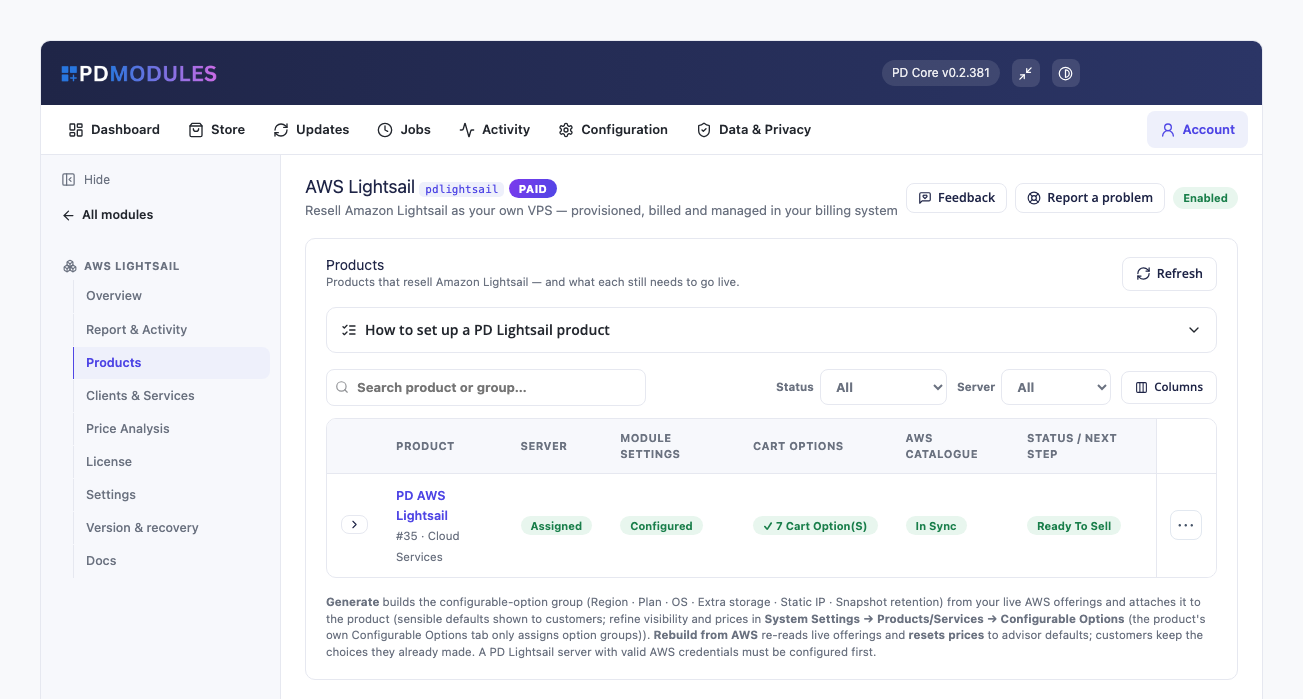
Create your products. Pick a plan and an operating system, or let customers choose. One click generates the cart options (region, plan, operating system, extra storage, static IP and automatic daily snapshots) from your live AWS catalogue, priced at your target margin for you to review.
Your customer orders. They choose their options at checkout and pay. The server is built in your account, its own SSH key is generated, and the customer's page shows progress until it is ready.
You get paid, they manage it. WHMCS keeps billing as usual. Upgrades to a larger plan go through WHMCS's normal upgrade flow and keep the customer's data.
The Products page: each WHMCS product mapped to its Lightsail plan and cart options, with what it still needs to go live
What you get in WHMCS
Selling and pricing
Cart options generated from your live AWS offerings: region, plan, operating system, extra block storage, static IP, snapshot allowance and automatic daily snapshots
Choose which options customers see; anything you hide is fixed to your product's setting
Price Analysis with the live AWS cost of every plan, searchable and sortable, and a suggested price at your target margin
IPv6-only plans for a cheaper product without a public IPv4 address
Windows and Linux plans, each with the right connection details for the customer
Optional bandwidth billing: a daily job records each server's data transfer in WHMCS, measured against the plan's allowance, and WHMCS can suspend on overage
More than one AWS account if you need them
Price Analysis: the live AWS monthly cost of every Lightsail plan beside a suggested price at your target margin
Provisioning you can trust
Orders that ask for a plan, image or region AWS no longer offers are refused before anything is created, with a clear reason
A failed setup is never shown as done: the customer is told your team will help, and the failure is logged for you with a WHMCS notification event
Data-preserving upgrades: the server is moved to the larger plan with its data, firewall rules, static IP and automatic snapshots intact
Downgrades and Linux-to-Windows switches are refused with a clear message instead of being attempted
A startup script and tag name per product, applied to every server
Running it day to day
Clients and Services: every server with its owner and live state, with Start, Stop, Reboot, Console and a Retry for a stuck order
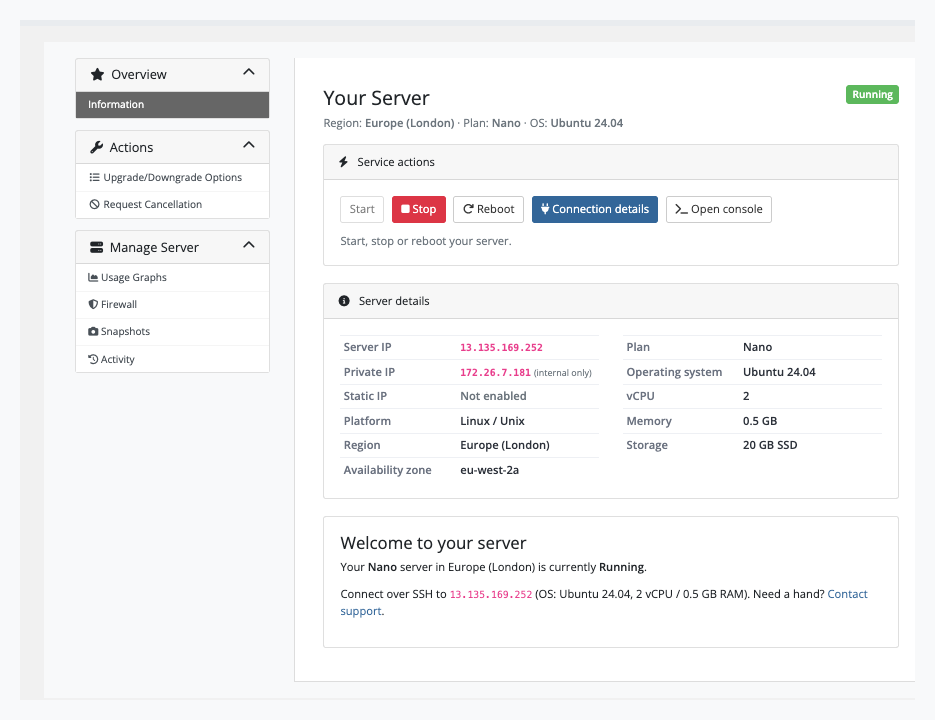
A full panel on each WHMCS service page: live status, specs, every address, static IP, a 24-hour usage snapshot and Take Snapshot
An admin console to any server, with every opening recorded
Logs of every provisioning and AWS operation, searchable, plus task history across all services
A products overview that shows what each product still needs before it can go live
A ready-made welcome email that tells the customer how to reach and manage their server
What your customers get
Start, stop and reboot, with buttons that only appear when they make sense
Connection details ready to copy: the IP addresses, SSH user, a private-key download and the exact ssh command; on Windows, the RDP details instead
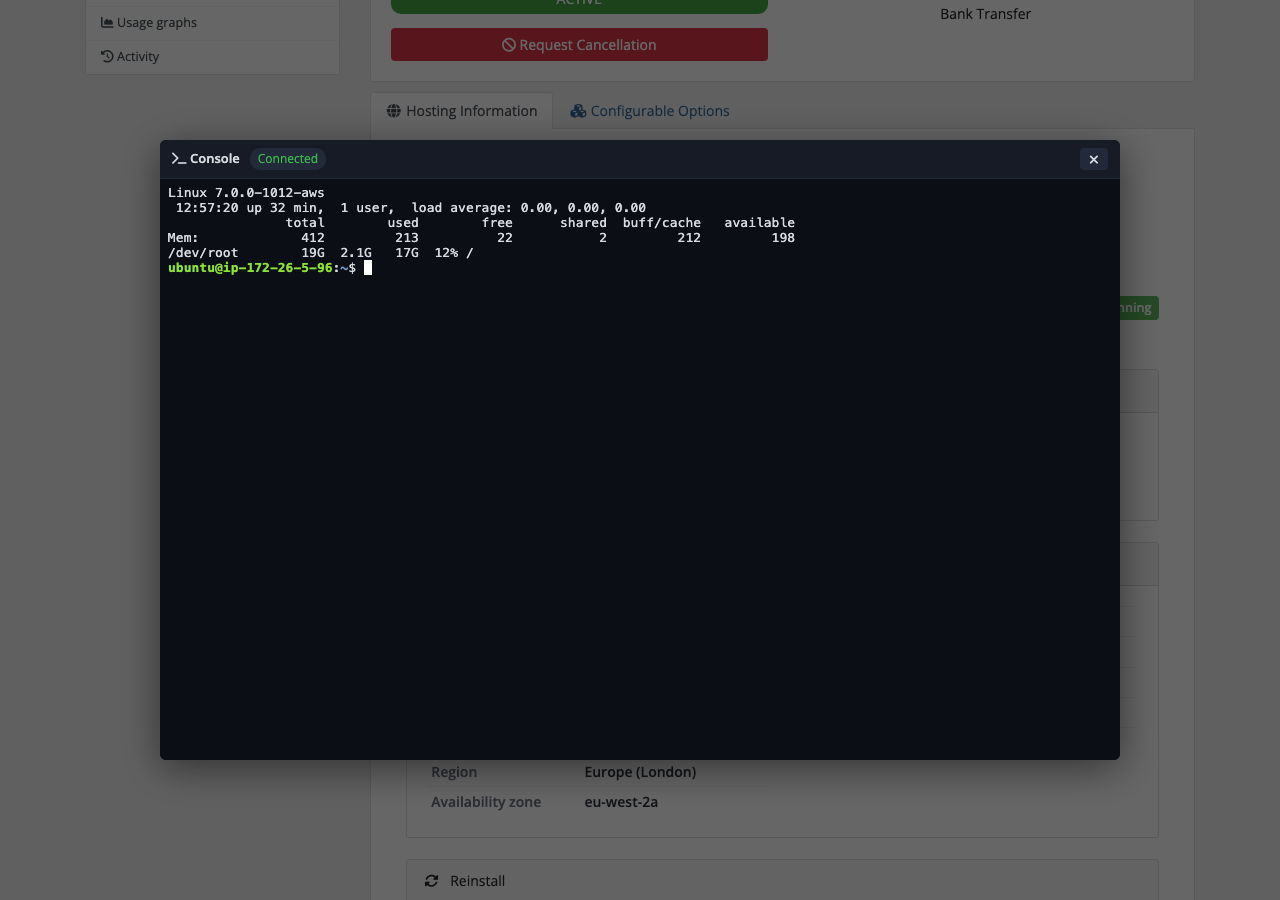
An in-browser terminal to their server with no SSH client and no key handling (you switch it on per product)
Snapshots they take, restore in a click and delete, up to the allowance they bought, plus Lightsail's own automatic daily backups (the latest seven kept)
A firewall they manage themselves: open and close ports for TCP, UDP or ping without a support ticket
A static IP they can add and release themselves
Their own SSH keys, added on the SSH Keys page and applied on the next rebuild
Reinstall with a fresh operating system, behind a typed confirmation
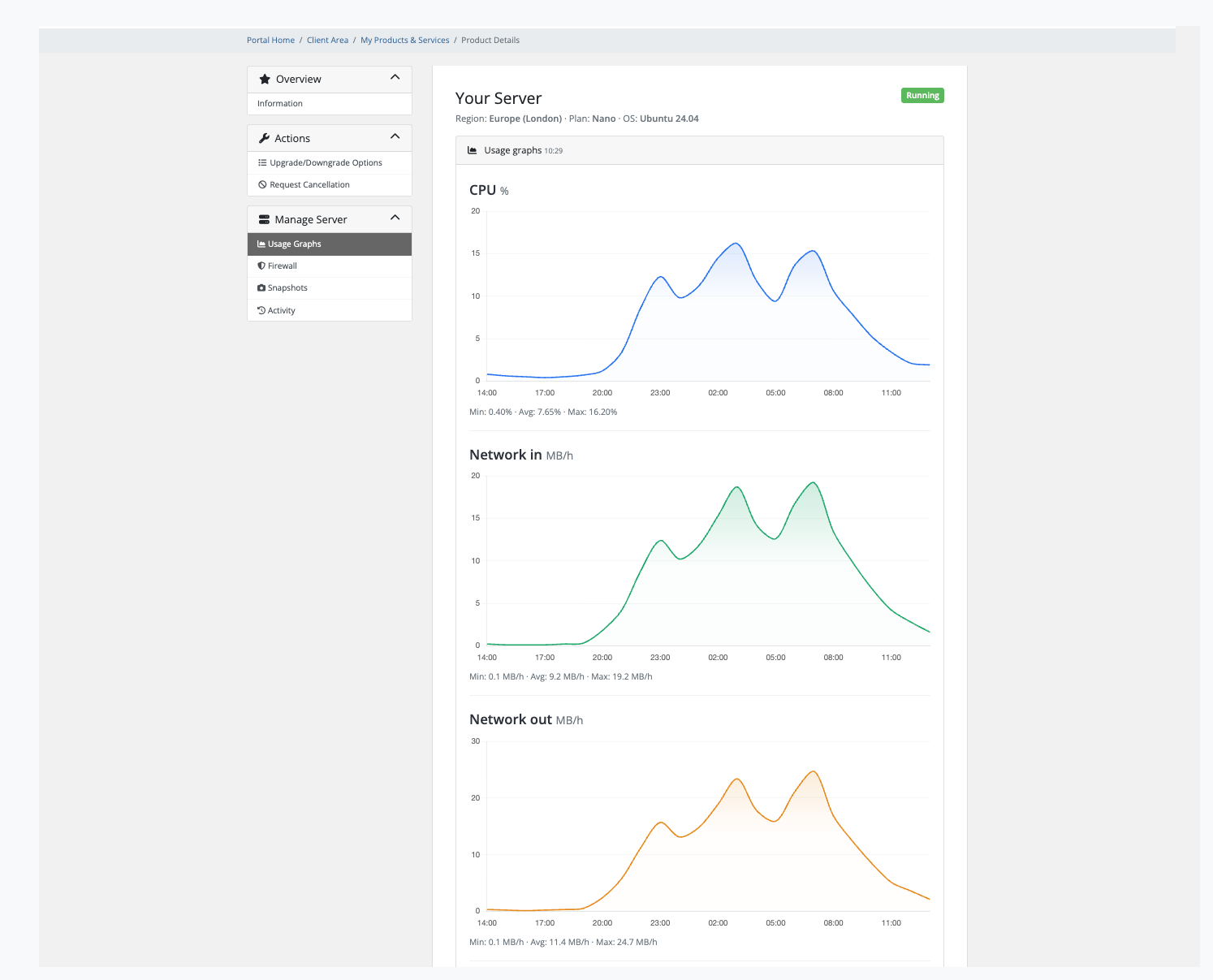
Usage graphs for CPU and network in and out
Recent activity in plain words: created, started, stopped, snapshotted, each with a time and a result
The customer's server page in your client area: power controls, connection details and live server detailsThe in-browser terminal: a real SSH session to the customer's server, with no SSH client to installUsage graphs: CPU and network in and out, with minimum, average and maximum
Every one of these is a switch on the product. Turn one off and it disappears from the customer's page, and the server refuses it too. The pages render natively on WHMCS's Six, Twenty-One and Nexus themes and are fully translatable, with wording overrides that survive updates.
Security built in
AWS keys live only on the WHMCS server record, stored encrypted, never on a customer page.
Every server gets its own SSH key pair. Your AWS account's default key is never placed on a customer's server.
Private keys are held encrypted on your own server, and only the signed-in owner of a service can download one.
The in-browser terminal is off until you switch it on. Each session is checked against the service's owner, sealed, single-use and expires in about a minute. The key never reaches the browser in readable form, and nothing inbound ever reaches your WHMCS server: no firewall rule to open, no relay for you to run.
One product, every feature
PD Lightsail is one paid module with everything included: provisioning, power, snapshots, firewall, static IPs, metrics, upgrades and the browser console. There are no add-on tiers to compare. It installs into PD Modules in one click, updates itself, and uninstalls cleanly without modifying any WHMCS files.
If your subscription ever lapses, your customers are not cut off. You get a 14-day grace period with everything working, then admin management locks while customers keep their servers, and only after that do customer features pause, behind a neutral "contact support" message that never mentions licensing. The servers themselves keep running in your AWS account throughout.
Requirements
WHMCS 9 or later on PHP 8.2 or later, with the ionCube Loader
An AWS account with Lightsail access (root keys or an IAM user with the policy we provide)
PD Modules, the free control panel every PD module installs into
Questions
Do I need my own AWS account?
Yes. You connect your AWS credentials once, and every client server is provisioned into your account — AWS bills you, you bill your client through WHMCS, and the difference is your margin.
Will my plans go out of date when AWS changes Lightsail?
Not silently. Plans and OS images are read live from AWS, and a daily check alerts you when one your generated options still offer has been retired; it stays orderable until you press Sync, which hides it without touching existing services.
Can clients get a real terminal on their server?
Yes — an optional in-browser SSH console gives them a full terminal with no SSH client, keys or setup on their side. It stays off until you switch it on, and only you decide which servers offer it.
What happens to a client's server if they're suspended or cancelled?
You stay in control: suspension and termination follow WHMCS's normal service lifecycle, and termination removes the server together with its snapshots, extra disk and static IP — so nothing is left billing. Copy off anything a client needs to keep before you terminate.
Do plan upgrades destroy the server?
No. Upgrades are data-preserving, so a client keeps their instance and data when they move up to a larger bundle.
Is this one price or lots of tiers?
One paid product with every feature included — provisioning, power, snapshots, firewall, metrics and the console. No confusing add-ons.
What happens if my subscription lapses?
Nothing of yours is touched, and nothing is deleted. The module steps down in stages instead: a 14-day grace period where everything still works and you get a renewal reminder, then admin management locks while your customers carry on being served, and only after that do the customer-facing features stop — behind a neutral "temporarily unavailable, please contact support" message that never mentions licensing to your customer. Anything the module provisioned keeps running in your own account throughout, and your data and settings stay exactly where they are. Renewing restores everything immediately.
What data leaves my server?
Your customers' data stays in your WHMCS. To confirm your licence, the platform sends us four things and nothing else: your licence key, the domain, your server's own IP address and the directory it is installed in — the four values recorded against your licence in your client area. Alongside that we see which module and version you run and whether its licence is healthy, so we can ship compatible updates. We never receive your clients' personal data, your credentials, or the contents of your WHMCS. The exception is the optional browser console: when you switch it on, each session hands our console relay the server's address, login user and SSH key, sealed so only the relay can open it and usable once, and the terminal's traffic passes through the relay while the session is open; nothing is stored there. Crash reports are off unless you turn them on, and a diagnostic report is only ever sent when you send one, after showing you a preview you can edit.
Which WHMCS and PHP versions does it need?
WHMCS 9 or later, on PHP 8.2 or later. It installs alongside whatever else you run — it adds its own tables and templates rather than modifying WHMCS files, so it does not collide with other vendors' modules or with a customised theme. Uninstalling removes its own tables and settings. Terminate its services and let their cleanup finish first — uninstalling also removes the record of any cleanup still in progress.
What’s new in 0.2.104
Fixed: the Services screen showed nothing when servers were provisioned, and the cleanup sweep never found released resources to tidy up. Both now work whichever billing system you run.