Sell Amazon S3 Storage Through WHMCS with Scoped Access and Usage Billing
Offer S3 storage with PD AWS S3 for WHMCS: customer buckets, scoped IAM access, generated options, usage visibility, sharing and storage lifecycle controls.
A customer buying storage needs more than a bucket name. They need a plan they understand, credentials that belong to their service, a way to connect their software and controls for the files they keep. A hosting business needs the other half: repeatable provisioning, usage visibility and a deliberate lifecycle for customer data.
PD AWS S3 connects Amazon S3 object storage to WHMCS products and customer services. The module provisions a customer bucket with scoped IAM access, generates storage-related checkout options and provides a client-area panel for connection details, buckets, sharing, usage and supported storage settings.
The resources stay in the host’s AWS account. That gives a hosting company or agency a way to offer S3-backed storage through its existing customer relationship, rather than handing customers a provider-wide administrator account or maintaining every service as a manual cloud task.
Build a storage offer around the customer workload
Object storage suits software that can use an S3 destination: application files, backup archives and other object-oriented workflows. It is different from adding a larger website directory or providing an interactive server.
PD AWS S3 lets the host describe that offer as a WHMCS product. The product can define storage quota, bucket allowance, versioning and region through its settings and supported configurable options. The host chooses the commercial terms and the customer-facing choices.

*Actual product-screen crop. The product identifier and status are demonstration data. Generated choices require the host’s pricing and order-form review before live sales.*
Imagine an agency whose application customers need a separate file-storage destination. It could define an S3-backed service, choose the appropriate supported region and offer the capacity choices relevant to that workload. The customer’s order then relates to a defined storage service rather than an unexplained shared bucket.
The WHMCS S3 product guide and options guide cover that setup. Review generated pricing and visible choices rather than assuming a rebuilt option group preserves every commercial setting.
Issue customer access without sharing host administration
The host configures AWS management credentials for the operations the module needs. Each storage service receives its own scoped IAM credential arrangement for the intended service buckets.
That separates the customer application from the host’s broader account administration. Customers use their service key pair and endpoint; they do not need the host’s AWS management key to upload or retrieve their own files.
The connection panel makes that handoff practical, with the service region, bucket, endpoint and key controls. The Connect guidance supplies examples for common S3 tools and backup destinations. A customer can match those values to the application they intend to use.
For example, a customer using rclone or an S3-capable backup application can configure the issued destination and verify a suitable upload and retrieval. This illustrates a possible workflow; it is not a certification of every tool or plugin that mentions S3.
The customer connection guide explains the service values. Scoped credentials still need to be kept private, and changing a product default does not migrate an already-created bucket into another region.
Give customers storage controls in their WHMCS account
A useful storage service should not make every ordinary task depend on the hosting team’s involvement. PD AWS S3 provides customer controls for supported bucket operations and storage settings within the customer’s service context.
Customers can create additional buckets within the service’s allowance. Extra buckets share the service region and credential scope, while their own settings still need to be reviewed. The primary bucket is protected from customer deletion through that extra-bucket control.
Credential rotation is another supported task. It replaces the service’s key pair without making the bucket a new storage resource. Applications need the replacement credentials, and links signed with retired credentials may stop working before their nominal expiry.
That is a practical service feature, not a promise of an invisible change to every connected application. A host can explain the handoff clearly and let the customer update the software that holds the credential.
Offer versioning, lifecycle and browser-access settings
PD AWS S3 exposes supported versioning, automatic clean-up and CORS controls. These address different storage tasks and deserve separate explanations in the offer.
Versioning preserves object history according to S3’s versioning behaviour. That can help with overwritten or deleted objects, but it is not an independent backup in another location. Retained versions also affect storage consumption.
The lifecycle builder supports the module’s selected clean-up operations, such as current-object expiry and unfinished-upload cleanup. It is not an editor for every advanced S3 lifecycle transition, and saving a configuration should be reviewed as a change to the bucket’s existing rules.
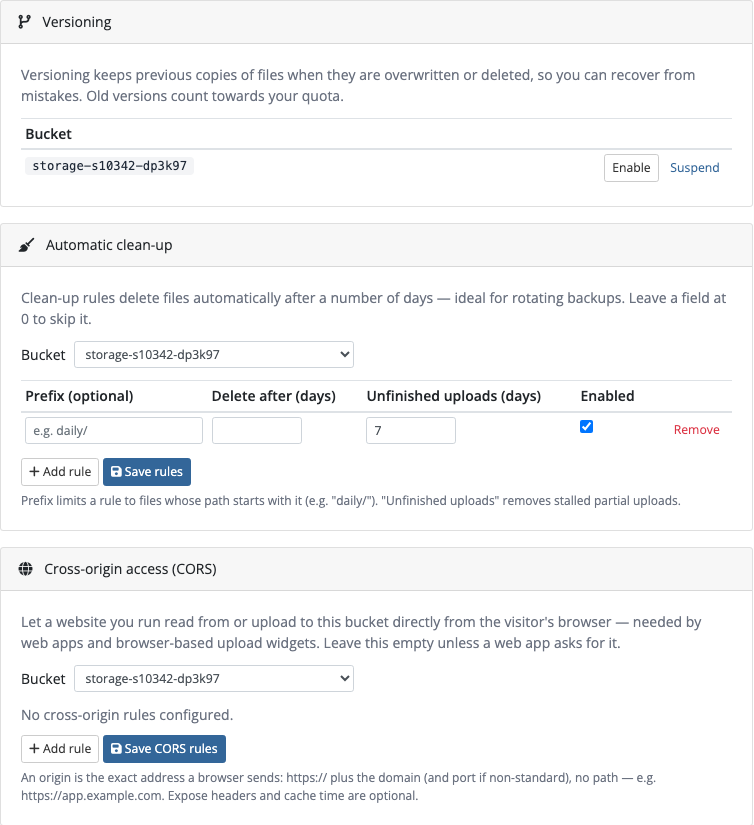
*Actual customer settings crop using a demonstration bucket. The controls illustrate separate supported tasks; no rule was applied and no live resource was changed for this article.*
CORS supports the browser’s cross-origin access rules for applications using the bucket. It does not grant S3 authorisation by itself. A web application’s browser settings and its permission to read or write objects are related but distinct parts of the connection.
The versioning guide and lifecycle guide provide practical follow-through. These controls make the service more useful to customers without requiring the host to describe every bucket as the same workload.
Share an object without distributing the whole key pair
A customer may need to send somebody a download link or allow an upload to a known object path. PD AWS S3 can generate supported presigned GET and PUT links with a chosen expiry.
The recipient uses the link rather than the customer’s permanent service key pair. That can suit a temporary file handoff, while the customer keeps the broader storage credential out of the conversation.
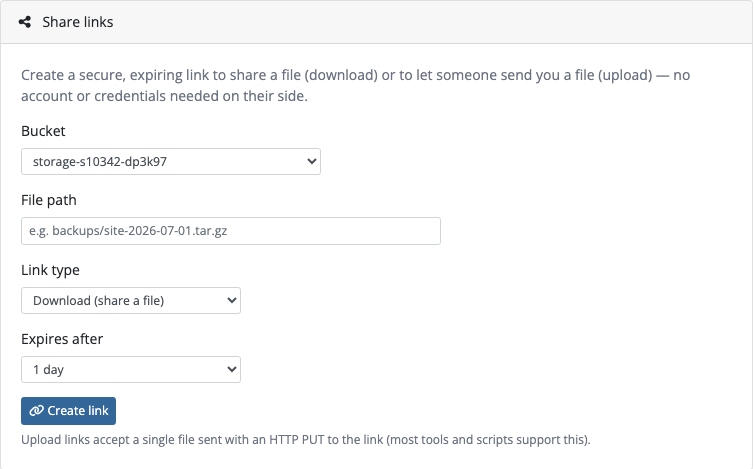
*Actual empty share-link form. No signed URL or live credential appears. The file path is an example input; the module is not being presented as an object-browser interface.*
A presigned link is not a one-use password. Its effective lifetime also depends on the credential and access state behind it. Treat the link itself as access to the specified operation rather than posting it somewhere unintended.
The download-sharing guide explains the supported task. It is a concrete example of storage self-service: the customer can arrange a limited handoff without granting the recipient full bucket administration.
Connect measured storage to the WHMCS offer
The module’s scheduled usage collection uses S3 storage metrics through CloudWatch and writes storage readings into WHMCS usage fields. That supports a service designed around usage visibility and configured native overage billing.
The distinction is important: the module supplies the measurement path; the host must configure and verify the actual billing arrangement. It should not be presented as automatically reproducing every AWS charge on the customer’s invoice. Storage, requests, transfer and the host’s commercial offer are different parts of the business model.
CloudWatch storage figures are periodic, rather than a live byte counter. The module also has a supported refresh path, with bounded measurements and fallback considerations. Review the reading and its timestamp when explaining the service’s usage.
Quota mode is a separate choice. Soft mode warns. Hard mode can pause uploads after a measured over-quota condition, while preserving the documented download and deletion operations. This is measured enforcement, not a claim that every upload is intercepted at the exact last byte of the allowance.
The usage guide explains the operational detail. A useful offer gives customers a clear allowance and visibility while the host reviews the relationship between provider costs and its own billing terms.
Separate an access pause from permanent data deletion
Storage lifecycle deserves a deliberate product policy. The module can restrict service access during suspension and revoke access on termination while retaining the data according to the configured retention and purge choices.
The default manual purge arrangement gives staff an approval step after the retention window. Other supported choices include automatic purging and immediate deletion. It would therefore be wrong to promise that deletion always requires approval regardless of settings.
An immediate purge uses typed-name confirmation, while retention controls can help the team distinguish a cancelled relationship from an immediate decision to destroy its stored data. Retention is still the original provider data, not another backup copy.
These features support a more considered offboarding workflow. A host can choose its intended policy and communicate it clearly, rather than having every service termination treated as an unexplained immediate bucket deletion.
Keep provider visibility with the hosting team
The administrative service view connects provisioned storage with the relevant WHMCS relationship. Reconciliation can help staff spot missing or unmatched resources for review without automatically deleting the things it finds.
That is useful as the offer grows. A customer-facing panel and a staff inventory solve different problems: one helps the customer use the service, while the other helps the host understand what it is operating.
The initial connection check is not a substitute for verifying the intended provisioning workflow and permissions. Start with a controlled service process and confirm the created bucket, scoped access, usage path and customer controls relevant to the offer.
Explore PD AWS S3 for WHMCS
Explore PD AWS S3 for WHMCS if you want to offer Amazon S3 storage through a recognisable hosting product and customer portal.
The value is the complete supported service path: define the plan, provision a customer bucket, issue scoped access, expose useful controls and manage the service lifecycle. Build the first offer around a clear customer workload, then expand the choices your business is ready to support.
Frequently asked questions
Can I sell Amazon S3 storage through WHMCS?
Yes. PD AWS S3 connects supported WHMCS products and options to customer storage in the host’s AWS account, with scoped access and a client-area management panel.
Do customers receive my AWS administrator credentials?
No. Applications use the issued service key pair. The host’s management credentials belong to its provider connection and should not be distributed as customer access.
Can customers create extra buckets and temporary file links?
The supported customer controls include extra buckets within the allowance and presigned download or upload links for object paths. Those links are time-limited, not one-use credentials.
Does the module provide versioning and lifecycle controls?
Yes, for its documented operations. Versioning is not an independent backup, and the lifecycle builder is not a complete editor for every native S3 rule type.
Is storage usage a live count of every new upload?
No. Scheduled CloudWatch readings are periodic, and refresh has its own supported limits. Review the measurement timestamp and configure the intended WHMCS billing arrangement.
Do all quota modes block uploads?
No. Soft mode warns; hard mode applies the documented access change after an over-quota measurement. The offer should describe the selected mode accurately.
Is terminated data always deleted immediately?
No. Behaviour depends on the configured retention and purge policy, including manual, automatic and immediate choices. Review that policy before describing the customer’s offboarding process.