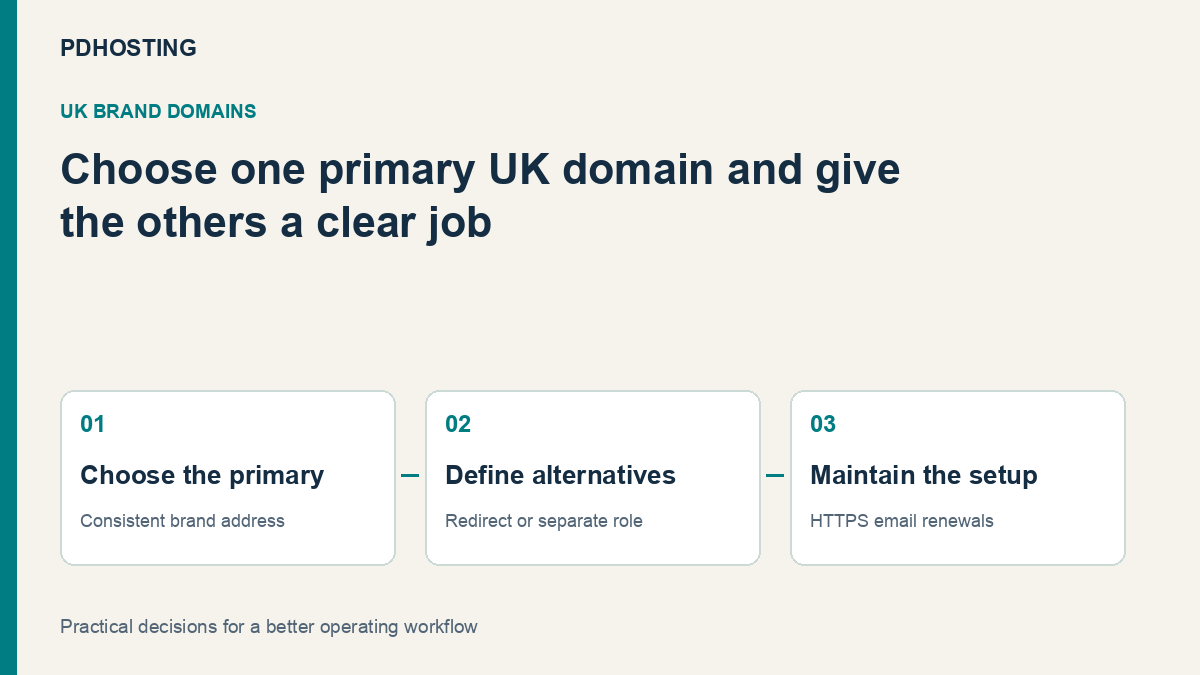
One Primary Domain, Several Useful Names: A UK Business Domain Strategy
Choose a primary UK business domain and give .uk, .co.uk and other useful names clear roles through redirects, email planning and renewal ownership.
A business can have several useful domain names without needing several copies of its website. The important decision is what each name is for and where customers should end up when they use it.
A practical UK business domain strategy starts with one primary website address, then gives additional names a clear role. A .uk and .co.uk version may support the same identity, an older name may help existing visitors find the current business, and a short campaign address may lead to a specific page.
That is a customer-recognition and site-management decision. Registering more names does not automatically produce more search visibility or turn duplicate copies of the same site into a useful marketing strategy.
Choose the address you want people to recognise
The primary domain is the one you use consistently on the website, business materials and customer communication. It should fit the business’s established identity and the way customers are likely to remember and type the name.
A UK business considering .uk and .co.uk should think about continuity as well as length. If customers already recognise one address, changing it creates a communication task. If the business is starting fresh, choose the address that best fits the intended identity and available names.
There is no need to assume that the shortest extension wins every decision or that changing an established domain automatically improves search results. The useful choice is one the business can use consistently and manage over time.
Record the intended primary address so an agency, designer or staff member does not introduce a different version by accident. A clear decision makes the later DNS, redirect and website configuration easier to review.
Give each additional name a purpose
Additional domains can be useful when the business has a reason to maintain them. That reason might be an alternative extension customers expect, a name used before a rebrand or a short address for a particular campaign.
| Domain role | Intended visitor outcome | What to manage |
|---|---|---|
| Primary business domain | Reach the main website and recognised identity | Website, email identity and ongoing registration |
| Alternative extension | Reach the same appropriate destination | Redirect, certificate and renewal |
| Previous business name | Find the current business through an older reference | Relevant redirects and transition communication |
| Campaign name | Reach the intended offer or landing page | Destination, lifetime and future retirement |
| Separate service brand | Reach genuinely distinct content where justified | Clear identity, content ownership and maintenance |
This table is a planning tool, not a recommendation to register every possible variation. Each name adds something the business needs to renew, secure and explain.
A hypothetical local company might keep its established .co.uk address as primary and use the matching .uk name to bring visitors to it. Another might choose the reverse. The role is the same: two recognisable names, one intentional main destination.
Redirect alternatives instead of publishing unexplained copies
If an extra domain is intended to take visitors to the primary site, configure an appropriate redirect rather than maintain a second independently accessible copy by accident.
Google’s redirect guidance describes choosing a preferred destination when a site can be reached through several URLs. Its canonicalisation guidance treats redirects as a strong signal of the preferred destination.
That supports a coherent site arrangement, not a promise of a ranking increase. A redirect tells visitors and crawlers where the content belongs; it is not a substitute for useful content or a complete site-migration plan.
For a permanent move, use the appropriate permanent redirect behaviour. A temporary campaign or short-lived change can have a different intention. The redirect type should describe what the business actually means to do with the address.
Match the destination to the visitor’s expectation
An older link may refer to a particular service, article or product. Sending every visitor to the homepage can lose that context, even if the browser technically reaches the new website.
Where a relevant replacement page exists, map the old path to that page. If the content was deliberately retired, decide the appropriate outcome rather than assuming an unrelated landing page is a helpful substitute.
The same principle applies to campaign names. If an advert promises a specific offer, the destination should make that offer easy to find. A short domain that lands on a confusing general page does not solve the marketing problem merely because it is easy to type.
Document the mappings that matter. A modest list of important old addresses and intended destinations gives the person implementing the change a result they can verify.
Remember that DNS alone is not a web redirect
DNS identifies where a name should be resolved. A browser redirect is an HTTP response from the service handling the request. Pointing an extra domain at the same server is therefore not, by itself, proof that the visitor will be redirected to the primary address.
The handling service needs to recognise the additional name and return the intended response. HTTPS requests also need a suitable certificate at the point where that name is served before the browser can follow the redirect normally.
This is why redirect setup should be checked through the actual visitor URL, including the expected secure address and any relevant www version. An entry saved in a DNS panel is a configuration step, not the final visitor test.
Keep the intended path simple. Unnecessary chains from one alternative to another make it harder to understand and maintain the result. Where appropriate, send the visitor to the actual final destination rather than another intermediate name.
Keep website and email identity separate in the plan
A website redirect does not create a mailbox or forward email sent to the alternative domain. If people may use that name for messages, decide whether it needs mail service, forwarding or a different explicit arrangement.
Likewise, a primary website change does not automatically update every sender, email signature, form or customer contact record. Plan those changes deliberately so the business presents a consistent identity.
For example, after a rebrand, an organisation may need to receive messages at an old address while sending from the new one. That is an email-service decision alongside the website redirects, not an automatic effect of the registration transfer.
PD Hosting’s current domain-service page includes DNS management and mail forwarding. Review the intended use with the provider rather than assuming a web redirect and a mail forward are the same product function.
Put renewal and account ownership behind the strategy
Every retained domain is another asset to manage. Keep its registrar account, renewal responsibility and contact details under the business’s control rather than allowing a useful alternative to depend on a forgotten individual login.
A name used only for a redirect can still matter. Existing printed material, bookmarks or customer expectations may depend on it even when it hosts no independent website.
Review the portfolio periodically. Keep names that still have a purpose, update changed destinations and make an intentional decision about retiring those that no longer serve the business. A campaign finishing does not automatically mean its name can be abandoned without considering old links and visitors.
This keeps the strategy proportionate. The aim is a useful set of names the business understands, not a growing collection whose purpose nobody can explain.
Check the result as a customer would
Before calling the setup complete, open the relevant source addresses and confirm the intended final destination. Include important old paths, alternative extensions and the expected secure and www forms where they are part of the plan.
Review whether the visitor arrives at the right page, whether the primary address is shown as intended and whether the site itself uses the chosen identity consistently. Test email separately if that name also receives messages.
For a rebrand or significant site move, keep a record of the change and review the important links over time. One successful homepage check does not establish that every historical path has a meaningful replacement.
The practical benefit is a more reliable public identity: visitors can use the names the business has chosen to maintain and reach a deliberate destination.
Choose domains around the business you are building
Explore PD Hosting domain services if you are selecting a new UK business name or reviewing an existing portfolio. Bring the intended primary address, useful alternatives and any email requirements to the discussion.
If the website itself also needs a new home, review WordPress hosting as a separate service decision. Registration, DNS, redirects, mail and hosting can work together without being confused with one another.
A sound domain strategy gives those parts a clear purpose. Choose the main identity, use additional names where they help people, and maintain the route between them deliberately.
Frequently asked questions
Should a UK business use .uk or .co.uk as its main domain?
Choose around the intended identity, availability and what customers already recognise. There is no universal reason to replace an established address solely because another extension is shorter.
Can I use several domains for one website?
Yes. Give each name a purpose and configure the intended destination. Alternatives meant for the same site can redirect to its primary address instead of exposing unexplained duplicate copies.
Does pointing two names at the same IP create a redirect?
No. The web service must handle the name and return the appropriate HTTP redirect. DNS resolution and the browser’s final destination are separate things to check.
Will registering more domain names improve rankings automatically?
No. Additional registrations do not establish useful content or guaranteed search visibility. Redirect and canonical signals help communicate the intended site arrangement, not promise results.
Does a web redirect forward email too?
No. Email needs its own receiving or forwarding configuration. Include that in the plan if customers may send messages to the alternative name.
Do redirect-only domains still need renewal management?
Yes. Visitors and old links may still depend on them. Keep account ownership, renewal responsibility and destinations under review even when the name hosts no separate site.