PD DNS Manager — Multi-Provider DNS Zone & Record Management for WHMCS
Manage DNS zones and records for any provider — Cloudflare, Route 53, cPanel, PowerDNS and more, in WHMCS
★★★★★5.0 · our rating, not customer reviews
Made and supported by Projektif Digital Ltd.
Runs inside PD Modules, the panel
every module installs into.
Domains & DNSBETA
See every zone's health, sync and DNSSEC status at a glance across every provider you run — plus one-click adoption for zones a provider already has, so nothing has to be re-entered by hand.A type-aware record editor that only shows the fields each record type needs, so a bad record can never be saved.Connect any of 16 DNS backends — cloud APIs, control panels or self-hosted servers — through one consistent interface, with a one-click connection test before you save.Build one record template with merge fields and apply it to every zone — no more copy-pasting the same setup for each new customer.Cap zones, records, and even specific record types per WHMCS product, with default TTLs pre-filled — DNS quotas enforced automatically as customers create records.Set guardrails on what customers can publish — blocked content patterns and IP allow/deny lists — enforced on every customer save, never on your own changes.Automate DNS from your own scripts with scoped, rate-limited API tokens, and mirror zones across two providers for a live, always-current secondary.Move zones between providers with a fully verified dry run before anything changes — see exactly what will be copied, skipped or adjusted, zone by zone.Point-in-time zone backups with one-click restore — including recovering a zone you deleted by mistake.Customers can snapshot and restore their own DNS zone right from their account — no support ticket needed.Customers see DNSSEC status and copy their DS records straight from the client area to paste at their registrar.1 / 11
PD DNS Manager lets a hosting company run DNS for its customers on whatever DNS service it already uses, or several at once, from one screen in WHMCS. Connect Cloudflare, AWS Route 53, cPanel/WHM, Plesk, DirectAdmin, DigitalOcean, Google Cloud DNS, Azure DNS, OVH, Hetzner DNS, Gandi LiveDNS, deSEC, DNSimple, Vultr DNS, PowerDNS or BIND 9. Your staff and your customers get the same zone and record editor on every one of them, inside your own WHMCS and your own theme.
It is built for hosts and registrars whose DNS is spread across more than one provider, or who expect to change provider one day, and who do not want a different tool, a different login and a different support answer for each.
Why hosts choose PD DNS Manager
One module for every DNS backend. Most DNS modules drive a single provider, so a host with Cloudflare for some customers, a cPanel cluster for others and a PowerDNS server of its own ends up with three modules, three sets of screens and three sets of training. PD DNS Manager drives sixteen backends through one interface, and you can connect more than one account of the same provider too.
Change provider without a customer noticing. Mark a provider "Existing domains only" and it keeps serving every zone it has while new zones go to the next provider that accepts them. When you are ready to leave it, move zones between providers with a dry run first: it shows what will be copied, what is skipped by record type, what has a TTL raised and where DNSSEC needs attention. The source is never changed, every record is verified at the target, and management moves only for zones that verified.
A second copy of your DNS. A replication pair mirrors every zone of one provider onto another, record by record, hourly or on demand.
Nothing to import. Zones and records are read live from the provider, with no local copy to drift out of date. If a provider already holds zones, they are listed straight away. Track matched zones binds every one that matches an active domain or hosting service to the right client in one go, and nothing is changed at the provider.
DNS that sets itself up. With auto-provision on, a zone is created at your default provider when a domain is registered or transferred, or a service with a domain is set up, and a Manage DNS link appears on that client's pages. If a server refuses at that moment, for example a control panel that cannot yet see the new delegation, the domain is queued and retried every 15 minutes at first, then less often, for up to seven days. The customer is told once, when it works.
Your customers stop opening tickets. They edit their own records, turn on DNSSEC, import and export zone files, take and restore their own backups and set up Google Workspace or Microsoft 365 in a click, all in your client area.
How it works
Connect your providers. Choose a backend, enter its credentials and press Test connection, which says whether the module can reach the account and what to fix if it cannot. Pick a default provider for new zones.
Decide how zones appear. Switch on auto-provision, choose which extensions you host DNS for and let the module point nameservers at you when those domains are registered or transferred, or create zones by hand.
Set the rules. Create quota packages and link them to your WHMCS products, add record templates and set the content policies customers must stay inside.
Your customers take over. They manage their own zones from your client area, and every change is logged with who made it.
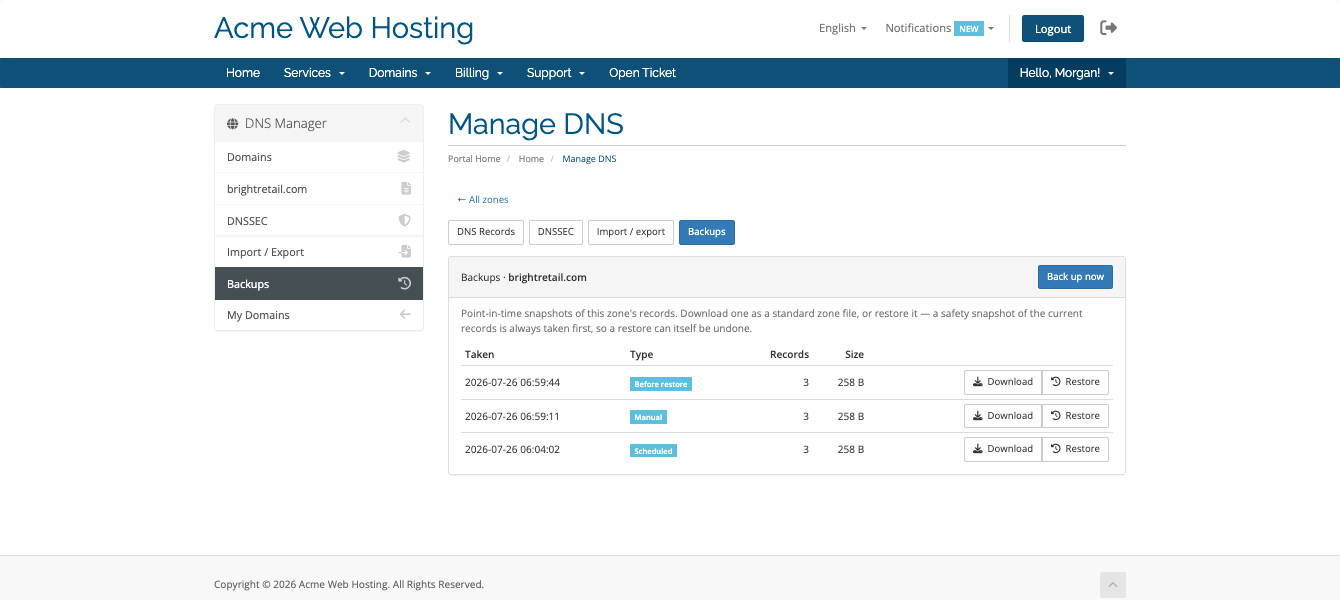
Customers snapshot and restore their own zone from the client area, with a safety snapshot taken before every restore
What you get in WHMCS
Providers and zones
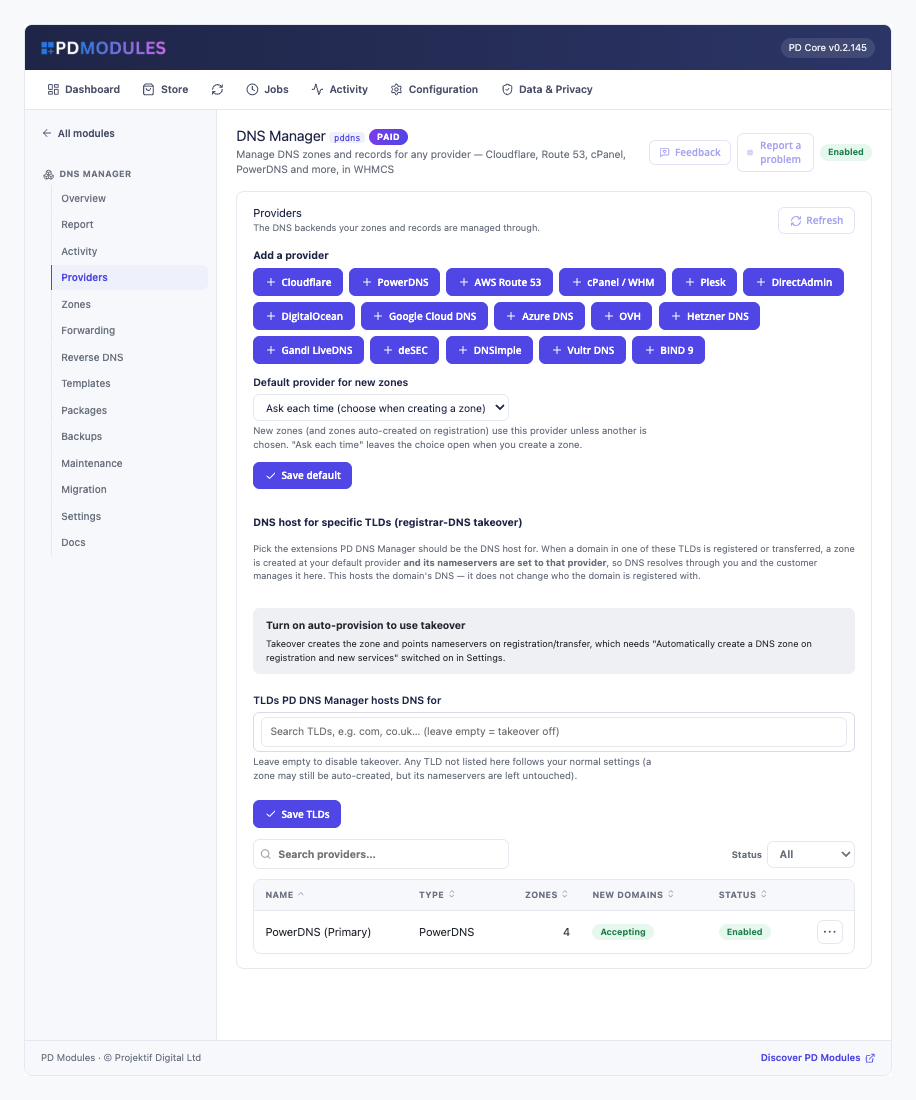
Sixteen backends, several at once, each with a Test connection before you save
A default provider for new zones, and an "Existing domains only" setting to retire one gracefully
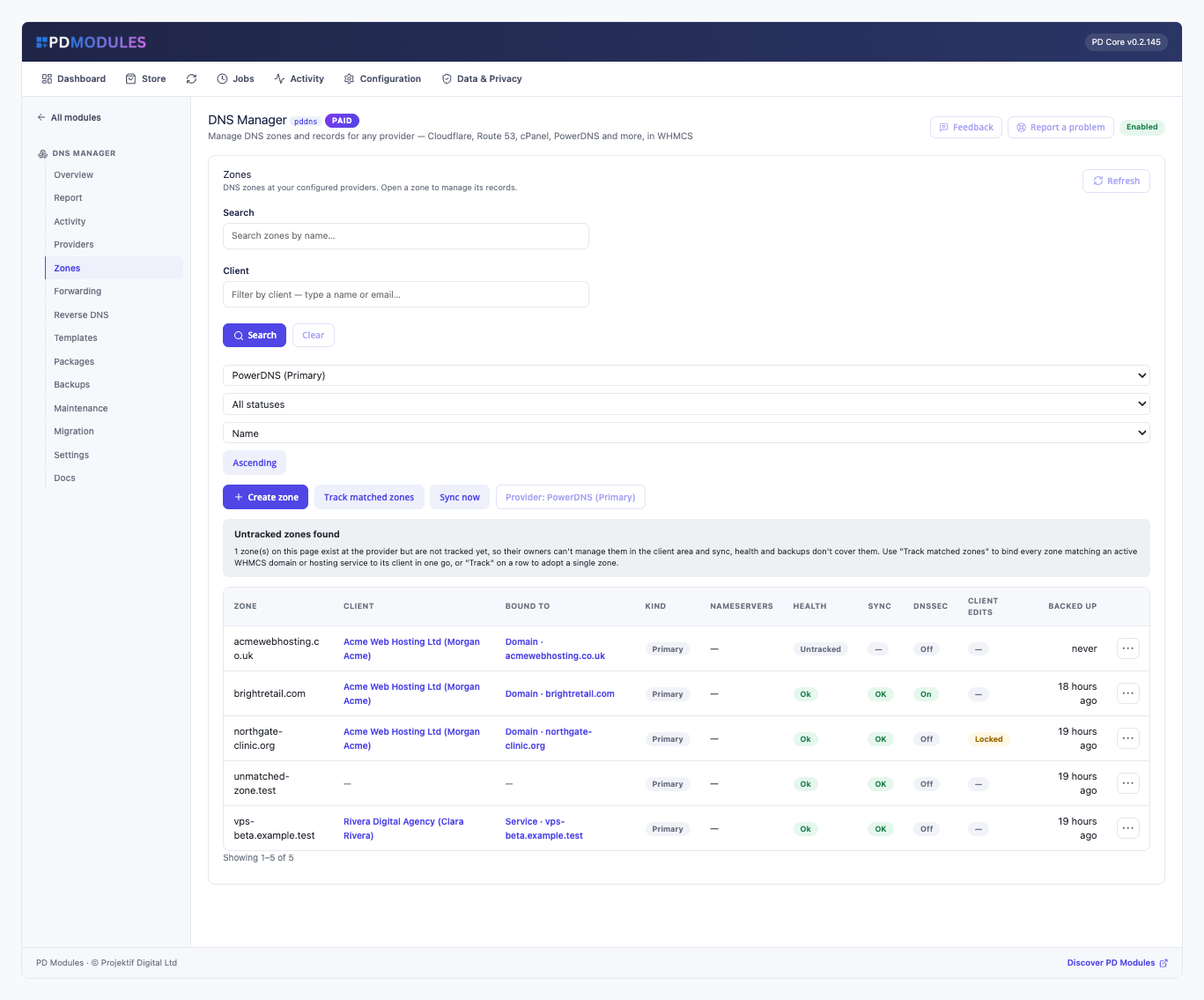
Zones list with search and filters by provider, tracking state, status and client; paged on the server so it stays fast with thousands of zones
Each zone shows its client, the domain or service it belongs to, nameservers, health, sync and DNSSEC state, whether client edits are locked and when it was last backed up
Create zone, assign a zone to a client with a searchable picker, lock a zone against customer changes, and delete a zone only after a confirmation
Zones with a client picked list that client's active domains and services that have no DNS zone yet, each with a one-click Create zone
Untracked zones are flagged, and Track matched zones adopts them without touching the provider
Records
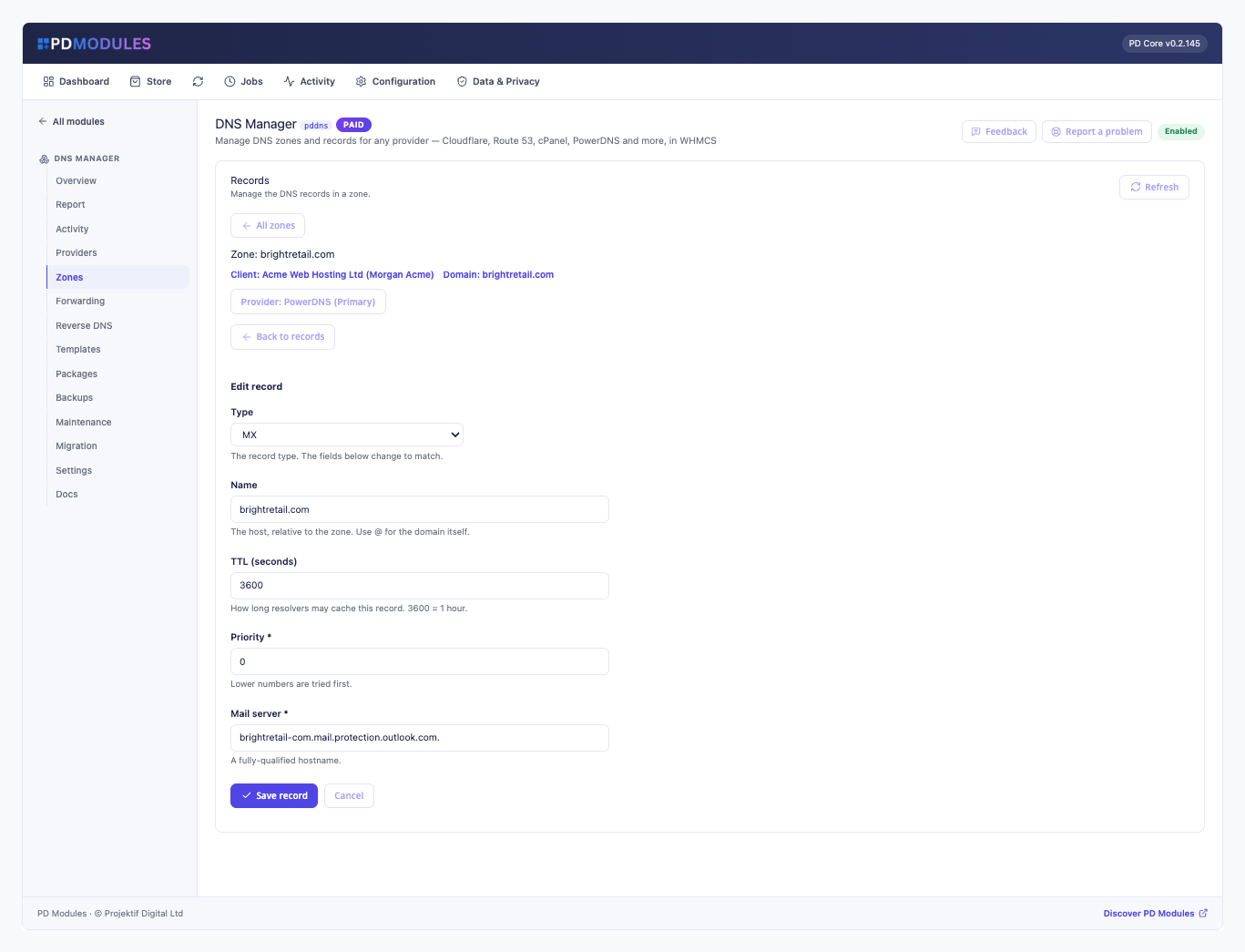
A type-aware editor that shows only the fields a record type needs, and checks addresses and hostnames before anything reaches the provider
Records are read live and written straight back, with search, type filter and server-side paging that reaches every record of a very large zone
Import a BIND zone file with a preview of how many records will be added; export any zone as a BIND file
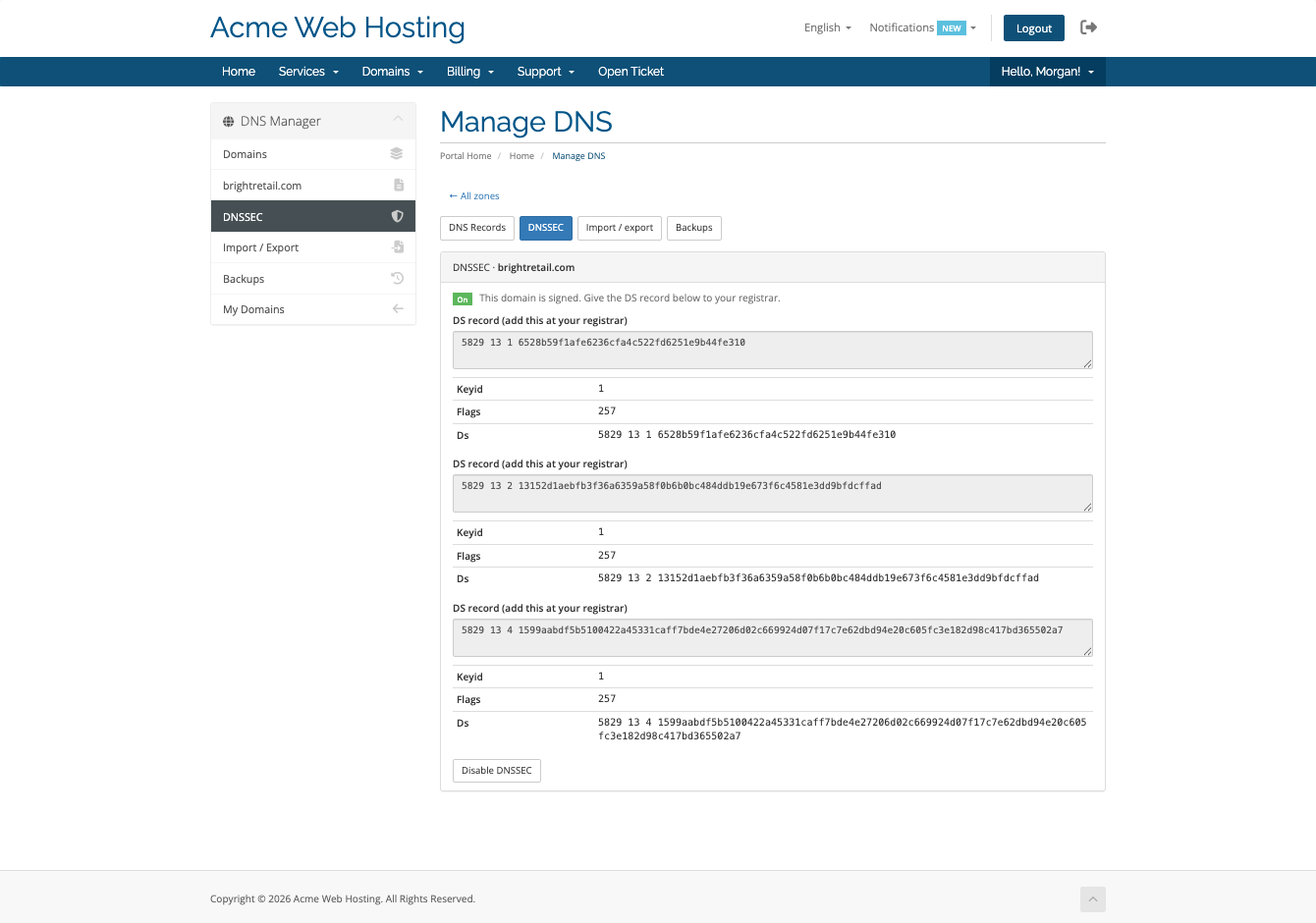
DNSSEC switched on per zone with one button, with the DS record shown ready to copy for the registrar
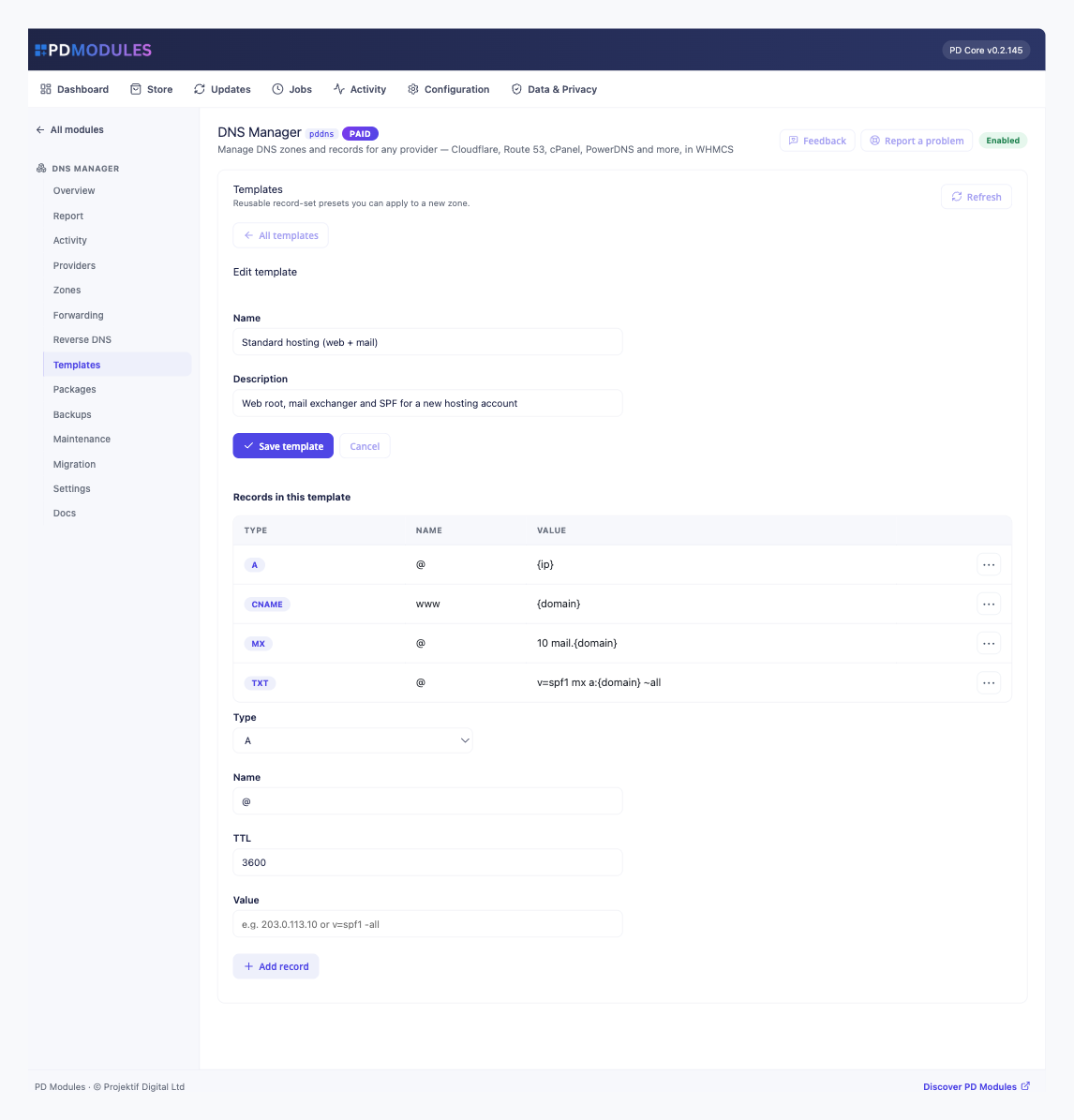
Record templates with merge fields such as {domain}, {ip} and {ns1} to {ns5}, applied from a zone's menu; applying twice is safe
Bulk operations that add, update or delete a record across many zones in the background, with per-zone results kept
Website and email forwarding for domains with no hosting, on providers that support it, with a warning before a forward overrides a host already in real use
Selling and controlling DNS
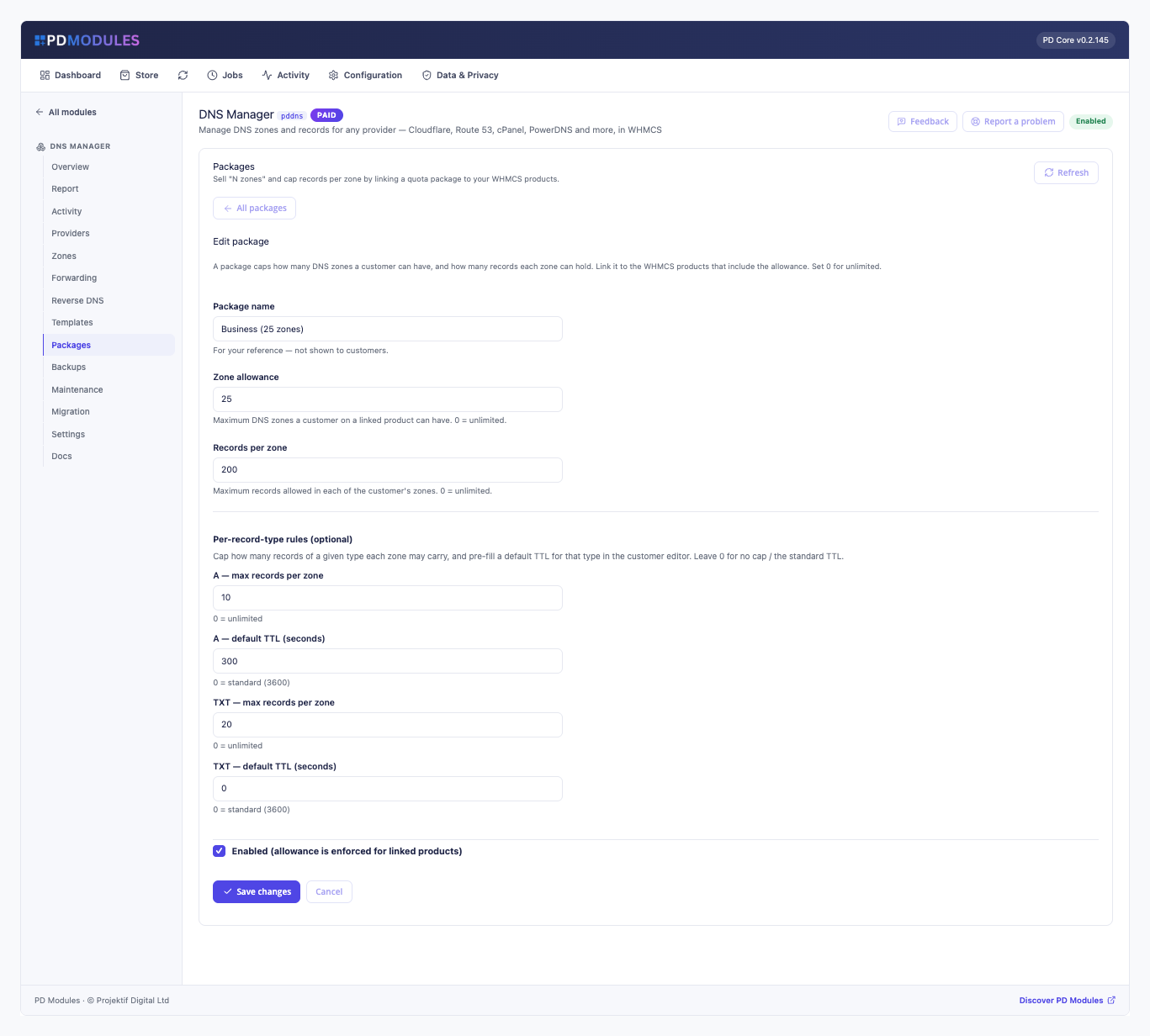
Quota packages that cap how many zones a customer may have and how many records a zone may hold, including a cap per record type with a default TTL, linked to the WHMCS products you sell
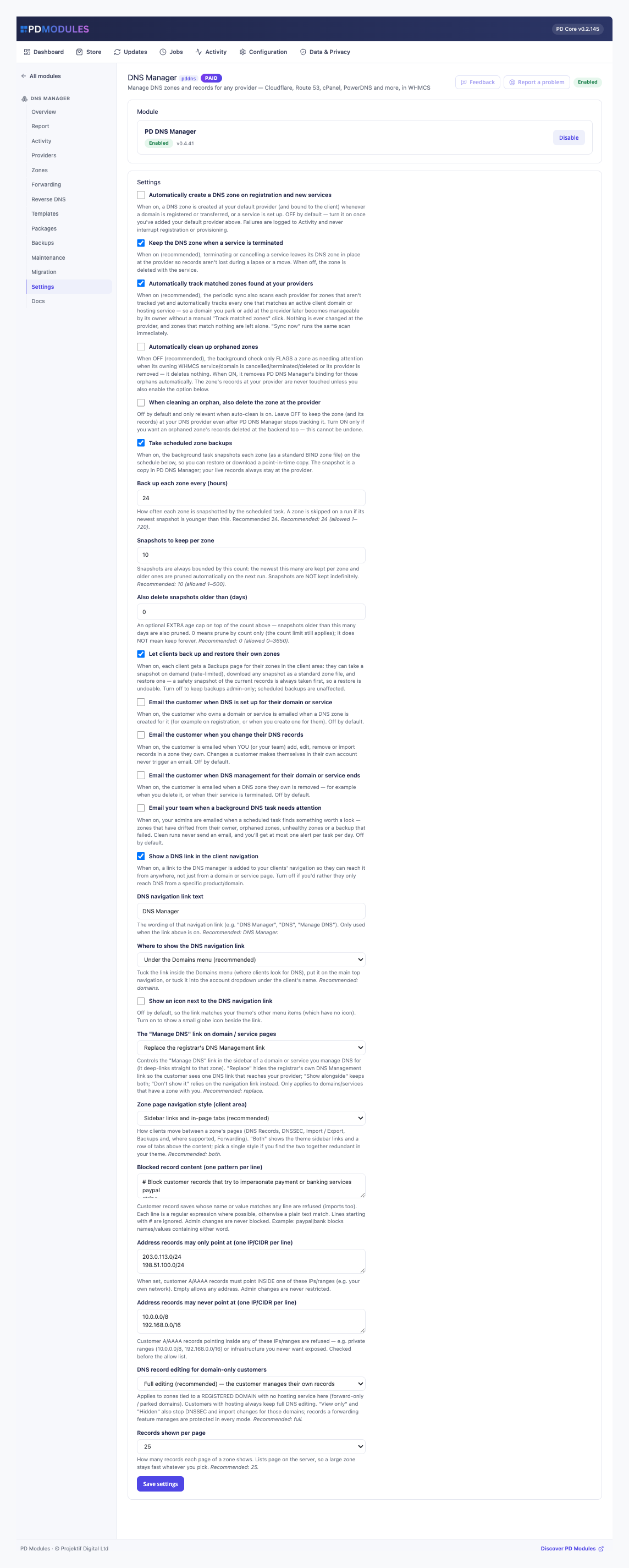
Content policies: blocked content patterns, and allow and deny lists for the addresses a customer's A and AAAA records may point at. They apply to customer saves, quick set-ups and imports, never to your own changes
Running it day to day
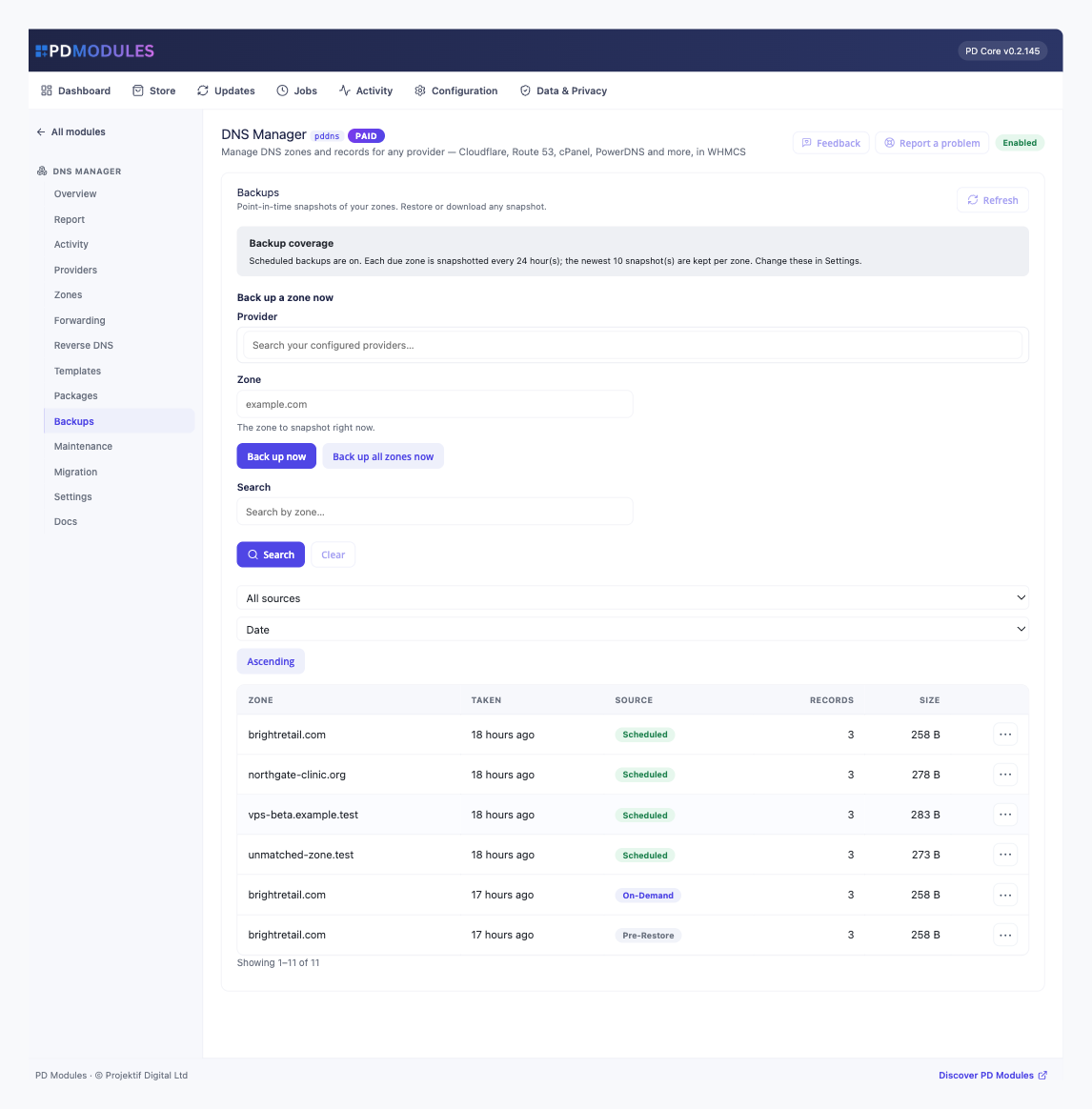
Scheduled zone backups on by default, every 24 hours, keeping the newest ten per zone, plus on-demand backups of one zone or all of them
Restore a snapshot to make the zone match it exactly, after a safety snapshot; recover a zone that was deleted by mistake with every record it had
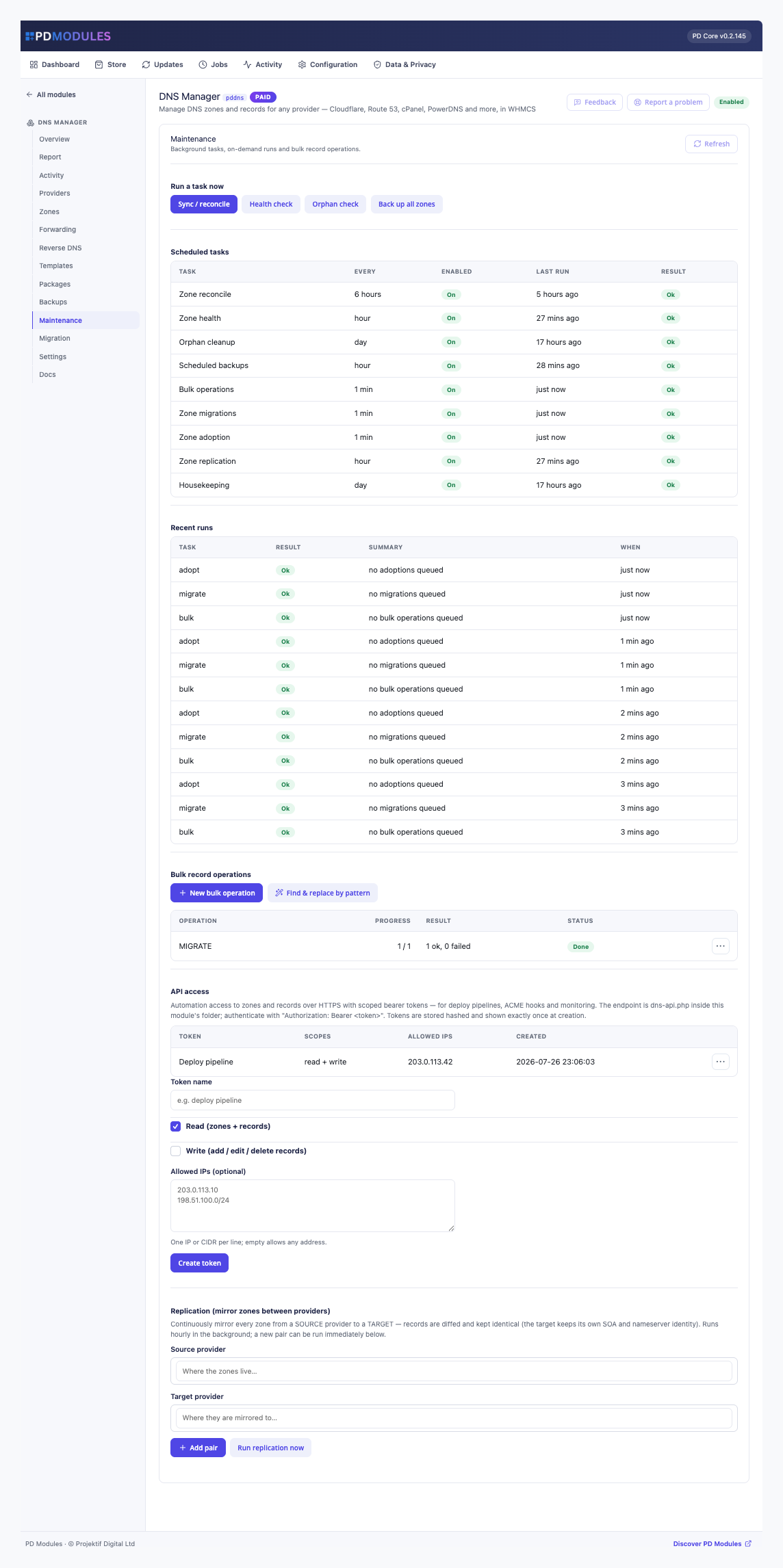
Health, reconcile and orphan checks run on WHMCS's own cron. An orphan is only flagged by default, and nothing is deleted at your provider unless you choose it
An activity log of every zone and record change, with who made it, when and whether it worked
A scoped REST API with read or write tokens, limited to the source addresses you choose, rate limited, with every write logged against the token's name
What your customers get
Their own DNS area with records, DNSSEC, import and export, forwarding and backups, reached by sidebar links, tabs or both
The same validating editor you use, limited to the zones that are theirs. Another account's zone cannot be reached, even by guessing an ID
Quick set-ups for Google Workspace, Microsoft 365 or an SPF lockdown, which add only what is missing and never a second SPF record
Self-service backups with a five-minute pause between snapshots, downloadable as zone files
DNSSEC status and DS records to paste at their registrar, on providers that support it
Pages render natively on WHMCS's Six, Twenty-One and Nexus themes, every string is translatable and your wording overrides survive updates.
Security built in
Provider credentials are stored encrypted in your WHMCS database and never shown back in the form.
Credentials never reach a customer's page, and customers never see which provider serves their DNS.
One product, every feature
PD DNS Manager is one paid module with every feature included and no per-zone, per-seat or per-record fee. Your providers bill you directly. It activates from your PD Modules subscription with no key to paste, adds its own tables and modifies no WHMCS files, and uninstalls without leaving orphans.
If your subscription lapses, your DNS records are never touched and your providers keep serving every zone. Admin management locks first while customers keep their self-service, and customer management stops later behind a neutral "temporarily unavailable" message. Renewing restores everything.
Requirements
WHMCS 9 or later on PHP 8.2 or later, with the ionCube Loader
An account with at least one supported DNS provider
PD Modules, the free control panel every PD module installs into
Questions
Which DNS providers are supported?
Sixteen backends: Cloudflare, AWS Route 53, cPanel/WHM (incl. a DNSONLY/cluster nameserver), Plesk, DirectAdmin, DigitalOcean, Google Cloud DNS, Azure DNS, OVH, Hetzner DNS, Gandi LiveDNS, deSEC, DNSimple, Vultr DNS, PowerDNS, and BIND 9. You can add multiple providers and mix backends across your zones.
Does it store my DNS records in WHMCS?
No. Records are fetched live from your DNS provider every time — they are never stored in your WHMCS database. Your DNS backend is always the source of truth. PD DNS Manager stores only zone metadata, backups and log entries.
Which providers support DNSSEC?
Cloudflare, PowerDNS, cPanel/WHM, DirectAdmin, Azure DNS and deSEC. On other providers the DNSSEC controls are not shown — they never appear where they can't work.
Can I migrate my existing DNS in?
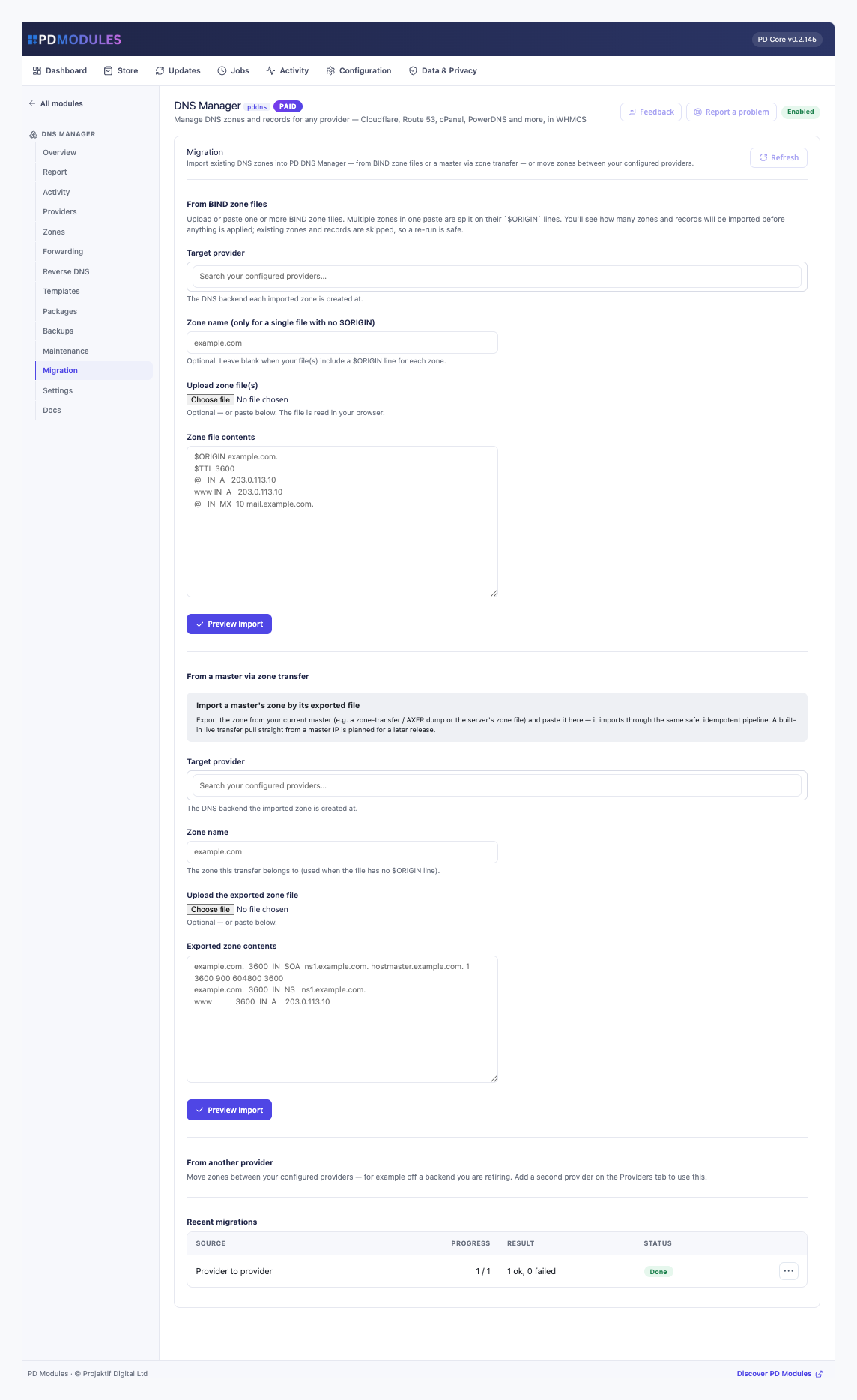
Yes. Import zones from BIND zone files, from a master server by zone transfer (AXFR), or move zones between your own configured providers with a verified dry run. Every import previews exactly how many zones and records it will create before anything changes, and re-running is safe.
I already have zones at a provider I've just connected — do I need to recreate them?
No. PD DNS Manager finds zones a provider already has and offers to bind every one that matches an active WHMCS domain or service to the right client automatically — nothing at the provider is changed.
Can I sell DNS as part of my hosting plans?
Yes. Create quota packages ('5 zones', '25 zones, 200 records each', with optional per-record-type limits and default TTLs) and link them to your WHMCS products, so each plan includes a defined DNS allowance that's enforced automatically as customers create zones and records.
Can customers forward a domain without hosting it?
Yes, on supported providers. Website and email forwarding lets a customer redirect a domain or forward its mail without a hosting account, with checks that warn before overriding a host already in real use.
Can I run a secondary DNS server automatically?
Yes. Multi-server replication continuously mirrors zones from one configured provider to another, keeping a live secondary in sync without any manual copying.
Can I automate DNS changes from scripts or monitoring tools?
Yes, via scoped API tokens (read-only or read/write, IP-restricted and rate-limited) for deploy pipelines, ACME DNS-01 hooks or monitoring.
Will removing a provider delete my DNS records?
No. Removing a provider from PD DNS Manager removes only our tracking of it. Your zones and records at the DNS backend are untouched. The same applies to orphaned zones — records at the provider are never deleted unless you explicitly enable that option in Settings.
Does the client area work on all WHMCS themes?
Yes. The client DNS pages carry both Bootstrap 3 and Bootstrap 4 class names and render correctly on Six, Twenty-One, Nexus, and any custom or child theme.
Does it need an extra cron job?
No. Zone backups, health checks, sync monitoring, bulk operations and migrations all run on your existing WHMCS cron — no extra configuration needed.
What happens if my subscription lapses?
The admin management interface locks at expiry. The client Manage DNS area continues to work through the grace period. Your records at the DNS provider are never touched — they keep serving traffic regardless of the subscription state.
What happens if my subscription lapses?
Nothing of yours is touched, and nothing is deleted. The module steps down in stages instead: a 14-day grace period where everything still works and you get a renewal reminder, then admin management locks while your customers carry on being served, and only after that do the customer-facing features stop — behind a neutral "temporarily unavailable, please contact support" message that never mentions licensing to your customer. Anything the module provisioned keeps running in your own account throughout, and your data and settings stay exactly where they are. Renewing restores everything immediately.
What does it cost to run, on top of the subscription?
Only what you already pay your provider. PD DNS Manager adds no per-unit fee and takes no cut — it connects to your own account with your own credentials, so the provider bills you directly at your rates, and you set what you charge your customers. From us it is the module subscription and nothing else.
What’s new in 0.4.142
Turning on email forwarding now asks you to confirm whenever the domain's current mail setup can't be checked, so a domain whose email is hosted elsewhere is never switched over without a warning.