PD Email Deliverability for WHMCS
£15/mo or £150 annual (save £30)
- Requires
- WHMCS 8.13 or later
- Version
- 0.2.23
- Updated
- 31 Oct 2026

Find out your customers' email is broken before their customers do
Made and supported by Projektif Digital Ltd. Runs inside PD Modules, the panel every module installs into.
£15/mo or £150 annual (save £30)
£15/mo or £150 annual (save £30)
Gmail rejects unauthenticated bulk mail outright. Microsoft followed. A domain with no SPF record, a DMARC record still sitting at p=none, a second SPF record somebody added last year, or an SPF record that quietly crossed the ten-lookup limit will land in spam or bounce — and you find out from the customer.
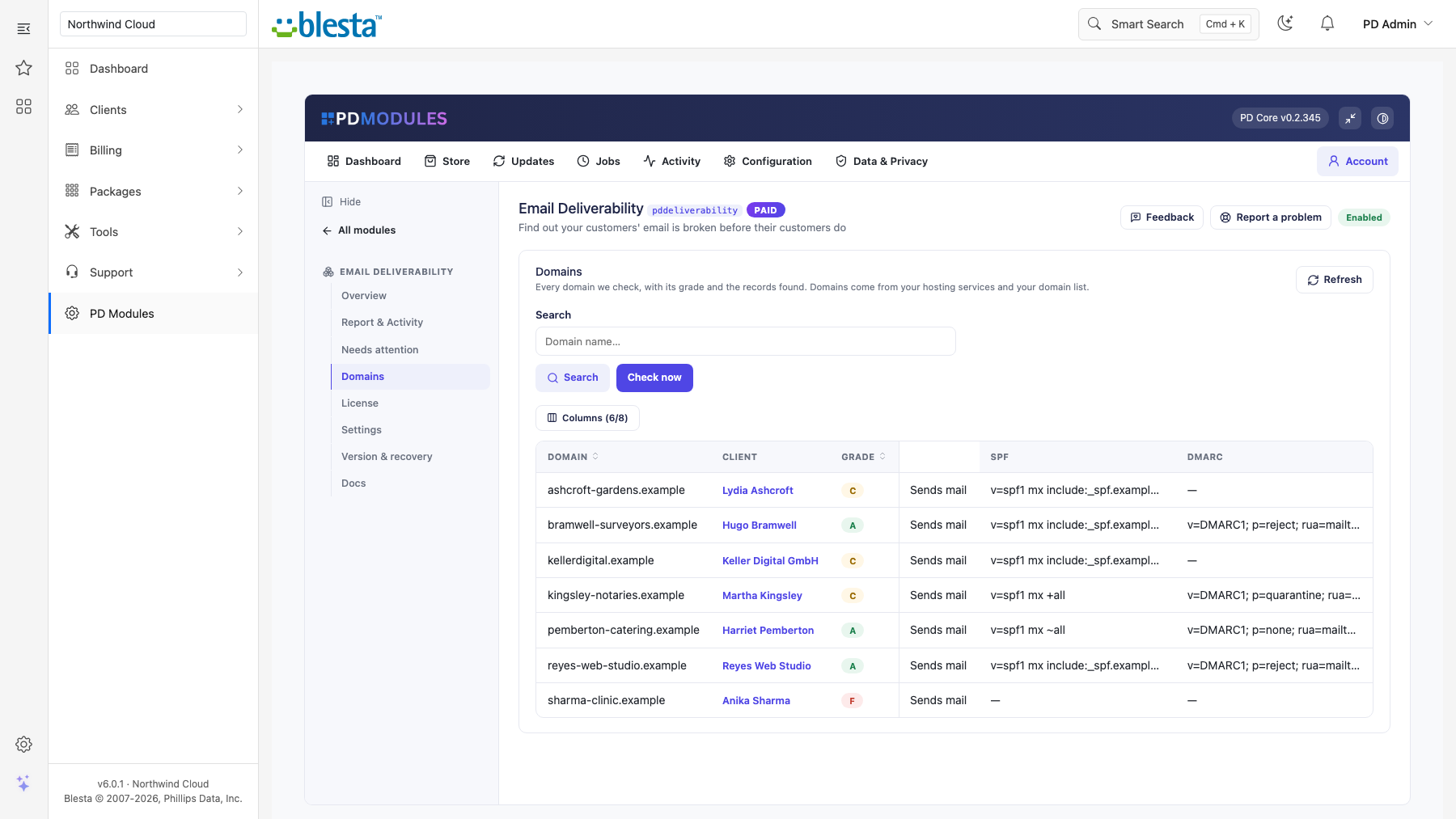
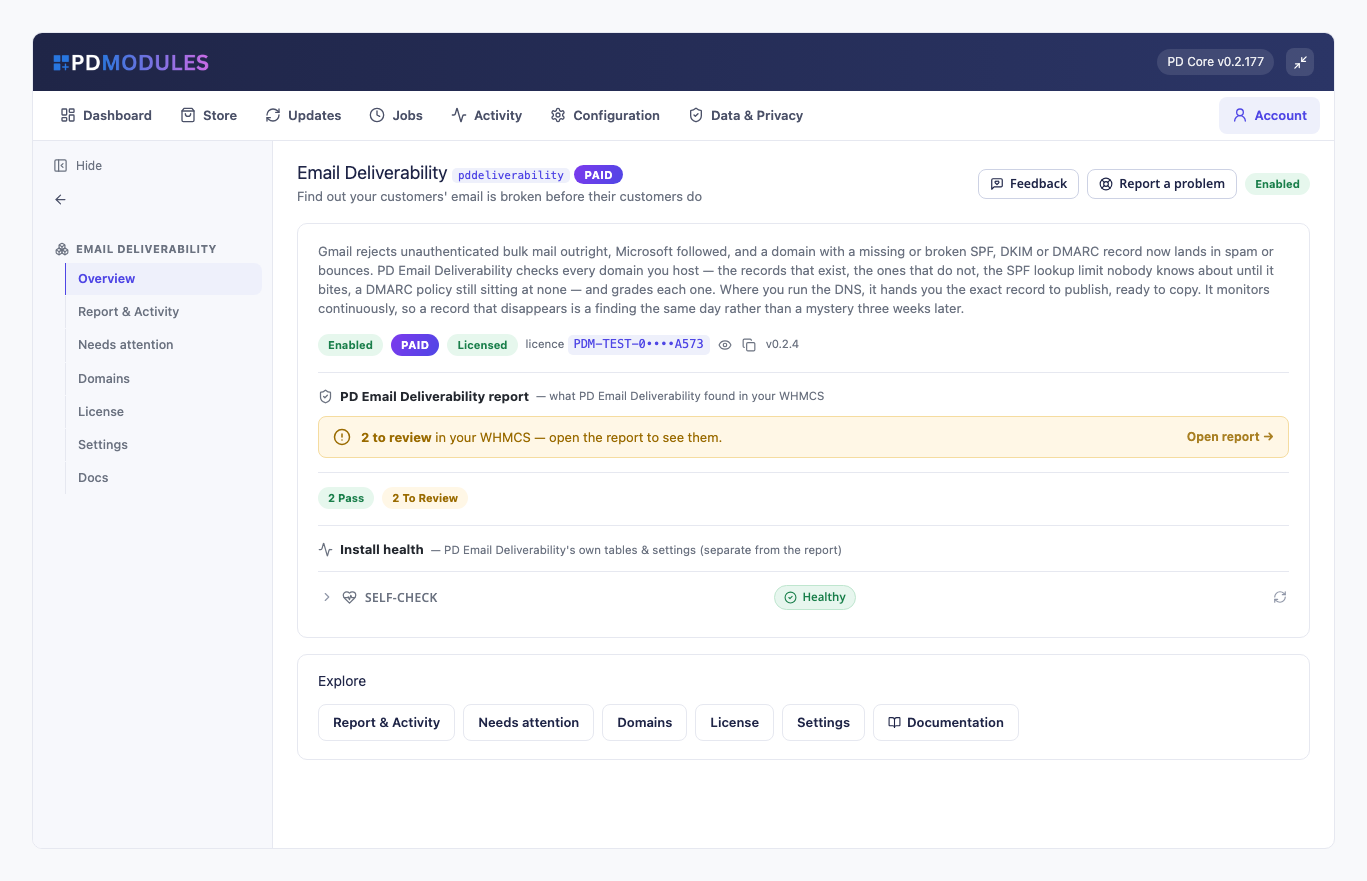
PD Email Deliverability checks every domain on an active hosting service and every domain in your WHMCS or Blesta domain list, grades it A to F, and tells you exactly what is wrong.
You install it and, if you like, tell it which DKIM selectors your mail platform uses.
The module reads every domain you host straight from DNS on a schedule, grades SPF, DKIM, DMARC, MTA-STS and the rest, and raises a finding in plain English. For each one it shows how to fix it: the exact record to publish, where it goes, why it matters, and a button to re-check that domain the moment you have published it. Where the right value depends on who sends the customer's mail, it says so instead of inventing a record that would authorise the wrong servers.
Your customer sees nothing. You fix it before they notice — which is the entire point.
Your DNS is never changed on its own. The module tells you exactly what to publish. Where one of our DNS modules manages the zone, Publish this record now writes it for you, but only after you confirm; the rest you publish where your DNS is hosted.
That is the whole point, because the failures that matter are the ones nobody notices:
include, a, mx, ptr, exists and redirect each cost one; ip4, ip6 and all are free. Add a fourth mail provider and you can cross the line silently.+all authorises the entire internet to send as the domain — worse than having no SPF at all.v=DMARC1 is not first is ignored by receivers, completely.p= has been revoked, and every message it signs will fail. It looks like a working record until you read it.DKIM selectors cannot be discovered from DNS — there is no query that asks a domain which it uses. So a key not found is reported as not found at the selectors tried, with your platform's selector configurable, rather than as a confident "no DKIM".
A TXT lookup that fails, which happens on busy apex domains, is reported as unreadable — never as "no SPF". A monitoring tool that cries wolf is worse than none.
Where the right answer is unambiguous — a DMARC record at the policy you choose, or v=spf1 -all for a domain that sends no mail — you get the exact record to publish, ready to copy.
A wrong edit to a live SPF record stops a business's mail, so nothing is changed without you. You get the record; where the zone is managed by one of our DNS modules on this install, one confirmed click publishes it, and anywhere else you publish it where your DNS lives.
A daily sweep, so a record someone deletes becomes a finding the same day rather than a mystery three weeks later — with an optional digest of what is newly broken.
PD Email Deliverability is available for WHMCS (8.13 or later) and Blesta (6.0 or later). Each has its own page with the screenshots, requirements and price for that system. A module is added to the PD Modules licence of the installation it runs on, so a WHMCS installation and a Blesta installation each hold their own licence.
Because DKIM selectors cannot be discovered from DNS — there is no query that asks a domain which selectors it uses. The module tries the common ones and reports honestly that it found nothing at the selectors tried. Add your platform's selector in Settings and the finding clears.
The standard allows exactly one. When a receiver finds two, the result is a permanent error and SPF fails entirely — so a domain with two carefully-written records is worse off than a domain with one sloppy one. They need merging into a single record.
SPF evaluation is capped at ten DNS lookups. include, a, mx, ptr, exists and redirect each cost one; ip4, ip6 and all cost nothing. Add a fourth mail provider and you can silently cross the limit, after which receivers stop evaluating and SPF fails. The module counts them for you.
It never changes DNS on its own, because a wrong edit to a live SPF record stops a business's mail. Every finding comes with the exact record to publish. When the domain's zone is managed by one of our DNS modules on this install, a "Publish this record now" button writes it there after you confirm; when the DNS lives elsewhere, you publish it where it lives.
No — not without checking each one. p=reject tells receivers to refuse mail that fails authentication, including legitimate mail from a sender nobody remembered to add. Start at p=none, read the reports for a fortnight, then tighten.
Not to send mail, because it does not send mail. But v=spf1 -all on a domain that never sends is the cheapest anti-spoofing measure there is. Turn on "Also check domains that do not send mail" to see which of yours are missing it.
Only DNS queries for the domains you host. No third-party service, no account to hold, and no customer data — a lookup contains a domain name and nothing else.
No. This is an operator tool with no client-area surface.
Open a ticket from your client area, or use Get help inside the PD Modules panel, which attaches a diagnostic report — you see a preview of exactly what it contains, and can exclude any part of it, before anything is sent. Support is included with an active subscription; bug reports are welcome whatever your licence state.
 Featured
Manage DNS zones and records for any provider — Cloudflare, Route 53, cPanel, PowerDNS and more, in WHMCS or Blesta
Forward a domain or its email — without hosting it. Set up URL and email forwarding inside WHMCS or Blesta.
Know about a domain problem before your customer does
Monitors that create themselves — every service you provision is watched from the moment it goes live