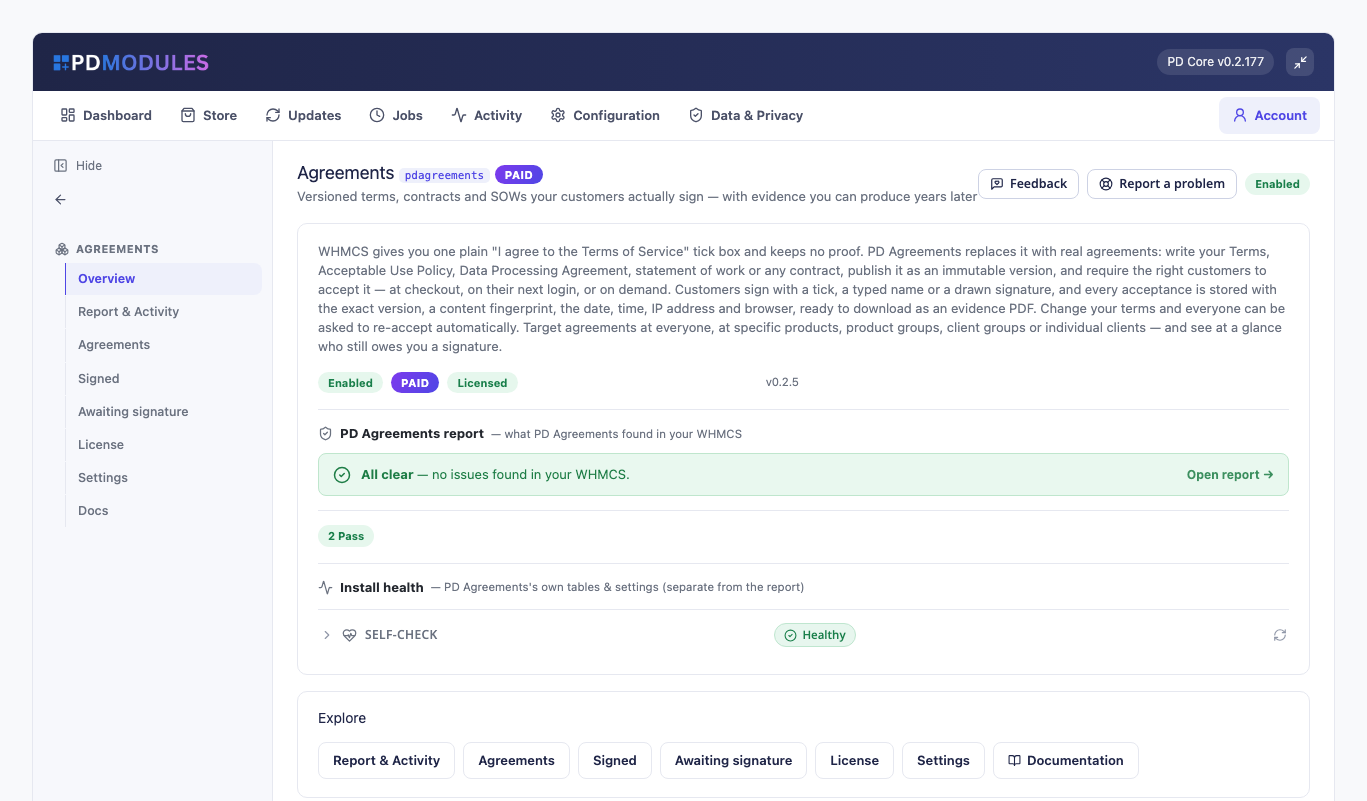
PD Agreements lets a hosting company put its Terms of Service, Acceptable Use Policy, Data Processing Agreement or any statement of work in front of the right customers, have them sign it, and keep proof of exactly what each customer agreed to. You write the agreement once in your WHMCS admin and publish it as a numbered version. Customers sign at checkout or the next time they sign in, and every signature is stored with the version, a content fingerprint, the date and time, and the method used.
It is built for hosts and agencies who need more than a tick box. When a chargeback, an abuse complaint or a data-protection question arrives years later, you can produce the signed record and an evidence PDF instead of an argument.
Why hosts choose PD Agreements
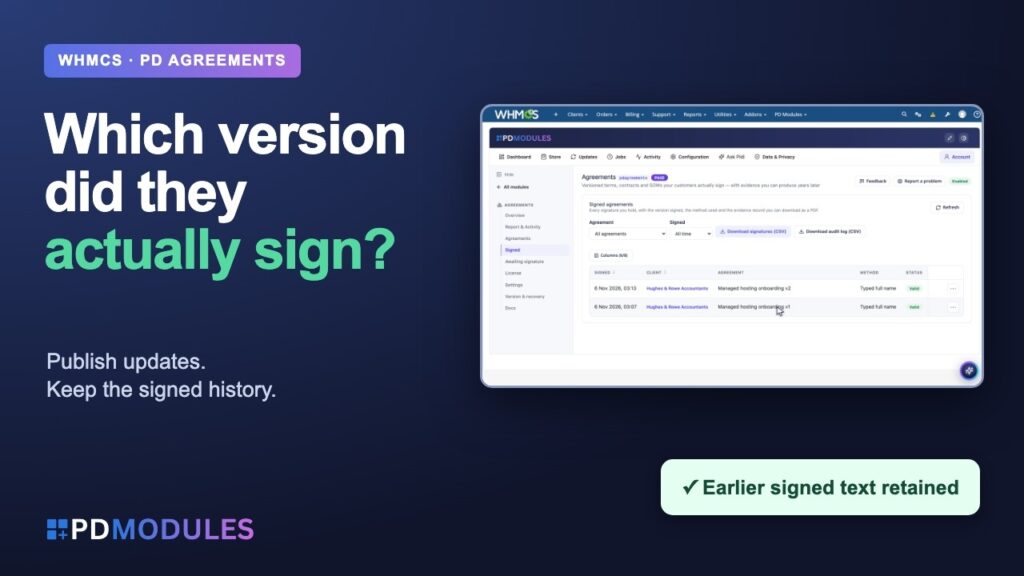
Proof, not a tick box. Publishing freezes the text as a version with its own SHA-256 fingerprint, publisher, time and change note. Earlier versions stay exactly as published, so a customer who signed version 1 stays attached to what version 1 said.
The order cannot skip the contract. A required checkout agreement blocks the order until it is accepted, and the acceptance is recorded against the order number. Agreements you set to "next sign-in" take the customer to a signing page when they next open the client area.
Ask only the customers who need to sign. Aim an agreement at everyone, or at chosen products, product groups, add-ons, client groups or individual clients. A support addendum can go only to customers who bought the support add-on. Choose "any of these" or "all of these", and leave out clients who have a product, add-on or group you name. An exclusion always wins.
Changed terms, asked again. Publish a new version and, if you tick "everyone who signed an earlier version must accept this one", earlier signers are asked again. Customers already on the current version are never asked twice, and a customer is only shown agreements that apply to them.
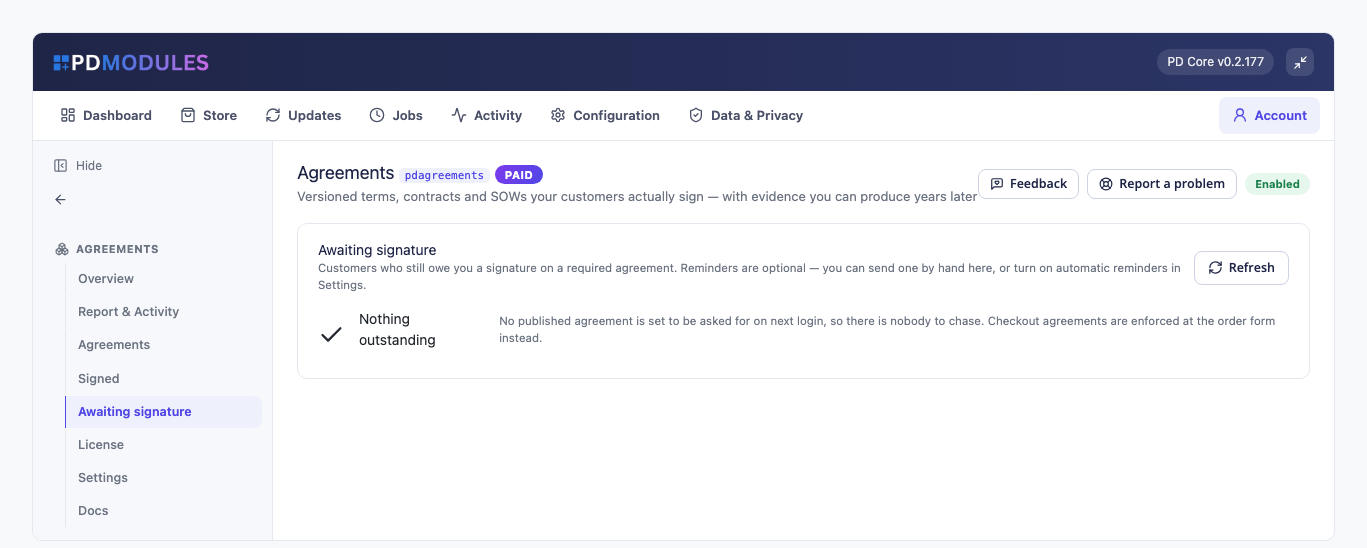
No chasing by hand. An Awaiting signature list shows every customer who owes a signature and exactly what is missing. Send a reminder to one customer or all of them, or switch on automatic reminders, which email everyone outstanding at most every N days through an email template you can edit and translate.
Evidence that stays yours. PD Agreements makes no outbound calls. The evidence PDF is generated on your own server, and your signatures live in your own WHMCS database.
How it works
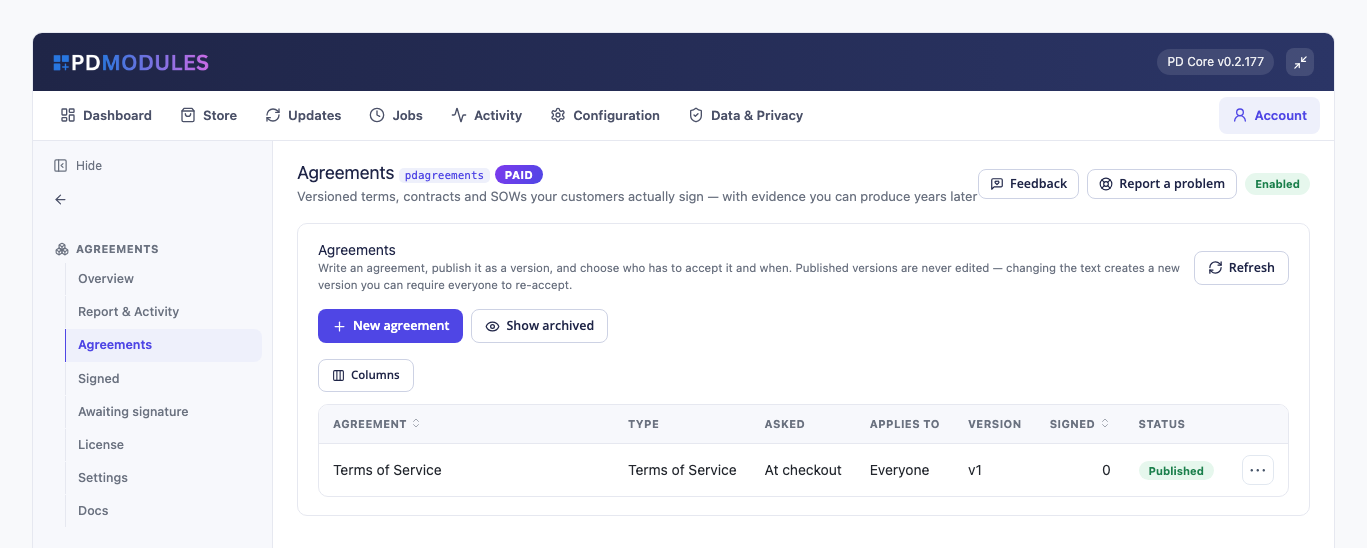
- Write the agreement. Compose it in plain Markdown, choose its type and how the customer signs, and save it as a draft. A draft is never shown to customers.
- Choose who signs and when. Pick the customers it applies to, and ask at checkout, on next sign-in or on demand. An agreement aimed at nothing is never enforced.
- Publish. The text is frozen as a numbered version with its fingerprint.
- Customers sign. They read, tick, and sign with a typed name, a drawn signature or a tick box, whichever you chose.
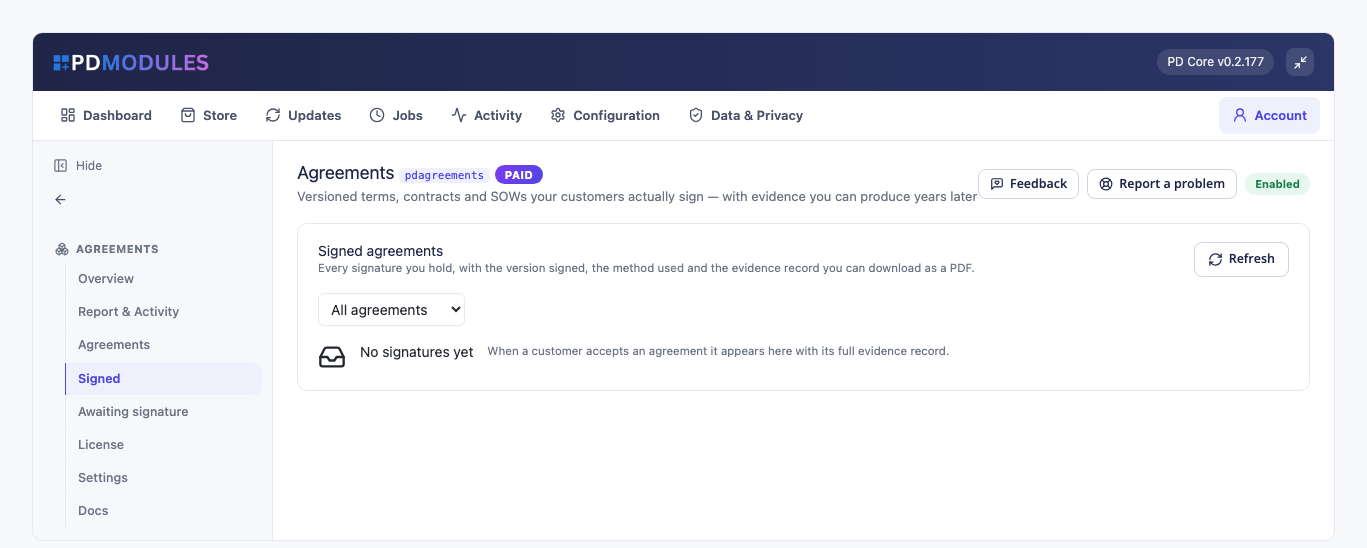
- You keep the proof. Open any signature to download its evidence PDF, or export signatures to CSV.
What you get in WHMCS
Writing and versioning
- Agreements of any kind: terms, acceptable use, data processing, statements of work, or your own
- Numbered, immutable versions, each with fingerprint, publisher, time, change note and a re-accept flag
- Drafts that stay private until published
- Delete an agreement to stop it being asked; every signature and the exact versions signed are kept
Targeting and timing
- Checkout, next sign-in, or on demand. An on-demand agreement never blocks anything, and the acceptance is still recorded
- Products, product groups, add-ons, client groups and individual clients, with add-ons chosen from a searchable list
- An agreement aimed at an add-on is asked at checkout when that add-on is in the cart, and on next sign-in for customers who already have it
- Put an agreement in front of one client whatever its targeting says, and take it back again; anything they signed is kept
- One switch pauses every checkout agreement, another every sign-in agreement, without deleting anything
Signing
- Tick box, typed full name (the default) or drawn signature, set per agreement
- "Require scroll" keeps the accept control disabled until the customer reaches the end of the document, and short documents unlock at once
- A drawn-signature agreement can be signed by typing a name instead, and the record shows the method actually used
- Keyboard and screen-reader friendly, with a "Jump to the end" control and labelled fields
- A grace period of N days adds "Remind me later"
Evidence and records
- Each acceptance records the version, fingerprint, date and time, source (checkout or client area), order number, and, while "record IP address" is on, the IP address and browser
- Evidence PDF with title, version, signer details, method, the signature or typed name, the full text as accepted, the fingerprint, a reference number and your own footer line
- A signature can be revoked with a reason and time recorded, never deleted; a revoked customer is asked again
- Signatures and the audit log export to CSV, filtered by agreement and date range, with the IP and browser columns left out when you have switched recording off
Running it day to day
- The client profile shows an Agreements row: signed, outstanding, evidence links, and a copyable signing link you can email
- While something waits for a signature, the client area shows a notice
- Choose what an unsigned customer can still do: by default they can pay invoices and open tickets, or you can block everything except new orders, or everything until they sign. Sign-out, password reset and the signing page always work
- Read-only assistant tools answer who has signed what and who is outstanding; the tools that change something ask for confirmation and are audited
What your customers get
- One clear block at checkout: the document, a tick, and their name as a signature. Nothing to download or send back
- Their own signed copies: customers can download their own evidence copies, and nobody else's
- Accessible signing: a keyboard-only or screen-reader customer can reach the end of the agreement, accept it and sign
- Your look: the order-form block renders on Six, Twenty-One and Nexus and their child themes
Security built in
- Signatures are never deleted and published text can never change
- Customers can only open their own signing records
- The authenticated API refuses callers without a valid connection token, and a connection limited to some clients cannot read or change any other client
- A drawn signature is stored in your database as an image and is never returned by the assistant tools
- Uninstalling removes the module's tables and settings; the reminder email template is kept
One product, every feature
PD Agreements is one paid module with everything included. There are no add-on tiers. It installs into PD Modules in one click, updates itself, and adds its own tables without modifying WHMCS files, so it does not collide with other modules or a customised theme.
If your subscription ever lapses, the signatures you have already collected stay readable and downloadable. Managing agreements locks once the licence has expired, and asking customers to sign stops only if it is later suspended.
Requirements
- WHMCS 9 or later on PHP 8.2 or later, with the ionCube Loader
- PD Modules, the free control panel every PD module installs into