PD Google Compute Engine — Sell Cloud Servers on Google Cloud as a Native WHMCS Product
Sell cloud servers on Google Cloud under your own brand — provisioned, billed and managed in WHMCS
Made and supported by Projektif Digital Ltd.
Runs inside PD Modules, the panel
every module installs into.
Servers & Compute
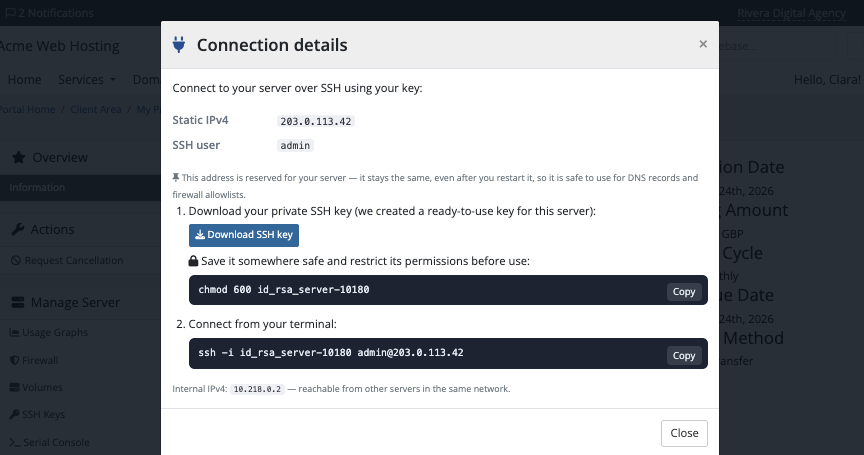
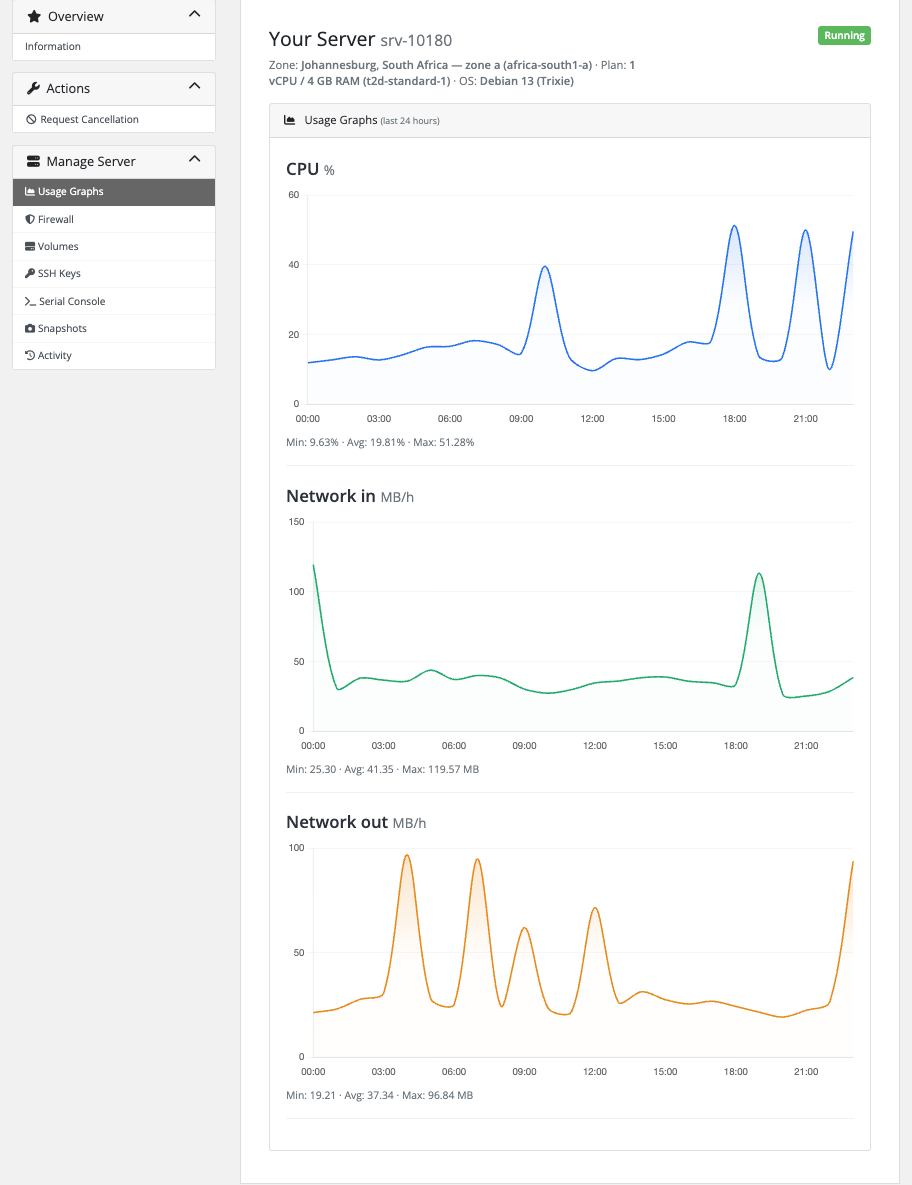
The whole server — power, firewall, console and metrics — managed from WHMCSCustomers manage their own firewall rules without the Google Cloud consoleSecure key-based access with a generated server key ready to downloadCopy-paste SSH connection details, keyed and ready to goLive CPU and network graphs keep customers informed1 / 5
PD Google Compute Engine lets a hosting company sell Google Cloud virtual machines as its own cloud server product. Your customer orders in your WHMCS cart, a dedicated server is built in your Google Cloud project when WHMCS sets the order up, and your customer manages it from your client area: a control panel in your brand that never names Google in its own words. You set the price, Google bills you the cost, and the difference is your margin.
It is built for hosts who want to offer cloud servers on Google Cloud without building a control panel, without giving customers access to the Google Cloud console, and without a support ticket every time a customer needs a reboot or a firewall rule.
Why hosts choose PD Google Compute Engine
Sell cloud servers under your own brand. Your customers see your company, your prices and your client area. They never see your Google Cloud account, key or console, and there are no per-server fees to us: you pay a flat module subscription and Google bills your own project.
Every order sets itself up. The server is built when WHMCS sets the order up, with the zone, machine type and operating system the customer picked at checkout. It is running with its control panel within a minute or two, with a reserved static IP and its own firewall rules already in place.
Customers help themselves. Power controls, connection details, snapshots, extra disks, a firewall, SSH keys, a boot and console log, usage graphs and an optional in-browser terminal are all on the customer's own service page. That is most of the tickets a server product normally generates.
Problems caught before they cost you. A machine type that a zone cannot build is refused before anything billable is created. An order whose region lacks the vCPU quota is refused with a guided "request an increase" message, and a missing role or blocked policy is named with its fix.
Nothing untracked, nothing left billing. Every server is recorded before Google is asked to create it, so a server can never exist without an owner. Terminating a service deletes the VM and its boot disk, removes its firewall rules, snapshots and extra disks, releases its static IP, and confirms at Google that everything is gone.
A stopped server is not a destroyed one. If a client's invoice lapses their server is stopped, not destroyed, and it comes back with the same IP once they pay. Data is removed only on termination.
How it works
Connect your Google Cloud project. Create a service account with the Compute Admin and Service Account User roles and paste its key into a WHMCS server record. Test Connection makes read-only calls only, names which role is missing, tells you if the Compute Engine API is not enabled and how to turn it on, and shows your vCPU quota in the default region.
Create your products. One click generates the order options (region and zone, machine type, operating system, boot disk size and snapshots you can keep) from the live Google Cloud catalogue. You set the price of each and choose which ones customers see.
Your customer orders. They choose their options at checkout and pay. The server is built with a reserved static IP, a firewall and a ready-to-use SSH key.
You get paid, they manage it. WHMCS keeps billing as usual. A plan change through the normal upgrade flow resizes the server in place and keeps its data.
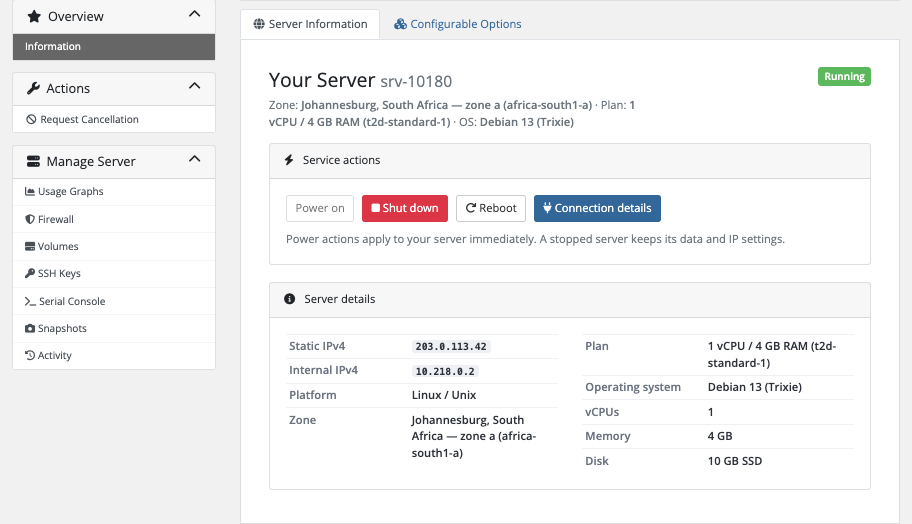
The customer's server page: power controls, server details and the pages for usage, firewall, disks, SSH keys, serial console and snapshots
What you get in WHMCS
Selling and pricing
Order options generated from Google Cloud: region and zone, machine type, operating system, boot disk size and the number of snapshots a customer can keep
Machine types read live from Google Cloud, in regions on every continent
Debian 12 and 13, Ubuntu 22.04 and 24.04 LTS, Rocky Linux 9, AlmaLinux 9 and CentOS Stream 9, each the latest image of its family
Choose which options customers see; anything you hide is fixed to your product's setting, and rebuilding keeps what is hidden and what customers already chose
A boot disk size setting per product (10 GB minimum), or let customers buy a size as a priced option
Included snapshots per product when you are not selling them as an option
A customer can give their own SSH public key at checkout, and your team's master key can go on every new server
Provisioning you can trust
Every plan a customer can pick can be built in the zone they pick
When Google refuses a server, the order is reported as failed with the reason
A suspended server is powered off with its data and configuration intact, and powered back on with the same IP when unsuspended. The customer's status banner says plainly that a stopped server still bills its disk and reserved IP
Plan changes are applied in place: stop, change machine type, start, with the data preserved. A refused type leaves the server as it was and says so
A boot disk upgrade grows the disk online without touching data; the disk never shrinks
Running it day to day
Clients and Servers: every server against the client paying for it, with its state
A full, readable activity history: creation, power actions, reinstalls, plan and disk changes, snapshots, firewall and SSH key changes
What your customers get
Power on, shut down and reboot, with the page telling them a reboot is a hard reset before they confirm
Connection details: the static IP and a ready-to-copy ssh command, with a one-click download of the server's generated key
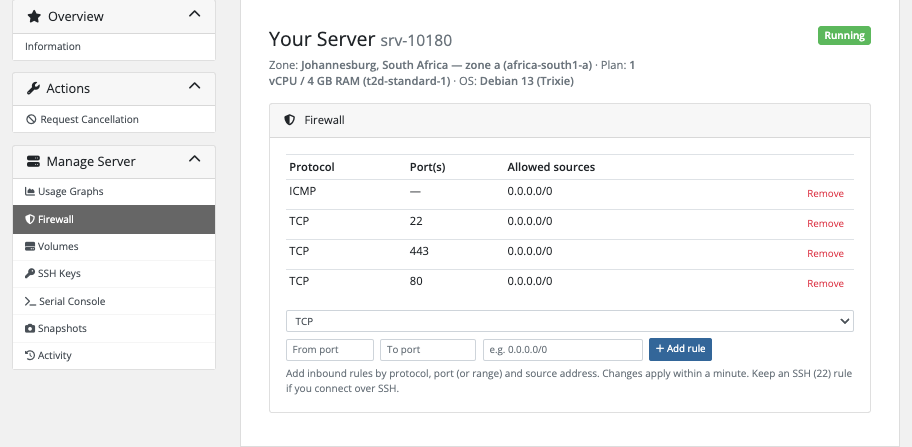
A firewall they manage themselves: add or remove rules by protocol, port or range and IPv4 source, applied within a minute. Anything not allowed is blocked
Snapshots they title, take, restore and delete, up to the allowance they bought. Restoring keeps the static IP and their keys
Extra disks (SSD, balanced or standard) they create, attach, detach and delete; detaching keeps the data
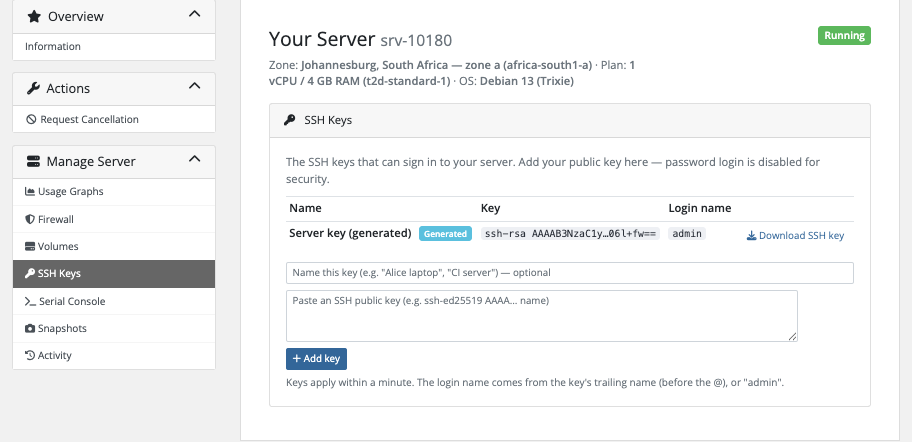
Their own SSH keys, added and removed at any time and reaching the running server within a minute. Password login is disabled
Reinstall from a fresh copy of the original operating system, behind a typed confirmation, keeping the static IP and keys
A boot and console log they can read, read-only, to diagnose a server that will not start
Usage graphs for CPU, network and disk over the last six hours
An in-browser terminal, off until you switch it on, with no SSH client to install
Activity: a timeline of everything that happened to the server
The firewall page: customers add and remove inbound rules without the Google Cloud consoleSSH keys: the server's generated key to download, plus the customer's own keysUsage graphs: CPU, network in and network out for the customer's own server
Every one of these is a switch on the product. Turn one off and it disappears from the customer's page, and the server refuses it too. The pages render natively on WHMCS's Six, Twenty-One and Nexus themes and are fully translatable, with wording overrides that survive updates.
Security built in
Your service-account key is stored encrypted on your own server, used only server-side, and never appears on a customer page. Servers accept SSH keys only, and a server's keys are removed with it.
The in-browser terminal is off until you switch it on, at the module and on each product. Only the signed-in owner of a service can open it. Each session is single-use and expires within a minute, and nothing inbound ever reaches your WHMCS server.
One product, every feature
PD Google Compute Engine is one paid module with everything included: provisioning, power, snapshots, disks, firewall, console log, metrics, upgrades and the browser console. There are no add-ons or tiers to compare. It installs into PD Modules in one click, updates itself, and uninstalls cleanly without modifying any WHMCS files.
If your subscription ever lapses, your customers are not cut off. A lapse never stops, deletes or alters a customer's server: it keeps running in your Google Cloud project throughout. Customers keep managing their servers until the subscription is suspended. New provisioning and admin configuration stop when it expires, and the browser console goes dark, though customers can still use their own SSH client.
Requirements
WHMCS 9 or later on PHP 8.2 or later, with the ionCube Loader
A Google Cloud project with the Compute Engine API enabled, and a service account with the Compute Admin and Service Account User roles
PD Modules, the free control panel every PD module installs into
Questions
Do I need my own Google Cloud account?
Yes. You connect a Google Cloud service-account key once, and every client's server is provisioned into your project — Google bills you, you bill your client through WHMCS, and the difference is your margin.
Do my machine types and images stay current?
Yes. Machine types are read live from Google when you generate (or rebuild) the options, skipping retired types, and OS images come from a curated list of Google's own public images. A plan a zone does not offer is refused before anything is created.
Can clients recover a server that won't boot?
Yes — the client area shows the server's boot and console (serial) log, read-only, plus power controls to stop, start and reboot the instance, without any access to your Google Cloud account.
What happens to a client's server if their invoice lapses?
The server is stopped, not destroyed — a lapse never deletes data. Everything is restored once the account is brought back into good standing. Data is only ever removed on an explicit termination.
Do plan upgrades destroy the server?
No. Machine-type and disk upgrades apply in place with the data preserved, through WHMCS's normal Upgrade/Downgrade flow.
Is this one price or lots of tiers?
One paid product unlocks every feature — no add-ons or tiers to juggle. You set your own price for each machine size.
Which WHMCS and PHP versions does it need?
WHMCS 9 or later, on PHP 8.2 or later. It installs alongside whatever else you run — it adds its own tables and templates rather than modifying WHMCS files, so it does not collide with other vendors' modules or with a customised theme. Uninstalling removes its own tables and settings. Terminate its services and let their cleanup finish first — uninstalling also removes the record of any cleanup still in progress.
How do I get help?
Open a ticket from your client area, or use Get help inside the PD Modules panel, which attaches a diagnostic report — you see a preview of exactly what it contains, and can exclude any part of it, before anything is sent. Support is included with an active subscription; bug reports are welcome whatever your licence state.
What’s new in 0.1.47
Fixed: when Google Cloud cannot create a server — for example because a zone has no spare capacity — the order is now reported as failed with the reason, instead of appearing successful with no server behind it.