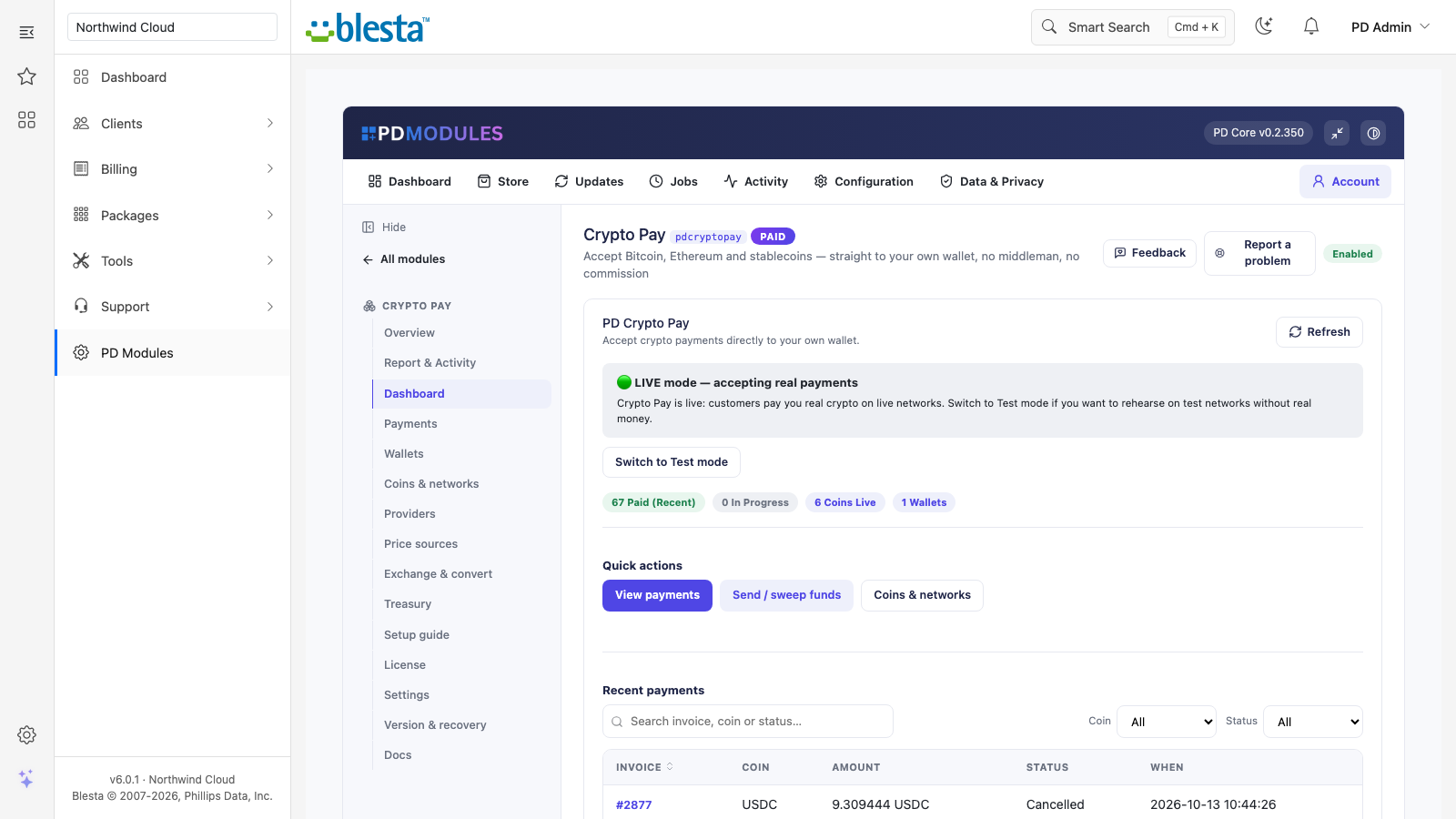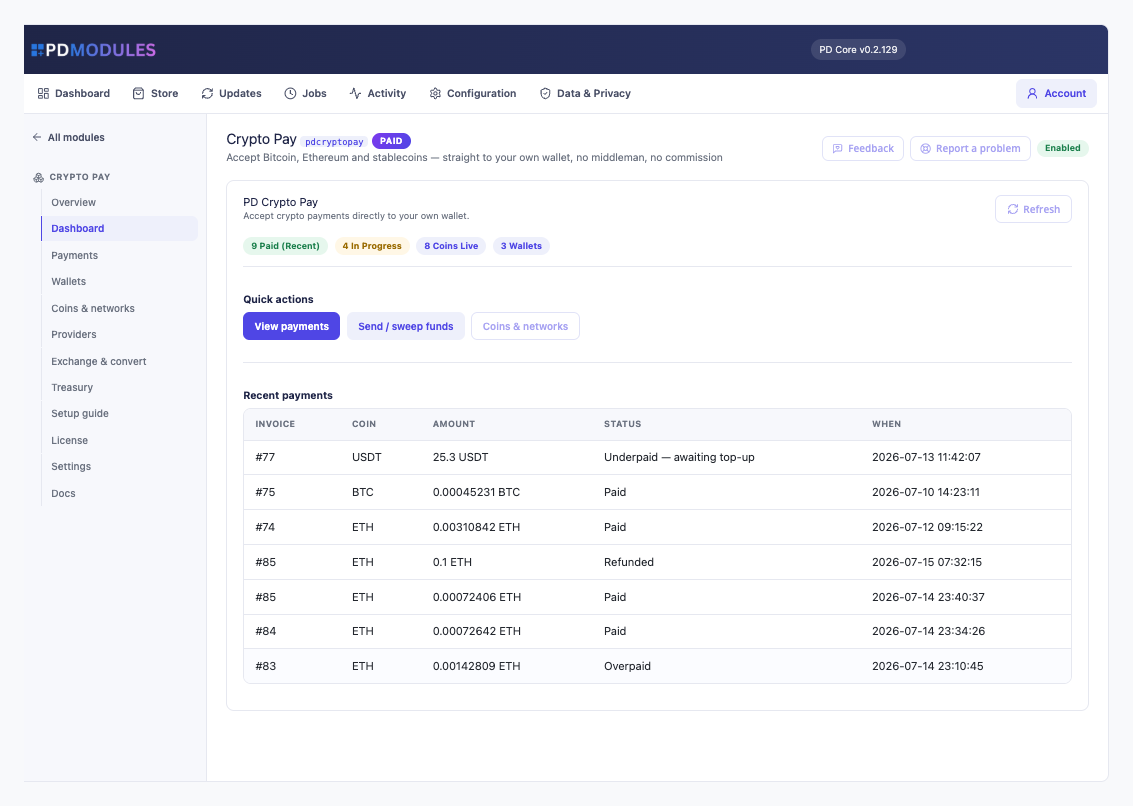
PD Crypto Pay for WHMCS
£18/mo or £180 annual (save £36)
- Requires
- WHMCS 8.13 or later
- Version
- 0.1.111
- Updated
- 4 Nov 2026
Accept Bitcoin, Ethereum and stablecoins — straight to your own wallet, no middleman, no commission
Made and supported by Projektif Digital Ltd. Runs inside PD Modules, the panel every module installs into.
£18/mo or £180 annual (save £36)
£18/mo or £180 annual (save £36)
Crypto customers are usually the ones a card processor has already turned away, and they pay without chargebacks. This makes accepting them a configuration task rather than a compliance project — and because nothing is custodial, the money is never anywhere except your own wallet.
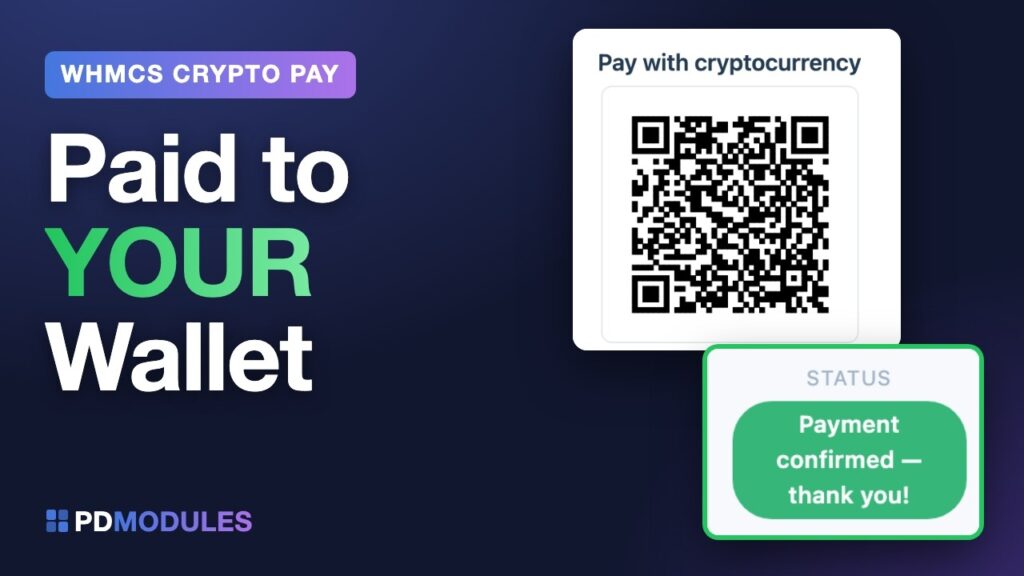
WHMCS Crypto Payment Gateway – Setup & No Custody, Straight to Your Wallet | PD Modules. Watch on YouTube. The player loads from YouTube when you press play.
PD Crypto Pay is available for WHMCS (8.13 or later) and Blesta (6.0 or later). Each has its own page with the screenshots, requirements and price for that system. A module is added to the PD Modules licence of the installation it runs on, so a WHMCS installation and a Blesta installation each hold their own licence.
No, and the module is built so that we cannot. Payments go directly from your customer's wallet to a wallet you control. Nothing routes through us, so there is nothing for us to freeze, delay or lose.
A flat subscription for the module. We take no percentage and no per-transaction fee, whatever your volume. The only other cost is the network fee the blockchain itself charges, paid by whoever sends the transaction.
Bitcoin, Ethereum, Tron and the major stablecoins are built in. You can add any ERC-20 or TRC-20 token yourself by pasting its contract address — you are not waiting on us to support a coin your customers want.
No. There is no processor account, no application and no approval step. You provide wallet addresses you already control and start taking payments.
Give each payment its own fresh address and every incoming transaction belongs to exactly one invoice. The module watches the chain, confirms the transaction and marks the invoice paid — including the awkward cases where someone pays too little or too much. With one address for everything, each invoice asks for a slightly different amount, and a payment is credited to the one invoice whose amount it matches. A payment that is none of the amounts asked for — part of an invoice, or more than it — is credited when only one open invoice could be its owner; when several could, it is credited to none of them, and is listed under Payments (and emailed to you) for you to place.
The payment is recorded against the invoice and the shortfall is shown, rather than the invoice being silently left unpaid. You decide whether to accept it, ask for the difference, or refund it. With one address for everything, that happens when the payment can only be that invoice's (see how payments are matched, above).
Nothing of yours is touched, and nothing is deleted. The module steps down in stages instead: a 14-day grace period where everything still works and you get a renewal reminder, then admin management locks while your customers carry on being served, and only after that does the checkout stop — behind a neutral "Crypto payment is temporarily unavailable" message that never mentions licensing to your customer. A payment a customer has already sent is still found and credited throughout, and your data and settings stay exactly where they are. Renewing restores everything immediately.
 Featured
Automatic discounts, product bundles and free trials for WHMCS or Blesta — rule-based, no promo code needed
Stop fake signups & order fraud before they provision
Find out which services you are losing money on — and which resources nobody is paying for
Versioned terms, contracts and SOWs your customers actually sign — with evidence you can produce years later