PD DigitalOcean Valkey — Sell Managed Valkey as a Native Blesta Package
Sell managed Valkey (Redis-compatible) caches on DigitalOcean under your own brand — provisioned, billed and managed in Blesta
Made and supported by Projektif Digital Ltd.
Runs inside PD Modules, the panel
every module installs into.
Databases
Every provisioned service in one place, with its real state from the provider.Customers manage their own access rules — no ticket, no waiting on you.Your customer sees exactly what happened and when — fewer "what is going on?" tickets.Connection details your customer can copy safely, without you emailing credentials.Generate the Blesta package and its options in one click, priced and ready to sell.1 / 5
PD DigitalOcean Valkey lets a hosting company sell managed Valkey, the Redis-compatible in-memory store, as its own caching package. Your customer orders on your Blesta order form, a dedicated Valkey cluster is built on your DigitalOcean account, and your customer manages it from the service page in your client area under your brand, with no DigitalOcean login. You set the price and keep the margin over what DigitalOcean bills you.
Valkey is what customers reach for when an application needs a cache, a session store, rate limiting or a job queue. It is for hosts whose customers already run web applications on your servers and want a fast key-value store next to them, without installing and patching one.
Why hosts choose PD DigitalOcean Valkey
A cache product that is easy to explain. Valkey is Redis-compatible, so customers connect with the redis-cli tool and the Redis client libraries they already use. The connect command on their page is ready to copy.
Customers set the memory policy themselves. DigitalOcean's default keeps everything and refuses new writes when memory is full. For a cache, removing the least recently used keys is usually right. Valkey customers choose the policy from their own client area, so a full cache is a setting they change, not a ticket they raise.
Failover you can price. High availability provisions a primary and one standby and is a checkout option you price yourself. The customer's page says how many standby nodes they have.
Resize without rebuilding. A customer who outgrows their cache changes plan through Blesta's own plan-change flow. The running cluster is resized in place, and its host, port and data are kept.
Access control without tickets. Customers add the addresses of their application servers to the trusted sources themselves. Until they add one, the database accepts connections from any address, and the page says so in plain words.
Nothing left billing. Cancelling deletes the cluster at DigitalOcean and confirms it is gone.
How it works
Connect your DigitalOcean account. Add your DigitalOcean API token once under Settings → Company → Modules, using a token with Full Access, then press Test Connection.
Create your package. Create a package with the module and pick Valkey as the Engine, then set a default region, plan and name prefix. Blesta's cron activates the service after payment.
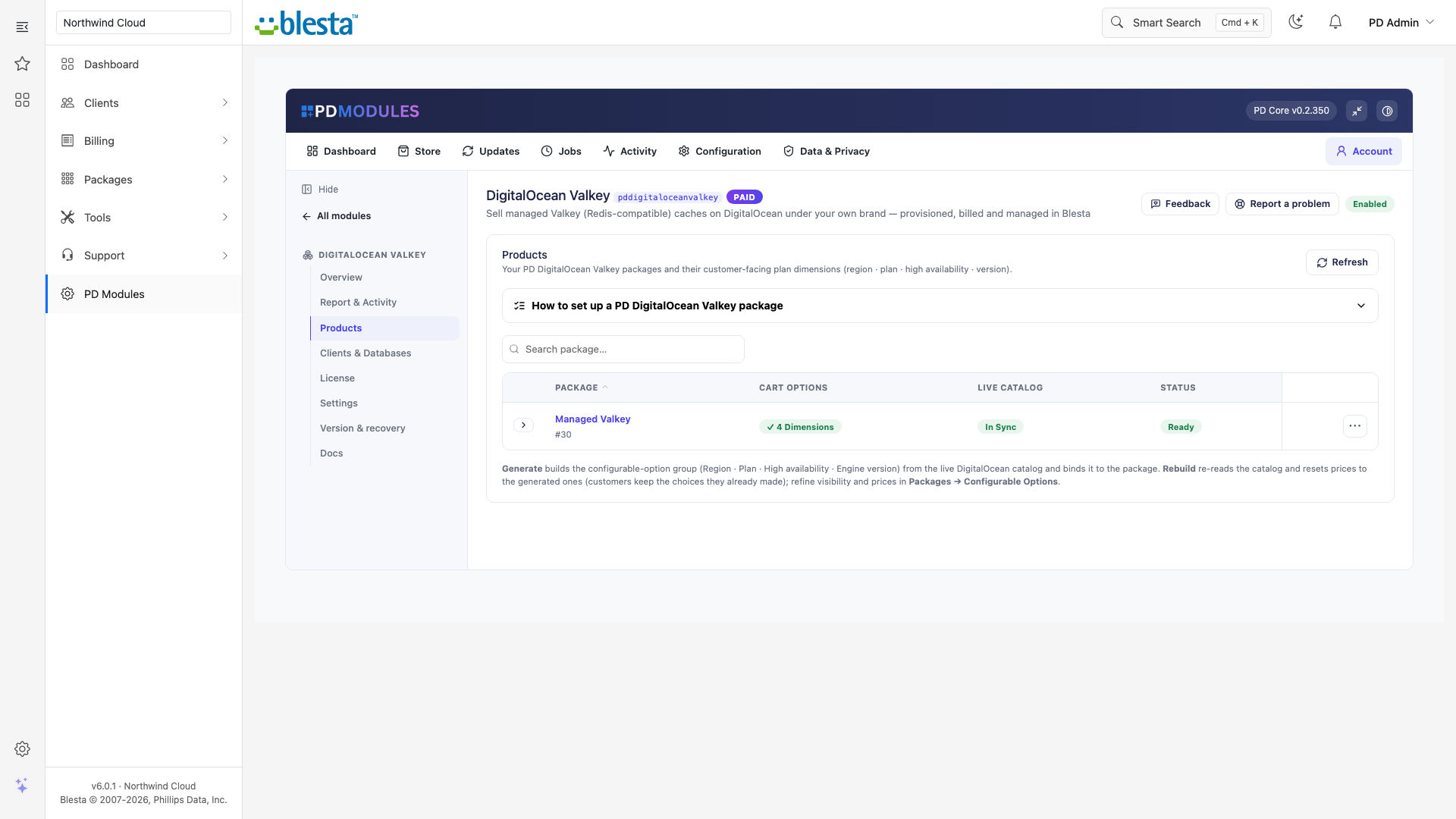
Generate the checkout options. Open the module's Products page and press Generate options. It builds the package's Region, Plan, High availability and Engine version options from DigitalOcean's live catalogue, all priced at zero for you to set.
Your customer orders. They choose their options and pay. The cluster is built on your DigitalOcean account in the background, and the connection details appear on their own once it is online, usually within a few minutes.
You get paid, they manage it. Blesta keeps billing as usual, and the customer copies the connect command and sets their own trusted sources.
What you get in Blesta
Selling and pricing
Checkout options for Valkey generated from DigitalOcean's live catalogue: Region, Plan, High availability and Engine version
Plans quoted as vCPU and RAM, so customers choose the memory their cache needs
Versions read live from DigitalOcean; a blank version means DigitalOcean's default
High availability as a priced checkout option
Generated choices start at zero in every currency and you price each one under Packages → Configurable Options; a sync never changes a price you have set
Choose which choices customers see at checkout; anything hidden uses your package's default and keeps its price
Clusters are named with your own prefix and the service number
The Products page: a Blesta package set to Valkey, with its four generated checkout options
Provisioning you can trust
A paid order creates a dedicated Valkey cluster on your own DigitalOcean account, with no step by you
High availability provisions a primary and one standby
An order DigitalOcean would refuse is stopped with a clear message before anything is created; Atlanta, Richmond and Kansas City carry only Premium plans
Every cluster is recorded before DigitalOcean is asked to create it, and pressing Create again never builds a second one
A provisioning failure appears in the service's activity with its reason, never left at "Provisioning"
A plan change through Blesta's own plan-change flow resizes the running cluster in place; host, port and data are kept
Suspend replaces the trusted sources with a rule nothing matches: the cluster keeps running (DigitalOcean still bills it), the data is untouched, and the customer cannot lift the lockdown. Unsuspend restores exactly the sources saved
Terminating deletes the cluster at DigitalOcean with its users, databases and backups, and confirms it is gone. There is no retention period, so tell customers to take their own backup first
Valkey, specifically
A Memory policy panel on the customer's page lets them choose what happens when the cache is full, with the default described in plain words: new writes fail when memory is full
The connect command is redis-cli with TLS switched on and the password prompted for
Every cluster enforces TLS in transit
There is no Backups page for Valkey: the module lists backups only for engines where DigitalOcean provides a list
Running it day to day
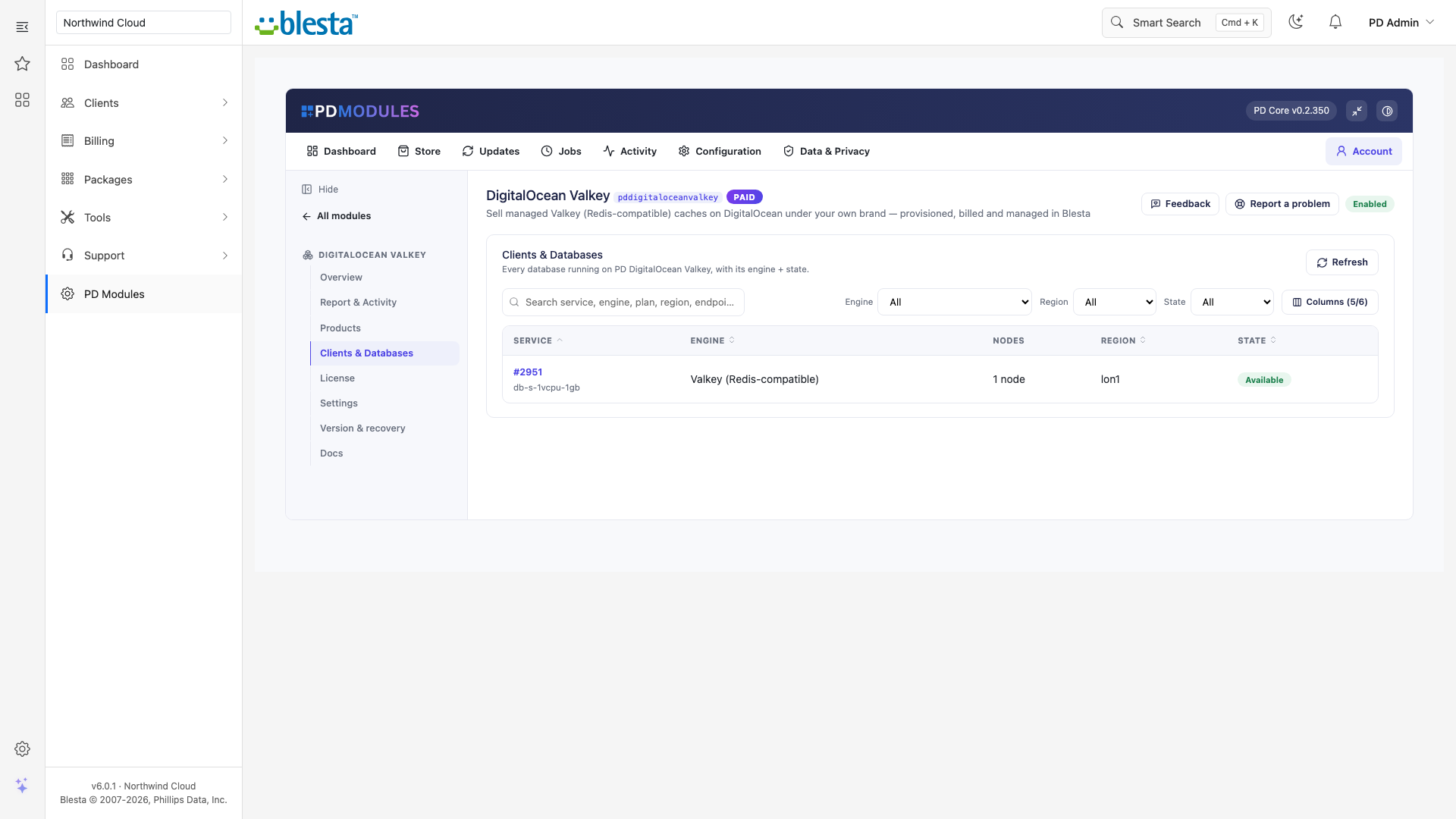
A Clients & Databases panel lists every cluster against the service paying for it, with engine, plan, region, endpoint and state
An Activity panel records every provisioning and lifecycle action with its outcome
A report shows your licence, whether a DigitalOcean account is connected and how many databases you run
A cluster deleted outside your billing system is flagged to you
Clients & Databases: each Valkey service with its nodes, region and live state
What your customers get
On Blesta the customer's pages are tabs on the service: Information, Trusted Sources, Backups (where the engine lists them) and Activity.
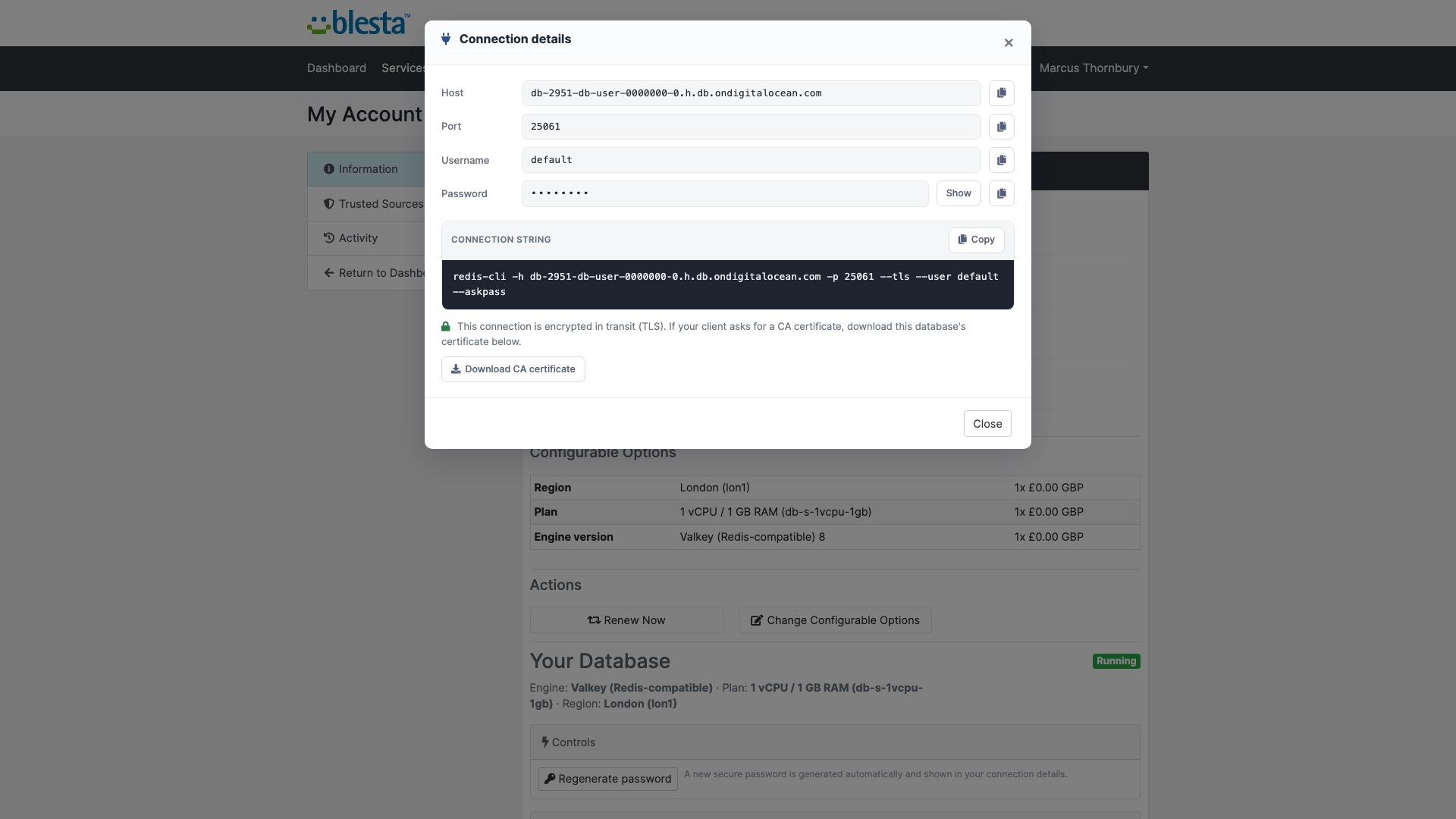
Connection details in one window: host, port, username and password (masked until Show, with Copy beside each), plus a ready-to-use redis-cli command with TLS switched on
The CA certificate as a download, for clients that ask for one; the connect command already uses TLS
Regenerate password in one click behind an in-page confirmation; the new password appears in the connection details
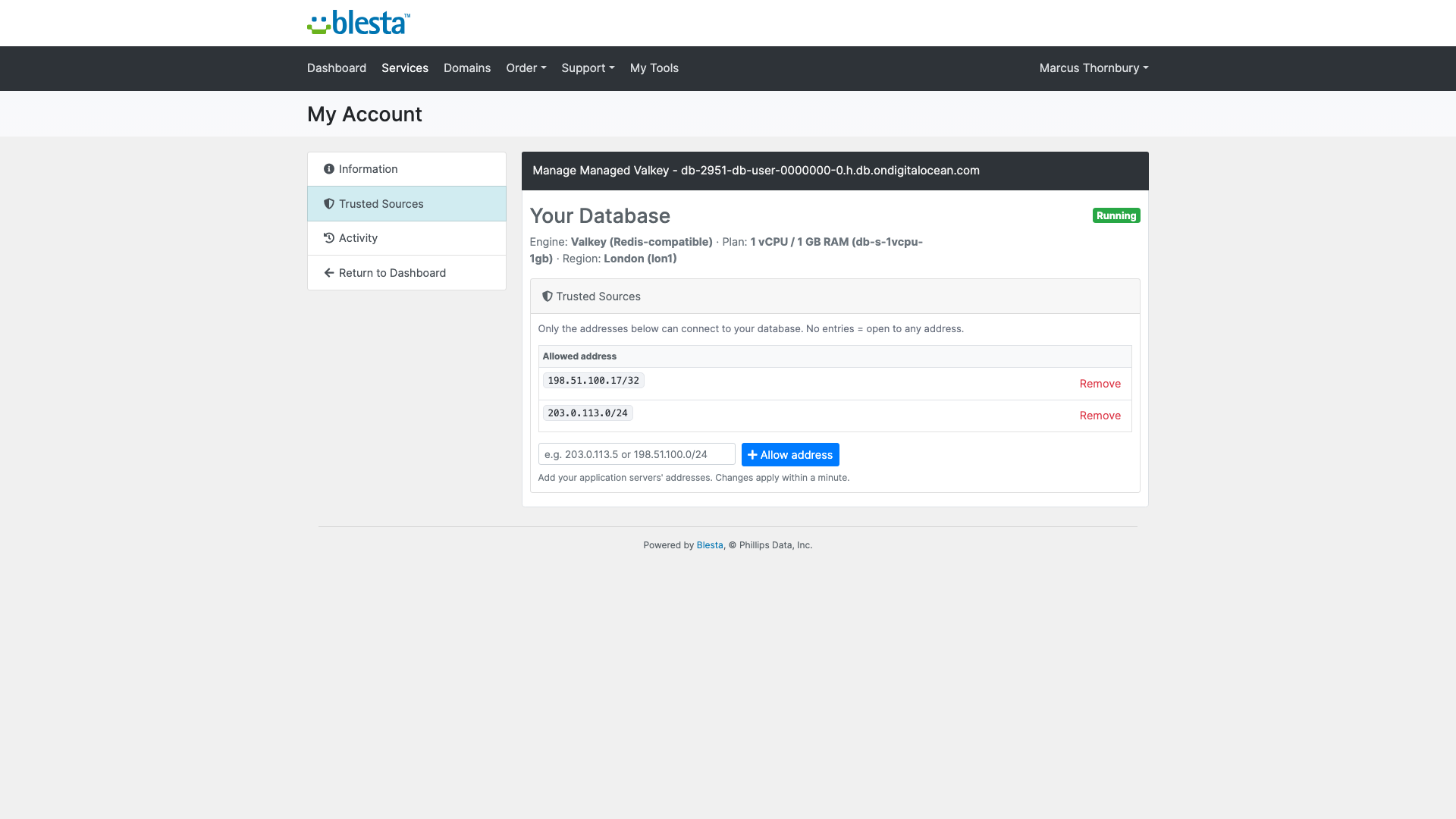
Trusted sources: add and remove the IPv4 addresses and ranges allowed to connect, with bad entries refused and changes applied within a minute
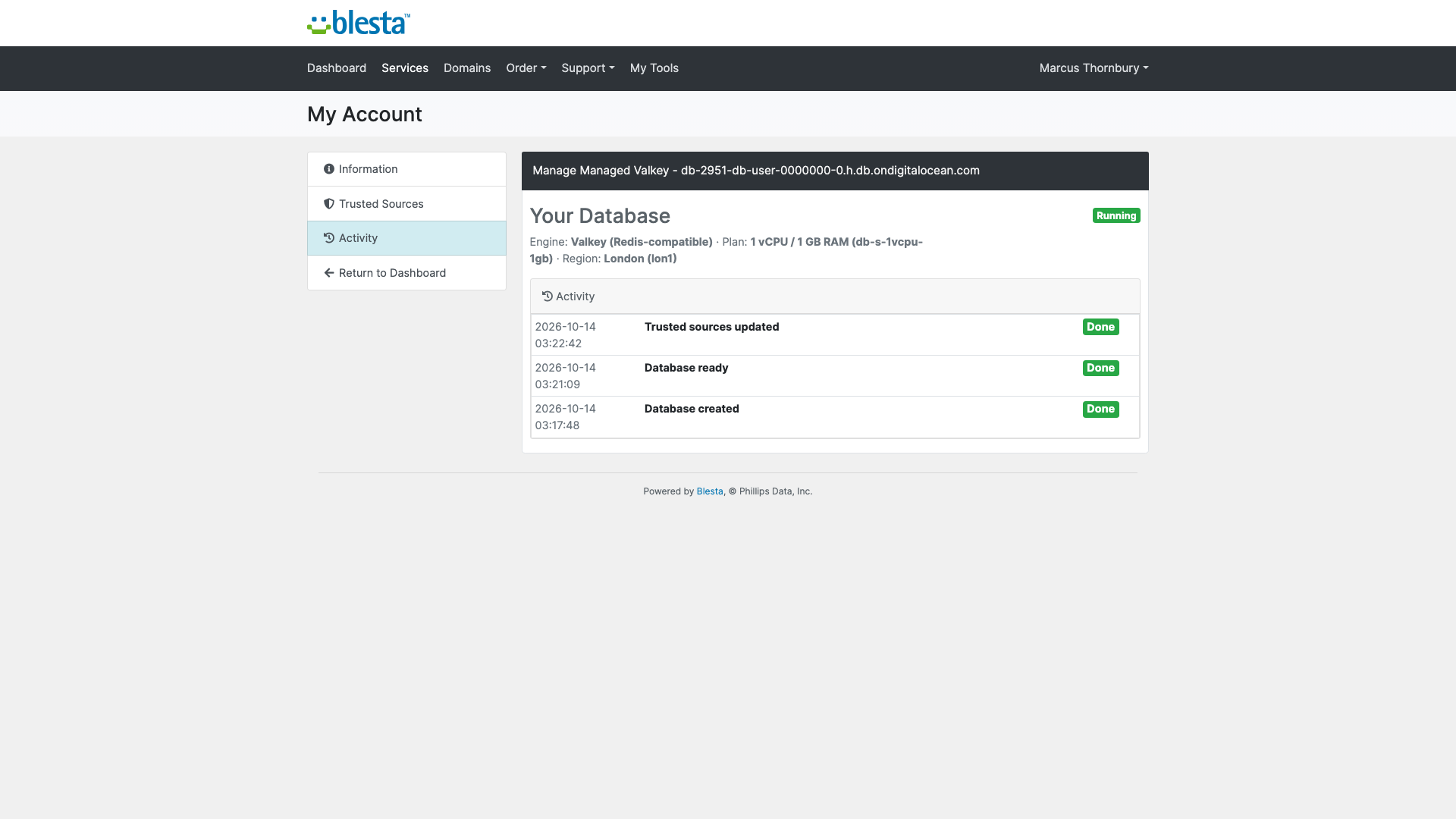
Recent activity: their latest actions, up to 40, each marked done or not
Cluster layout in plain words: how many standby nodes a highly available database has
Connection details for a Valkey service: masked password, a ready redis-cli command and the CA certificate downloadTrusted sources: customers add their application servers' addresses themselvesActivity: the cluster being created, becoming ready and having its trusted sources updated
The firewall, connection details and backups pages are each a switch on the package: turn one off and it is hidden and refused. The pages render in Blesta's client theme, and every line of customer text is translatable, with overrides that survive updates.
Security built in
Your DigitalOcean API token is stored encrypted, only ever sent to DigitalOcean, and never shown on a customer page or in a customer message.
Each database password is stored encrypted and shown only to the signed-in owner of that service.
Every customer action needs a signed-in owner of the service and a valid security token.
When something fails at DigitalOcean, the customer sees a neutral message and the reason goes to your activity log.
One product, every feature
PD DigitalOcean Valkey is one paid module with everything included: provisioning, memory policy, high availability, trusted sources and password reset. There are no add-on tiers to compare. It installs into PD Modules in one click, updates itself, and uninstalls cleanly: its own tables and settings are removed and no Blesta files are modified.
If your subscription ever lapses, your customers are not cut off. A running database is never stopped, deleted or altered. New provisioning and admin configuration lock first, customers see a neutral "temporarily unavailable" message with their connection details still visible, and cancellations still complete. Renewing restores everything with nothing lost.
Requirements
Blesta 6.0 or later on PHP 8.2 or later, with the ionCube Loader
A DigitalOcean account with billing enabled and an API token with Full Access
Blesta's cron running every minute, which finalises new clusters and confirms cancellations
PD Modules 0.2.322 or later, the free control panel every PD module installs into
Questions
What version of Valkey do customers get?
Valkey 8. If you expose the Engine version dimension at checkout, the customer chooses; otherwise they get your product default.
Can customers upgrade their plan later?
Yes — through Blesta's normal Upgrade/Downgrade flow. The cluster is resized in place and the data is preserved, with no migration.
How do customers secure who can connect?
From the Trusted Sources page in their client area. They add their application servers' IP addresses; once any are added, only those can connect. Every connection also enforces TLS.
What happens to the data when a service is cancelled?
Terminating deletes the cluster on DigitalOcean and cleans up every associated resource — zero orphans left billing on your account. Take a backup first if you need to retain data beyond cancellation.
Do I need my own DigitalOcean account?
Yes. You resell on your own DigitalOcean account, at your own margin. Your API token is stored encrypted on your Blesta server and is never shown to a customer.
Does a lapsed PD Modules licence break my customers' services?
No. A licence lapse withdraws the management layer in stages but never stops, deletes or alters a running customer resource. Your customers keep serving throughout.
How do I get help?
Open a ticket from your client area, or use Get help inside the PD Modules panel, which attaches a diagnostic report — you see a preview of exactly what it contains, and can exclude any part of it, before anything is sent. Support is included with an active subscription; bug reports are welcome whatever your licence state.
What’s new in 0.1.86
A database whose setup did not complete now tells your customer so on their service page, instead of saying it is still being set up. Pages for a database being resized or removed now say that too.
A plan that DigitalOcean does not offer in the chosen region is now stopped at checkout, before payment, with a message naming the plan and the region. Pairs DigitalOcean refuses are remembered for 90 days.
Cancelling an order that was never built no longer leaves a failed database in your list of databases.
Syncing generated options now names DigitalOcean in its confirmation.