PD BIND 9 DNS for WHMCS
£12/mo or £120 annual (save £24)
- Requires
- WHMCS 8.13 or later
- Version
- 0.1.101
- Updated
- 5 Nov 2026
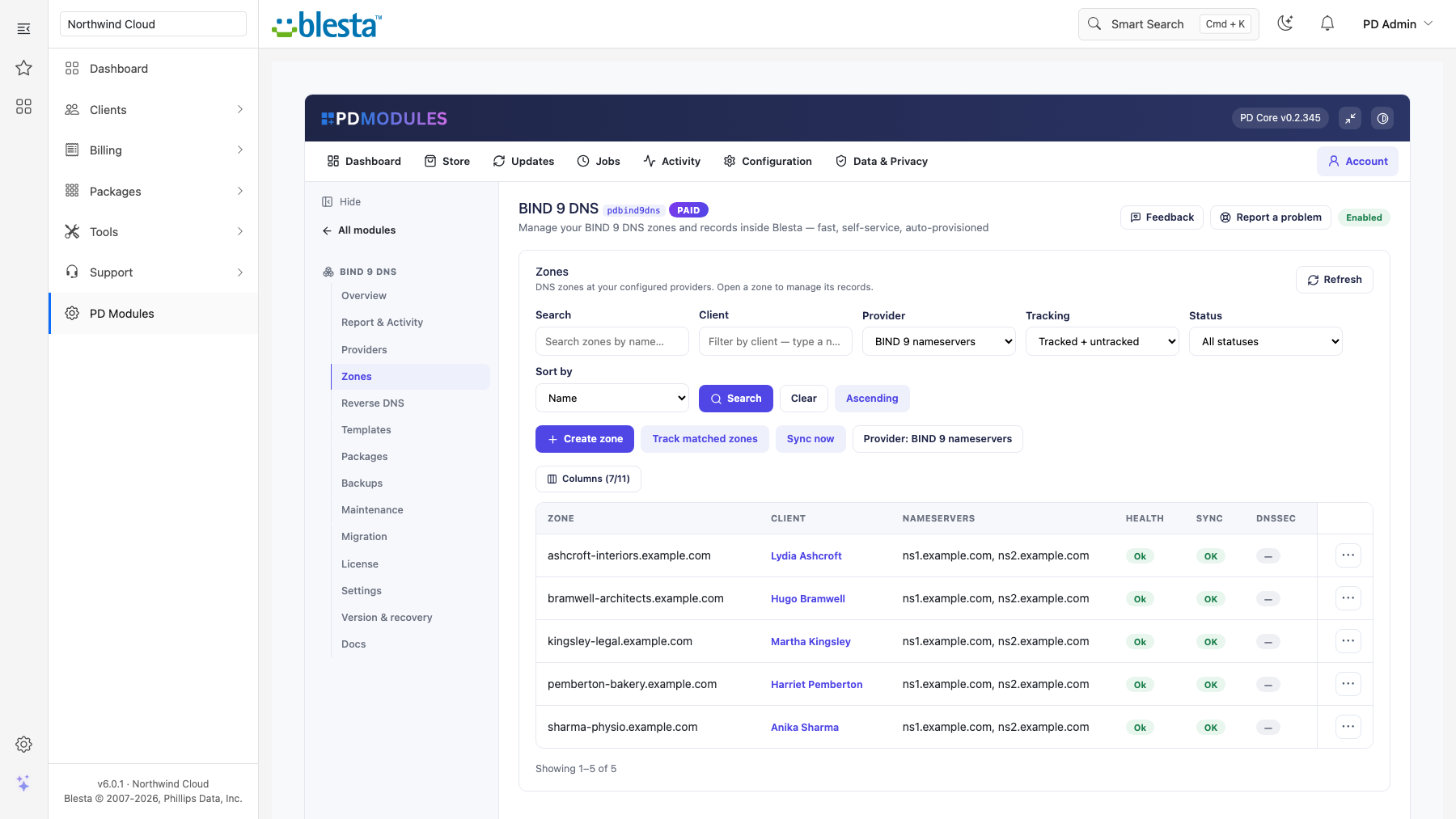
Manage your BIND 9 DNS zones and records inside WHMCS or Blesta — fast, self-service, auto-provisioned
Made and supported by Projektif Digital Ltd. Runs inside PD Modules, the panel every module installs into.
£12/mo or £120 annual (save £24)
£12/mo or £120 annual (save £24)
If you run your own ISC BIND 9 name server, PD BIND 9 DNS brings every hosted zone and record under your WHMCS or Blesta admin — and gives your customers a clean, self-service Manage DNS portal so they can add and update their own records without opening a support ticket.
Every zone file on your BIND server appears in a fast, searchable list the moment you connect over SSH. No import. No sync. No manual setup per zone. The list pages server-side, so performance stays consistent whether you have ten zones or ten thousand.
Open any zone and you get a full record editor with live filtering by type and name. Changes write directly to the BIND zone file — there is no local cache to get out of sync.
Every record change goes through a lock → read → mutate → SOA bump → named-checkzone → promote → rndc reload sequence. If named-checkzone rejects the change, the temporary file is discarded and the live zone file is never touched. You cannot accidentally break DNS with a typo — the module enforces it.
Choosing a record type in the editor shows exactly the right fields for that type — and only those fields. An MX record gets a priority and a mail server target; an SRV record gets all four SRV fields; a TLSA record gets the certificate fields. Built-in validators prevent a malformed record from being saved. Supports A, AAAA, CNAME, MX, TXT, NS, SRV, CAA, PTR, TLSA, SSHFP, NAPTR and more.
Bind any zone to a WHMCS or Blesta client and a Manage DNS link appears in their client portal — on their domain page, their service page, or in the navigation. Customers use the same type-aware editor (backed by the same atomic write sequence) to add, edit and delete their own records, without support involvement and without any access to your BIND server.
Scheduled BIND-format snapshots of every zone run automatically. Restore any zone to a previous state in one click — the restore goes through named-checkzone and writes directly to your BIND server. Download any snapshot as a BIND zone file.
A DNS zone is created on your BIND server automatically whenever a customer registers or transfers a domain, or orders a service. Each new zone gets a valid SOA and NS block using your configured authoritative nameservers, validated by named-checkzone and reloaded into BIND.
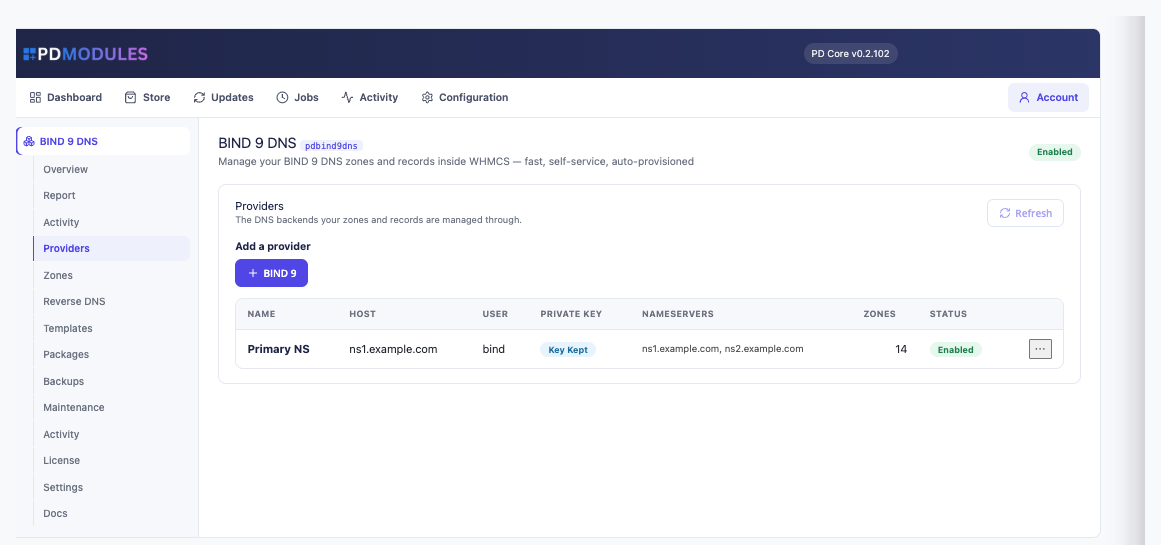
Authenticate with an SSH private key (or password). Your team works inside WHMCS or Blesta — no one needs shell access to the BIND server for day-to-day DNS work. The private key is stored encrypted in your WHMCS or Blesta database and never exposed through the module interface.
---
---
rndc, and run named-checkzonePD BIND 9 DNS is available for WHMCS (8.13 or later) and Blesta (6.0 or later). Each has its own page with the screenshots, requirements and price for that system. A module is added to the PD Modules licence of the installation it runs on, so a WHMCS installation and a Blesta installation each hold their own licence.
No. Your BIND 9 server remains the single source of truth. The module reads records live from your zone files over SSH and writes changes straight back to them. The only things kept in your WHMCS or Blesta database are metadata — zone ownership, backup snapshots and activity logs. There is no local copy of your records to drift out of sync.
A running ISC BIND 9 server that is reachable over SSH from your WHMCS or Blesta server. It connects with an SSH user that can read and write your zone files and run rndc and named-checkzone. Because a non-login SSH shell often has a minimal PATH, you provide the full paths to rndc and named-checkzone so the module can always find them.
You connect once over SSH — no new API keys and no third-party accounts. An SSH private key is preferred (a password also works). The key is stored encrypted in your WHMCS or Blesta database, shown masked in the interface and never exposed through the module. Your team does day-to-day DNS work inside WHMCS or Blesta without anyone needing shell access to the BIND server.
Every change is an atomic write: lock the zone, read the current file, bump the SOA serial, validate the result with named-checkzone, promote it, then run rndc reload. If named-checkzone rejects the change, it is discarded and your live zone file is never touched. A typo cannot take a zone down.
When the module creates a new zone, it needs valid SOA and NS records to write. Your configured authoritative nameservers become the zone's SOA MNAME and its NS records, so every new zone is served correctly by your own name servers from the moment it is created. It is a required part of setup for this reason.
No. PD BIND 9 DNS does not sign zones or manage DNSSEC keys. If you need signed zones, keep signing them with your own BIND tooling (for example dnssec-policy on your server) — the module manages your record data and leaves DNSSEC key management to BIND.
Yes. The module can add a secondary zone block to your configuration and run rndc reconfig so your BIND server starts serving the slave zone. This is handy when you run BIND as a secondary for zones that are primary elsewhere.
Your DNS records are never touched. Zones stay exactly as they are on your BIND server and keep resolving without interruption. A lapsed subscription only withdraws admin management and customer self-service inside WHMCS or Blesta — everything resumes as soon as the subscription is renewed.
Only what you already pay your provider. PD BIND 9 DNS adds no per-unit fee and takes no cut — it connects to your own account with your own credentials, so the provider bills you directly at your rates, and you set what you charge your customers. From us it is the module subscription and nothing else.
 Featured
Manage DNS zones and records for any provider — Cloudflare, Route 53, cPanel, PowerDNS and more, in WHMCS or Blesta

Rich client, service & domain notes with reminders
Know about a domain problem before your customer does
Forward a domain or its email — without hosting it. Set up URL and email forwarding inside WHMCS or Blesta.