PD Google Cloud MySQL — Sell Managed MySQL on Google Cloud as a Native Blesta Package
Sell managed MySQL databases on Google Cloud under your own brand — provisioned, billed and managed in Blesta
Made and supported by Projektif Digital Ltd.
Runs inside PD Modules, the panel
every module installs into.
Databases
Build the package once — plan, region and limits — and it is ready to sell.The service as you see it: its state at the provider and every control, in one place.Connect your own provider accounts — your keys, your billing, no middleman.What your customer sees: their service, its state, and the controls they can use themselves.Connection details your customer can copy safely, without you emailing credentials.The customer-facing side of Google Cloud MySQL, on their own service page.Databases created, listed and removed by the customer, without provider access.Your customer sees exactly what happened and when — fewer "what is going on?" tickets.1 / 8
PD Google Cloud MySQL lets a hosting company sell managed MySQL databases as its own product. Your customer orders on your Blesta order form, a dedicated Cloud SQL for MySQL instance is created in your Google Cloud project, and your customer runs it from your client area: connection details, an allow-list of trusted addresses, their own databases and users. Google bills you at cost, you set the price, and the difference is your margin.
It is built for hosts whose customers run WordPress, WooCommerce, Magento, Laravel and other MySQL applications and want a database that is not on the same server as their website. You get the product without building a control panel, and your customers never need a Google Cloud account.
Why hosts choose PD Google Cloud MySQL
A real database per order, not a shared one. Every order gets its own Cloud SQL instance and its own credentials. Nothing is shared between customers, and the instance is created in the region the customer picked at checkout, from more than 40 Google Cloud regions.
Sell the MySQL versions customers ask for. MySQL 8.4 is the default and MySQL 8.0 is available. Offer the version as a choice at checkout, or fix it per package. A blank setting uses 8.4, and the setting says so.
Orders set themselves up. A paid order creates the instance with no step from you. It is built in the background, and the connection details appear on the service page on their own once Google reports it running. A failed create shows Google's reason in the service's activity and is never left spinning as "creating".
Customers help themselves. Trusted sources, databases, users and password changes are all on the customer's own service page. That is most of the tickets a managed database normally generates.
Nothing left billing. Terminating a service deletes the instance and the module confirms it is gone. Termination completes even if your licence has lapsed, so a cancelled customer never stays on your Google bill.
Your Google account stays yours. The service-account key lives on your Blesta server, stored encrypted, and never appears on a customer page or message. Customers see your brand and your prices.
How it works
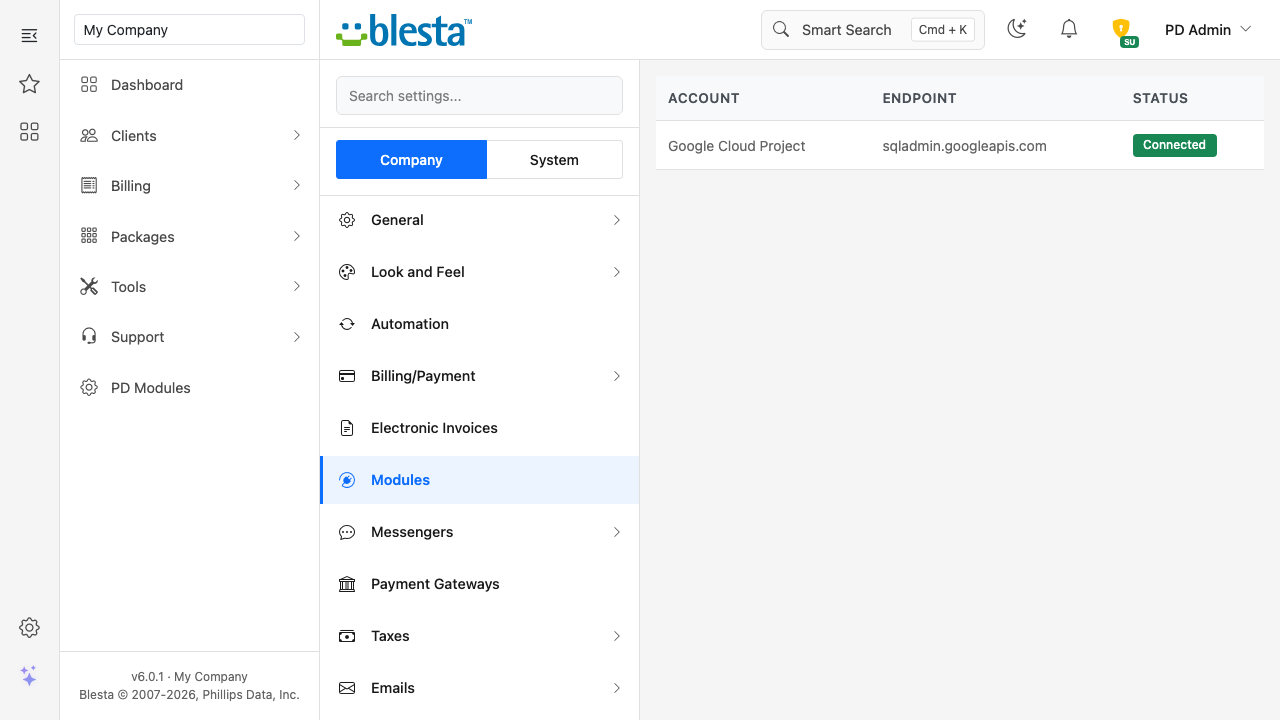
Connect your Google Cloud project. Create a service account with the Cloud SQL Admin role, add a Google Cloud account under Settings, Company, Modules with its JSON key pasted in, and press Test Connection. It makes one read-only call and changes nothing. If your Google organisation blocks key creation, Test Connection names the policy and gives the Console path and the gcloud command that lift it.
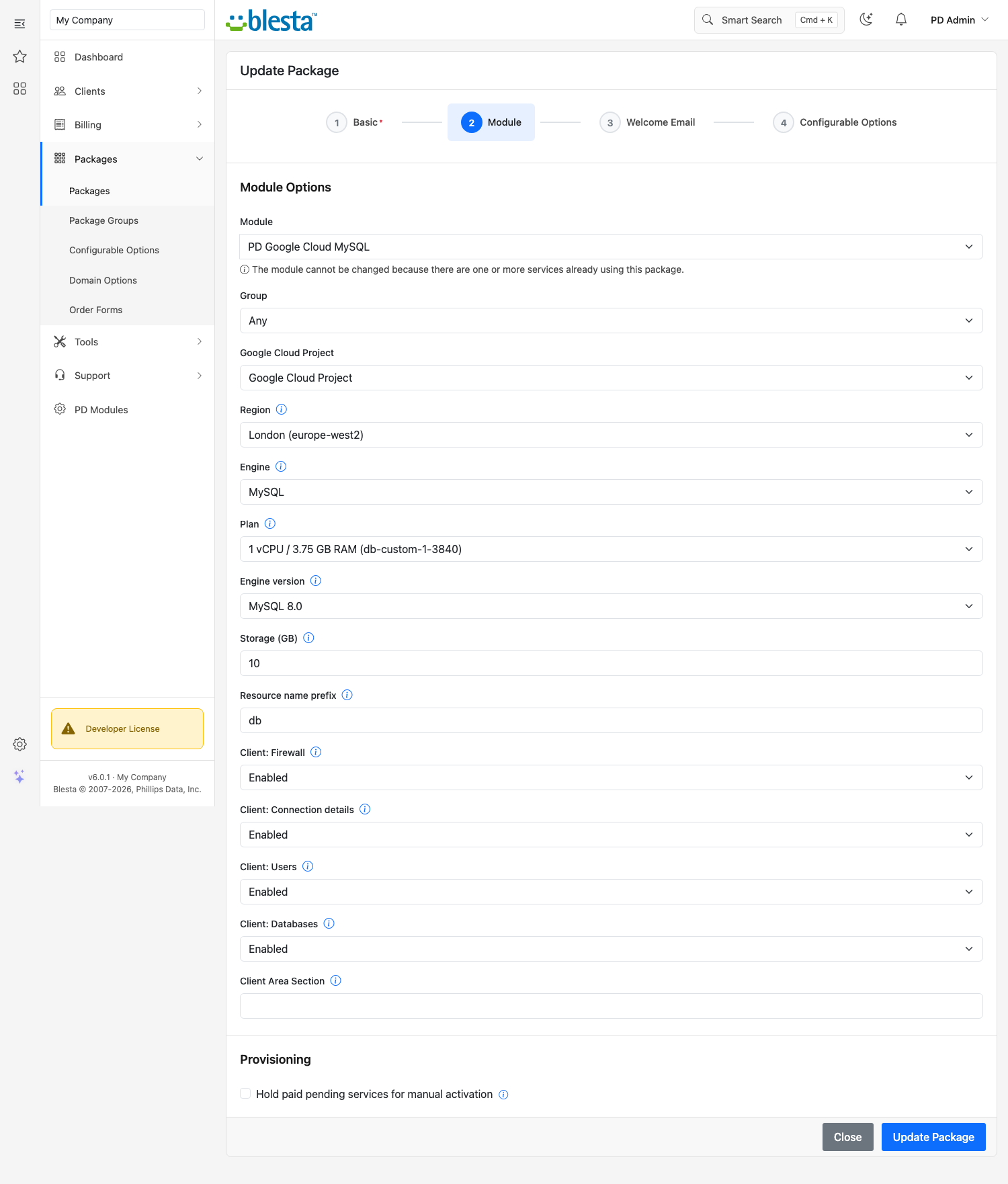
Create your package. Pick default region, plan, MySQL version and storage, then generate the package options in one click: Region, Plan, Engine version and Storage. Generated choices start at zero, so you set each price.
Your customer orders. They choose their options at checkout and pay. Blesta provisions the service once its invoice is paid, and the setup guide shows where to keep that task switched on. The instance is created and named with your prefix, and the customer sees a "being set up" message, never an error, until it is ready.
You get paid, they manage it. Blesta keeps billing as usual. Plan and storage upgrades go through Blesta's own upgrade flow.
Your Google Cloud account connected once under Settings, Company, Modules, with its status
What you get in Blesta
Selling and pricing
Package options generated for you: Region, Plan, Engine version and Storage, linked to the package on Blesta
Show or hide each option per package; anything hidden is fixed to your package setting
Prices you set survive a sync; Rebuild from Google Cloud re-reads the catalogue and warns that prices return to their starting value
Plans from the shared-core db-f1-micro and db-g1-small to db-custom vCPU and RAM sizes, chosen from a catalogue curated against Google's published lists
Storage from 10 GB, sold as an option if you wish
A name prefix for instances, so they read as yours; a blank prefix means "db"
The package settings: region, MySQL version, plan, storage, name prefix and the four customer-area switches
Provisioning you can trust
Running Create again never builds a second instance: the one already recorded is reused
Plan upgrades and downgrades resize the instance in place and keep the data; storage grows in place, and a smaller size is refused
A plan and storage change made together applies both
Changes to one instance run one at a time; a change asked for while another applies is told to try again in a minute
Suspend stops the instance and keeps the data, and a suspension that arrives while Google is busy is queued, not dropped. Google still bills storage while an instance is stopped; terminate to stop all billing
An instance deleted outside Blesta is detected and flagged to you, and your billing is never changed by it
Running it day to day
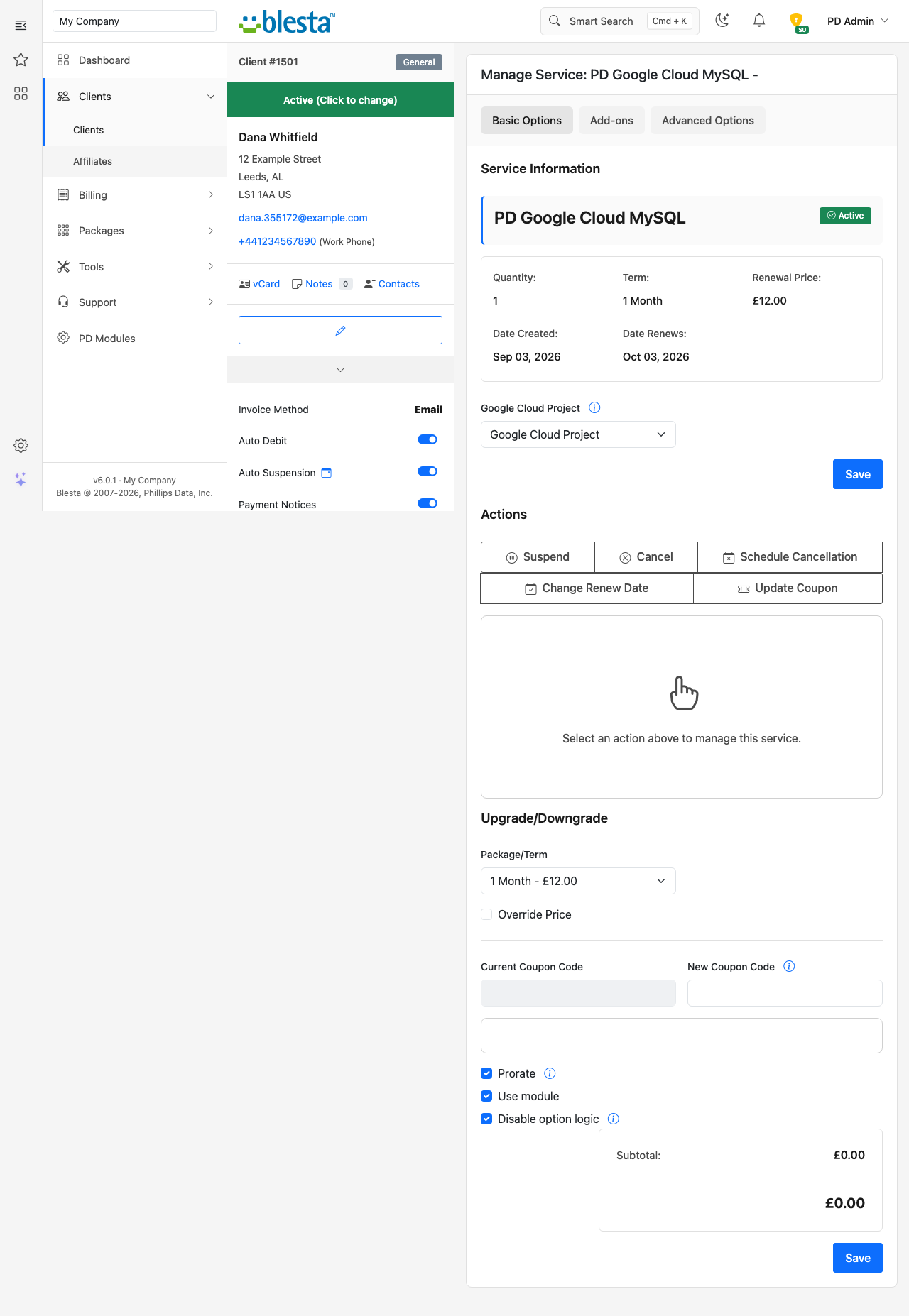
Clients and Databases: every provisioned instance against its service, with its state
An activity log of provisioning, upgrades and password resets, each with its outcome
Read-only assistant tools that report a service's instance, engine, version, size, region and state, list your databases newest first and show recent provisioning. They cannot create, resize, delete or restore anything
What your customers get
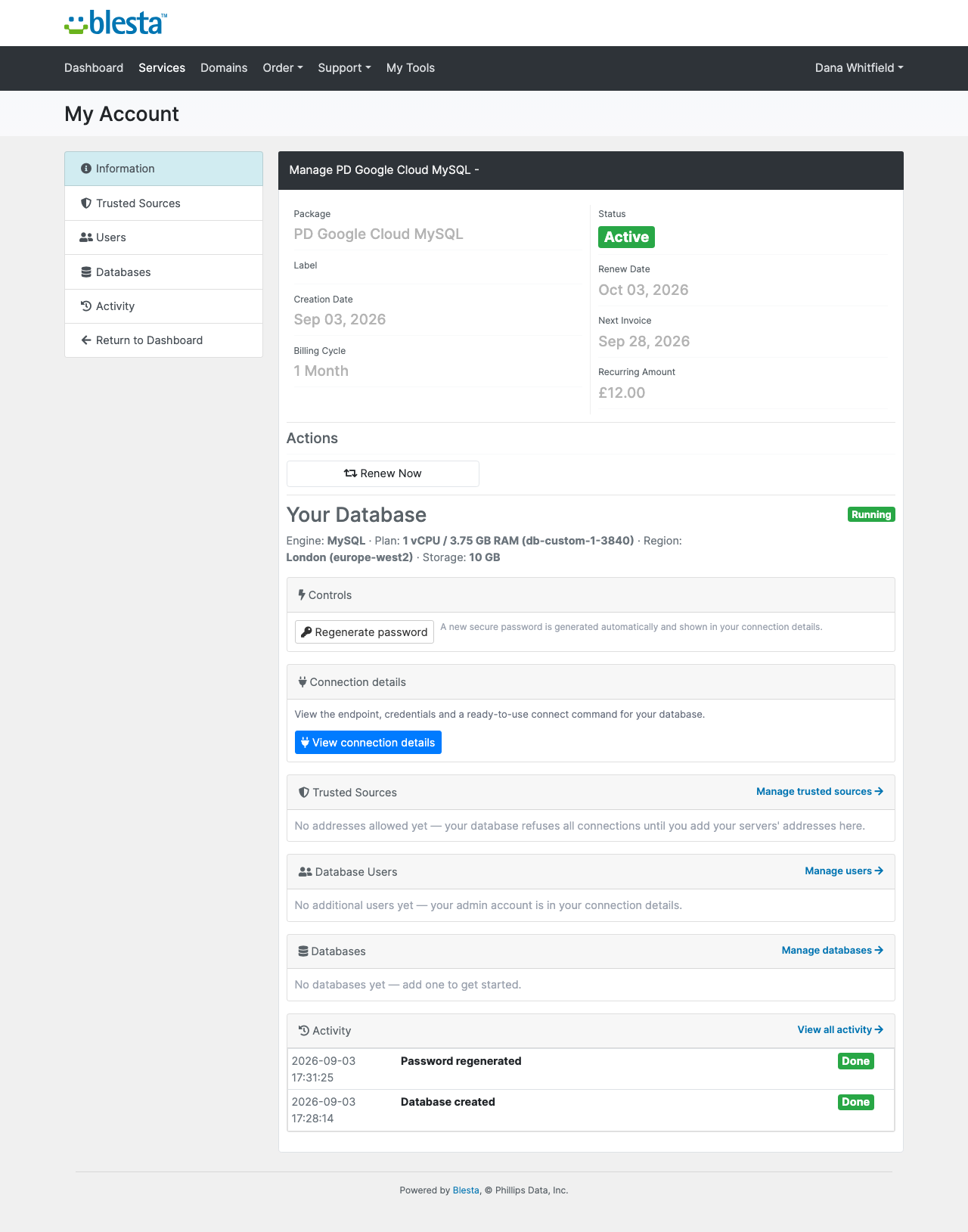
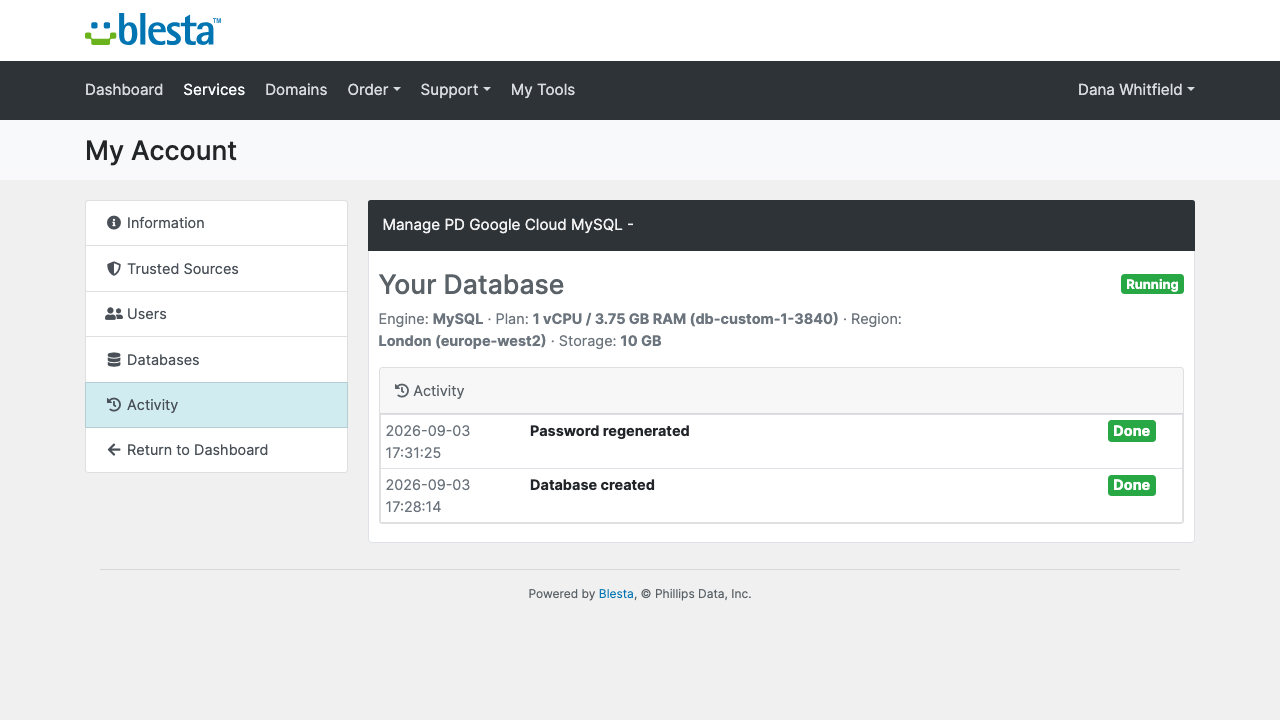
On the service page in Blesta's client area, a menu gives them Information, Trusted Sources, Users, Databases and Activity.
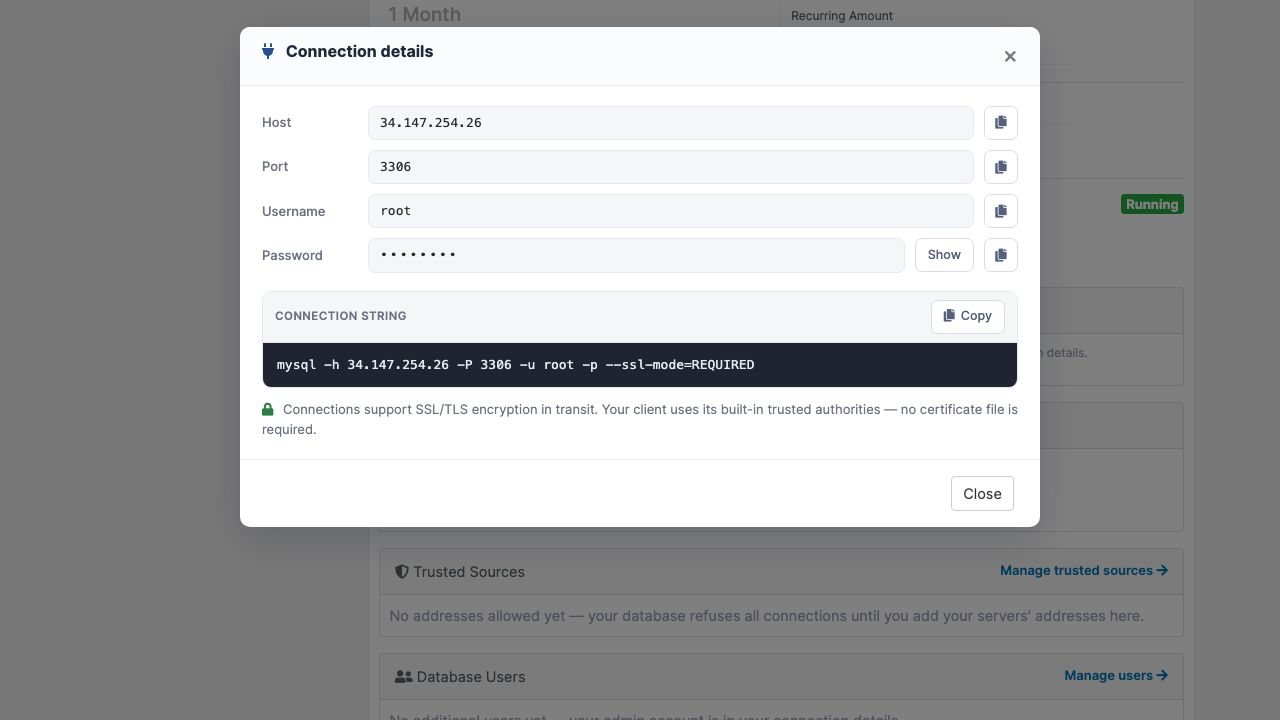
Connection details ready to copy: host, port 3306, the root login, a password they can show or copy, and a mysql command. Connections can use SSL/TLS
Trusted sources: a new instance accepts no connections until the customer adds an address. They manage the list themselves, an invalid entry is refused with a message, and changes apply within a minute
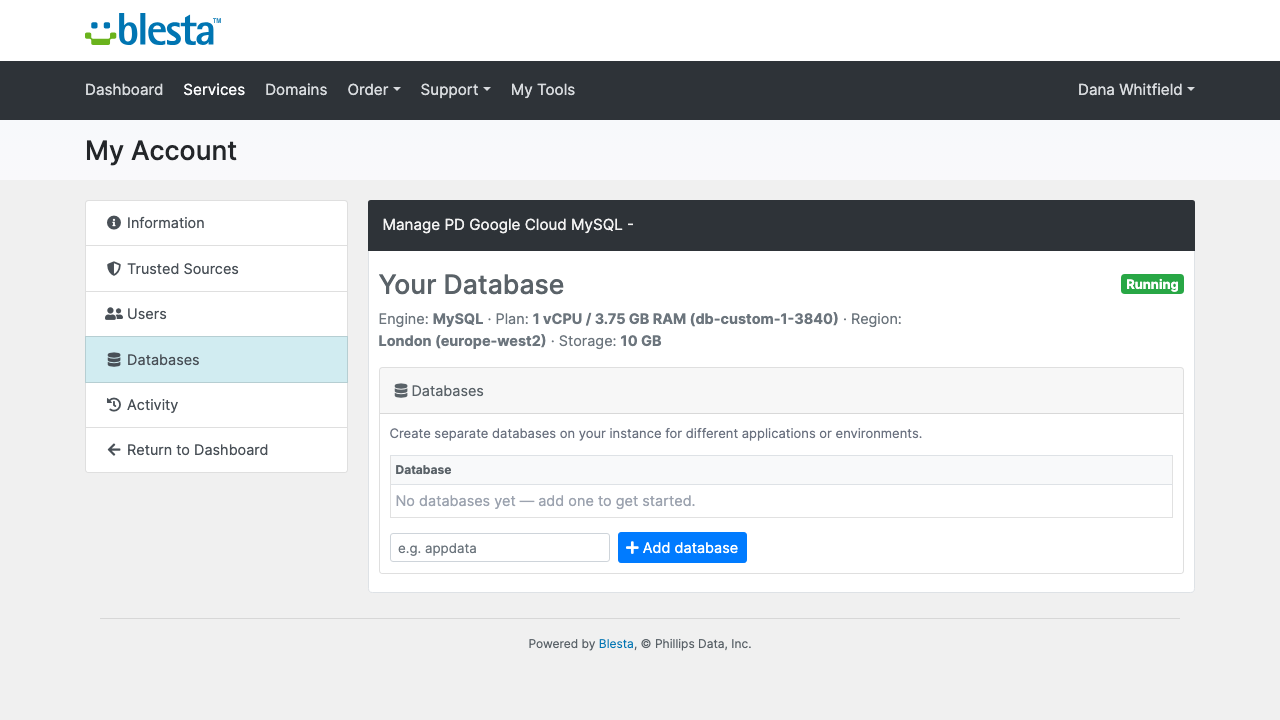
Their own databases created and dropped from the client area, with system databases protected
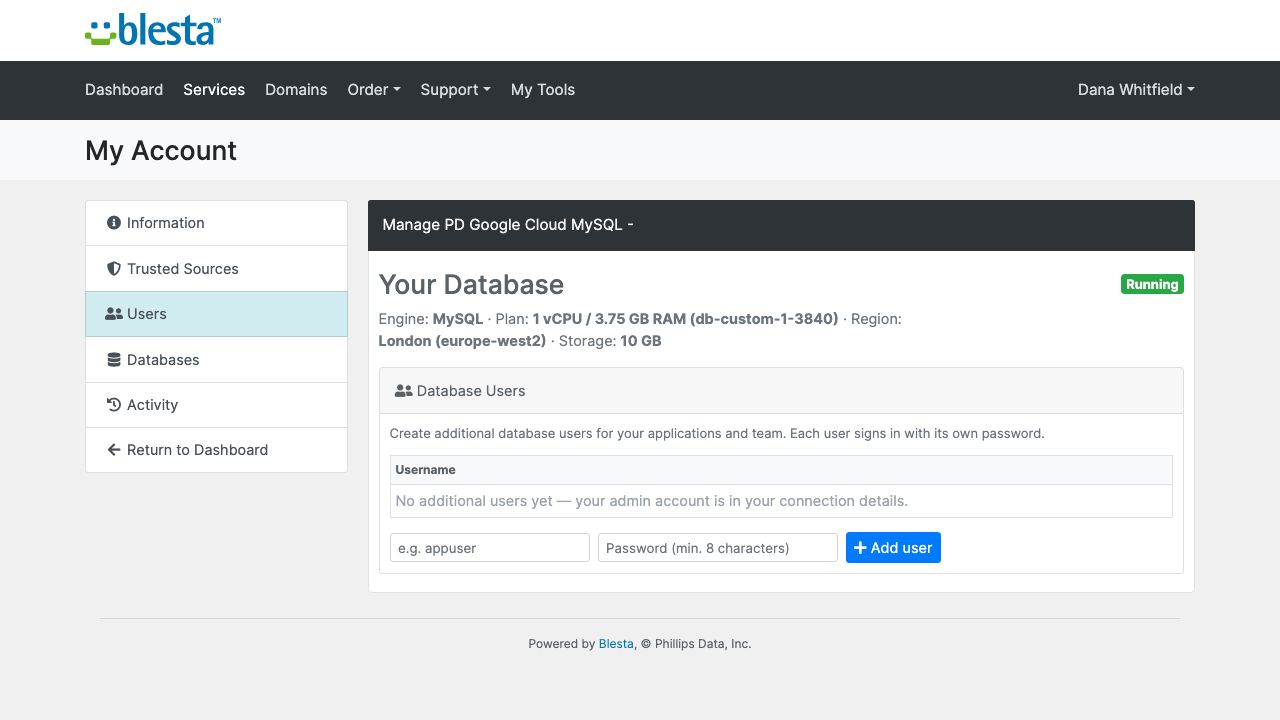
Their own MySQL users with a password they choose, with the admin login and system accounts protected
A new root password in one click, shown in the connection details
Recent activity in plain words, each action with its outcome
Confirmation first: destructive actions ask in an in-page dialog
The customer's service page: running status, plan and region, password regeneration, connection details and recent activityActivity: a timestamped history of what happened to the database
Every customer section is a switch on the package: Firewall, Connection details, Users and Databases. Turn one off and it is hidden and refused by the server. The pages render natively on the Blesta client theme and are fully translatable, with wording overrides that survive updates. An optional section of your own HTML can sit on the overview page.
Every instance is created with automated daily backups and point-in-time recovery switched on. Restores are done by you in the Google Cloud console; customers ask you.
Security built in
Your Google key is stored encrypted on the module account and is never shown to a customer.
Each database password is stored encrypted and shown only to the signed-in owner of the service.
Customer actions need a signed-in owner and a valid security token.
When something fails on your side, such as a missing role or an organisation policy, the customer gets a neutral message and the detail goes to your activity log.
Customers' data, credentials and connection details are never sent to us. The module only calls Google's Cloud SQL Admin API and the licence check.
One product, every feature
PD Google Cloud MySQL is one paid module with everything included: provisioning, trusted sources, databases, users, upgrades and teardown. There are no add-on tiers to compare and no per-instance fees to us. You pay Google at cost and keep the margin. It adds its own tables and templates, does not modify Blesta files, and uninstalls without leaving orphans.
If your subscription ever lapses, your customers' databases keep running: it never stops, deletes or alters an instance. New provisioning and your management screens are withdrawn while read-only visibility stays, and everything returns when you are in good standing again.
Requirements
Blesta 6 or later on PHP 8.2 or later, with the ionCube Loader
A Google Cloud project with billing and the Cloud SQL Admin API enabled, and a service-account key with the Cloud SQL Admin role
PD Modules, the free control panel every PD module installs into
Questions
Do I need my own Google Cloud account?
Yes. You connect a Google Cloud service-account key once, and every client's database is provisioned into your Google Cloud subscription — Google bills you, you bill your client through Blesta, and the difference is your margin.
Which MySQL versions can I sell?
MySQL 8.4 (the default) and 8.0 — the currently supported majors. You can expose the version as a choice at checkout or fix it per package.
Can clients connect to their database from outside the cloud?
Yes. Each server gets a public endpoint on port 3306 with SSL/TLS, protected by a trusted-sources allow-list the client manages themselves — nothing can connect until they add an address.
Can clients manage their own databases and users?
Yes — from their client area they create and drop databases and users, set passwords and regenerate the `root` admin password, all with a ready-to-paste `mysql` command and no Google Cloud console.
What happens to a client's database if their invoice lapses?
Their database keeps running — a lapse never deletes or breaks it. Management is withdrawn in stages and everything is restored once the account is brought back into good standing. Data is only ever removed on an explicit termination.
Can clients upgrade their machine size or storage later?
Yes, through Blesta's normal Upgrade/Downgrade flow. The server is resized in place with the data preserved, and storage also auto-grows on its own before the disk fills.
Which Blesta and PHP versions does it need?
Blesta 6.0 or later, on PHP 8.1 or later. It installs alongside whatever else you run — it adds its own tables and templates rather than modifying Blesta files, so it does not collide with other vendors' modules or with a customised template. Uninstalling removes its own tables and settings and leaves no orphans behind.