PD AWS PostgreSQL — Resell Fully-Managed PostgreSQL Databases on AWS in Blesta
Resell fully-managed PostgreSQL databases on AWS — provisioned, billed and managed in Blesta
Made and supported by Projektif Digital Ltd.
Runs inside PD Modules, the panel
every module installs into.
Databases
Build the package once — plan, region and limits — and it is ready to sell.The service as you see it: its state at the provider and every control, in one place.Connect your own provider accounts — your keys, your billing, no middleman.What your customer sees: their service, its state, and the controls they can use themselves.Connection details your customer can copy safely, without you emailing credentials.Customers manage their own access rules — no ticket, no waiting on you.Snapshots your customer takes and restores themselves.The customer-facing side of AWS PostgreSQL, on their own service page.Your customer sees exactly what happened and when — fewer "what is going on?" tickets.1 / 9
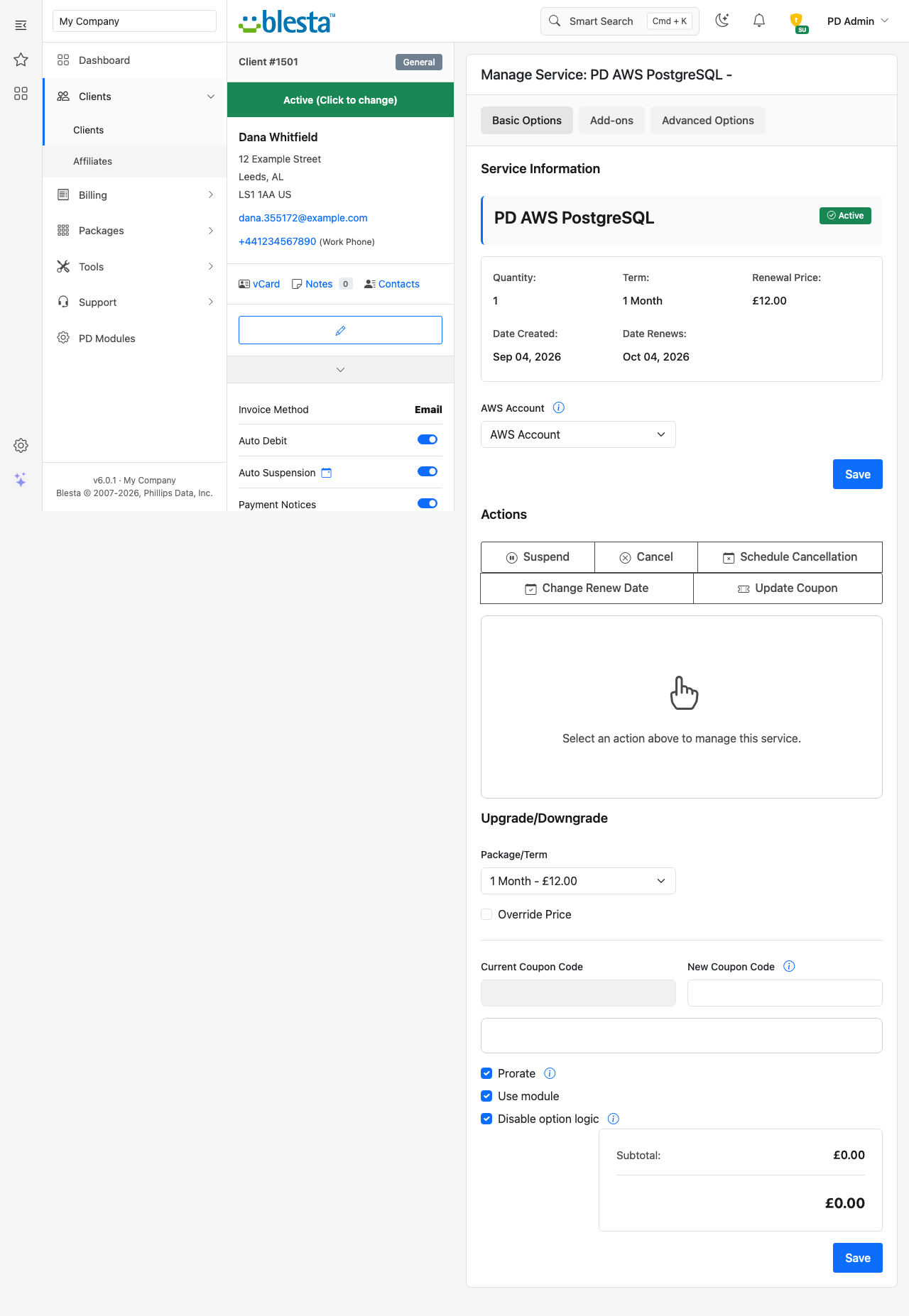
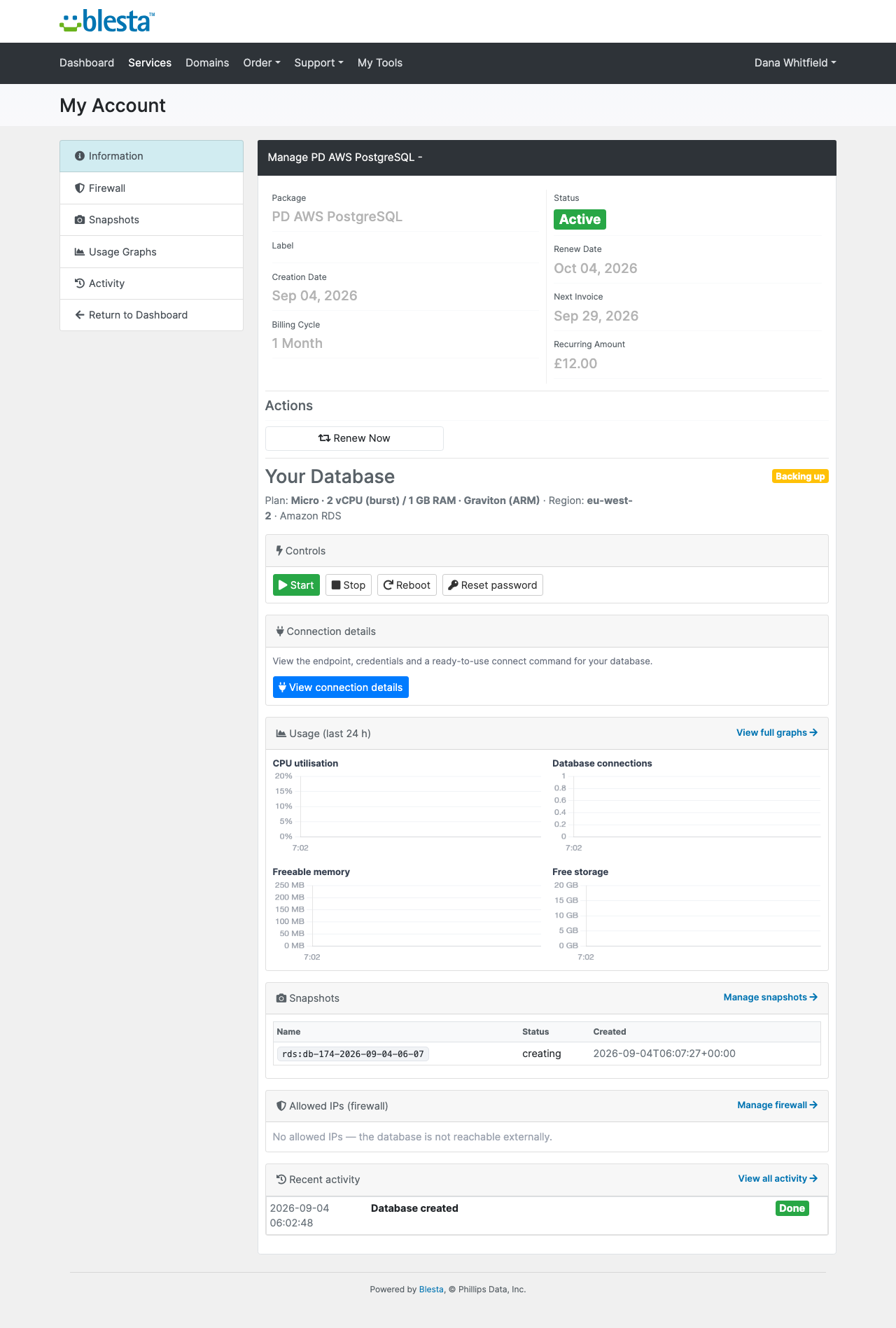
PD AWS PostgreSQL lets a hosting company sell managed PostgreSQL databases as its own package. Your customer orders in your Blesta order form, a dedicated PostgreSQL database is built in your AWS account, and your customer manages it from their Blesta service page: connection details, usage graphs, snapshots and a firewall, with no AWS console and no AWS login. You set the price, AWS bills you its cost, and the difference is your margin.
It is built for hosts whose customers are developers, agencies and software teams who ask for PostgreSQL by name and would rather buy it from their host than set up an AWS account of their own.
Why hosts choose PD AWS PostgreSQL
The engine developers ask for, at two price points. Back a package with Amazon RDS for resizable, firewalled plans with optional high availability, or with a flat-priced Lightsail database for an entry-level offer, and mix both. RDS plans are generated on AWS's Graviton processors, from db.t4g.micro to db.m6g.xlarge; Lightsail plans are flat-priced bundles. Lightsail databases have no firewall, so that section is hidden for them.
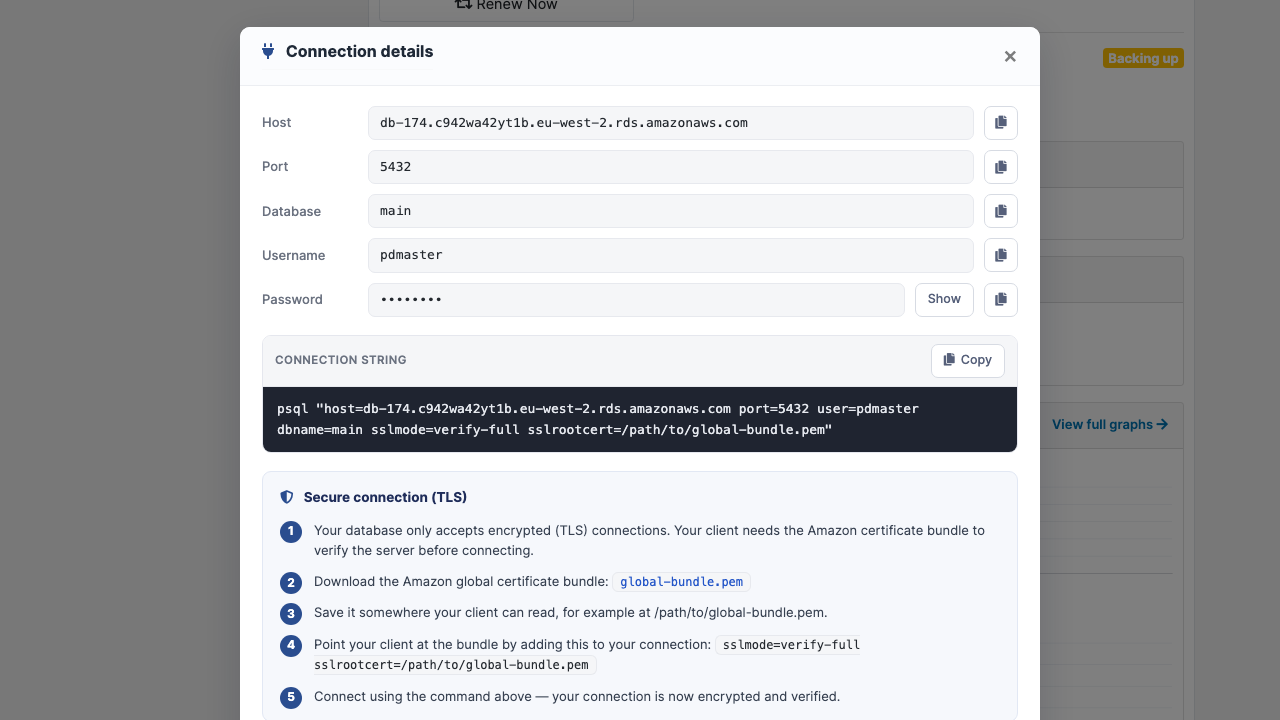
Connect with certificate checking built in. The connection details window gives a ready-to-paste psql command with sslmode=verify-full, so the connection is encrypted and the server is verified against the Amazon certificate bundle, with the exact setting to use. Port 5432 is the only port the firewall ever opens.
Strong passwords, stated up front. The reset form states the rules PostgreSQL on RDS enforces, 8 to 128 characters from letters, digits and - _ ! # %, and refuses a bad password at once, before anything is queued.
Every customer is isolated. Each order gets its own instance, master credentials and firewall group. Nothing is shared, even with another installation using the same AWS account, and the module refuses to take over a database it did not create.
Changes made safely. A snapshot is taken before a plan or storage change is applied, so a restore point exists. Storage is only ever grown, online.
Nothing left billing. Terminating a service deletes the database with its backups, snapshots and firewall group straight away. A host who wants a copy keeps one in the AWS console first.
How it works
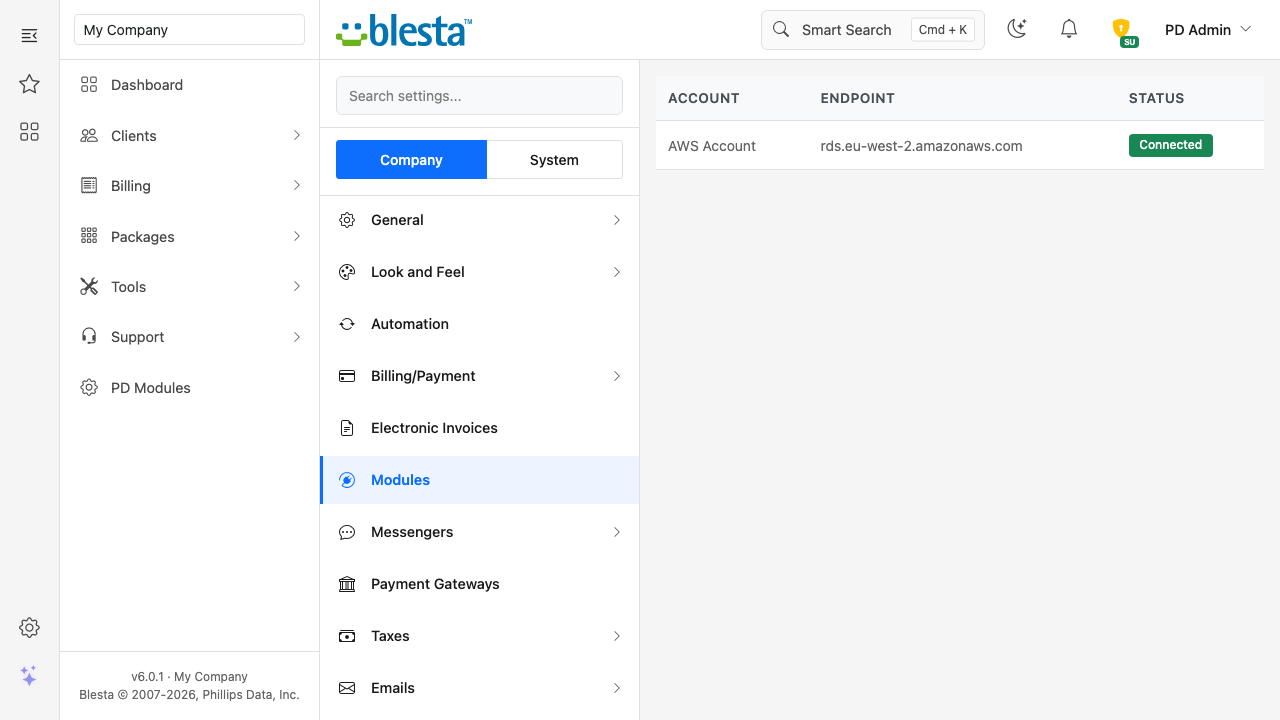
Connect your AWS account. In Blesta, open Settings, Company, Modules, and add an account with your access key. The secret is stored encrypted. Test Connection, in the PD Modules panel, makes one read-only call and creates nothing.
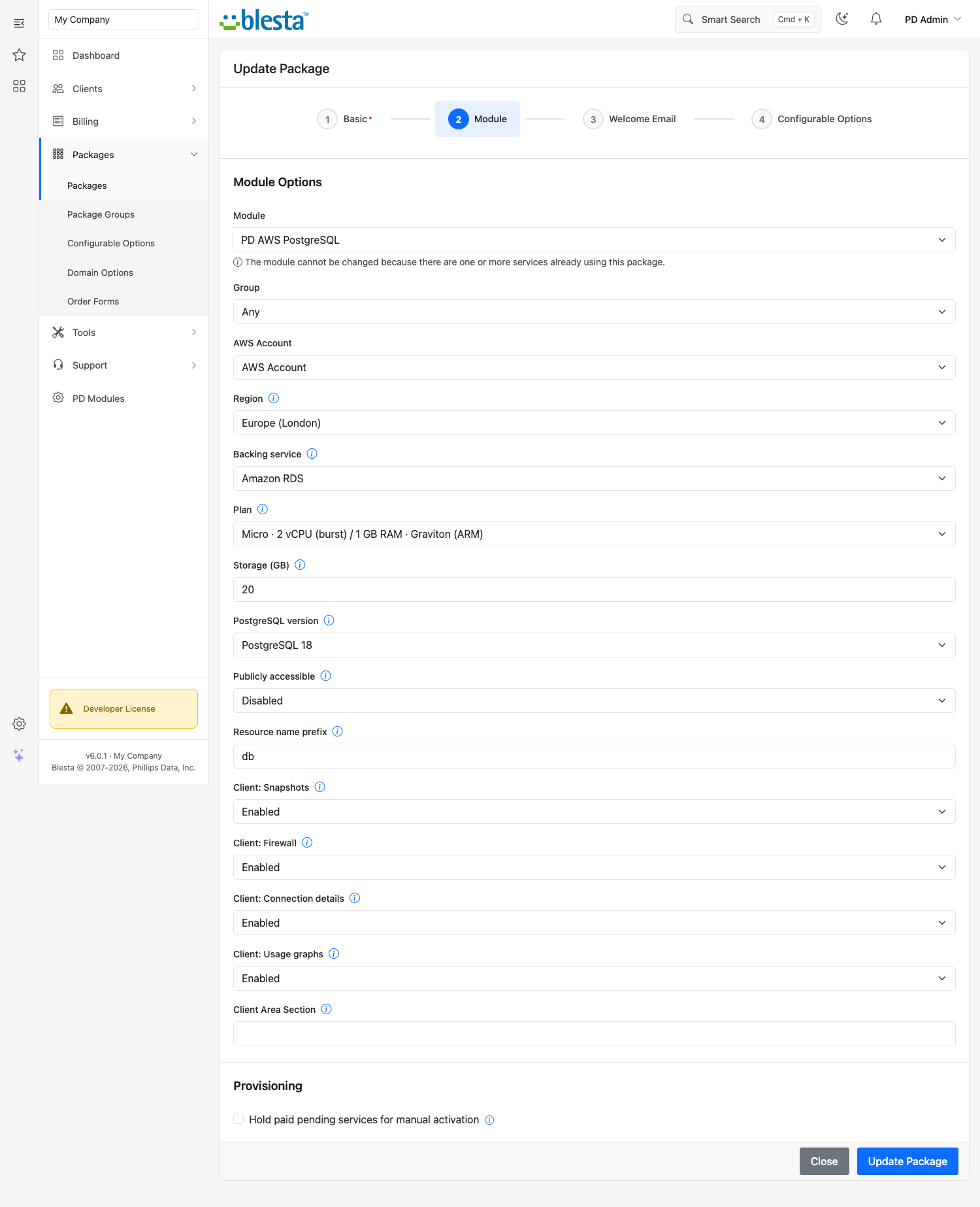
Create your package. Add a Blesta package, choose PD AWS PostgreSQL as its module, and set the backing service, region, plan, storage and PostgreSQL version. Press Generate plans to create the option group customers pick from.
Your customer orders. Once the order is paid, the database is built in the region and size they chose, usually within a few minutes. Their service page says so, then fills in by itself.
You get paid, they manage it. Blesta keeps billing as usual, and suspend, unsuspend and cancel follow your normal billing.
The package form: AWS account, region, Amazon RDS, a Graviton plan, storage and the PostgreSQL version
What you get in Blesta
Selling and pricing
A package option group generated from the live AWS catalogue: region, plan, storage, high availability, public access and PostgreSQL version; the versions offered are the ones AWS currently offers in your region
Every choice starts at no extra charge; you set the prices under Packages, Package Options
A "High availability (Multi-AZ)" choice that gives the customer a standby in a second zone
A public-access choice; left off, the database is reachable only inside the AWS network
Sync with AWS hides choices AWS has retired and adds new ones, without touching prices or existing customers
Billing stays yours: the service is charged at the prices of the package and its options, and nothing is metered into Blesta
Provisioning you can trust
Plan upgrades resize an RDS database in place and keep its data; Multi-AZ is switched on or off in place
A change that cannot be applied in place is reported to you as not applied, never accepted silently while the bill changes
Failed setups are recorded with the real reason; running setup twice never creates a second database
Suspend stops the database and keeps it stopped, even though AWS restarts stopped databases after seven days. Unsuspend starts it again with its data
Running it day to day
Clients & Databases, in the PD Modules panel, lists every database with its service, backing, plan, region, endpoint and live state
An activity log of provisioning, resizes, snapshots and password resets across every service
A report that checks your licence, the AWS SDK and how many credential sets and databases you have
Read-only assistant tools that report a service's database state and recent provisioning activity, with no way to create, resize, delete or restore anything
What your customers get
Start, stop and reboot, and a stopped database keeps its data
Connection details with one-click copy, and the password masked until revealed
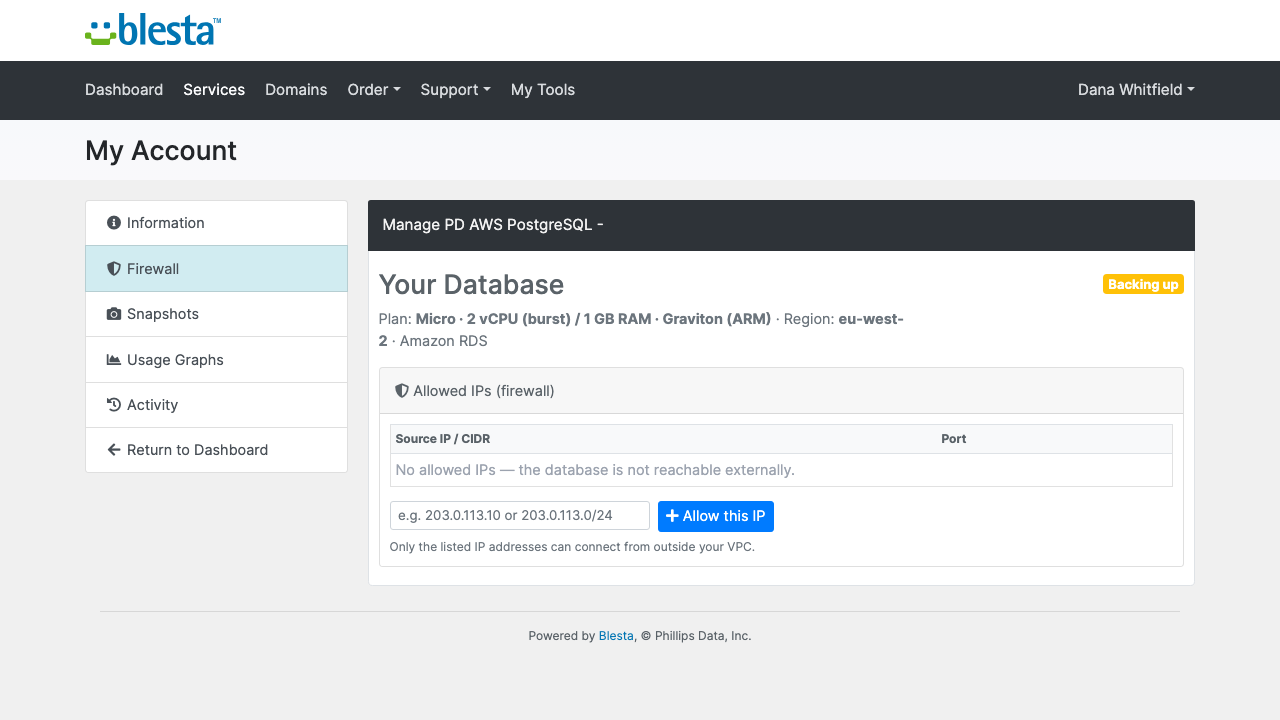
A firewall of allowed IPv4 addresses and ranges, applied on the next scheduled run and followed under Activity
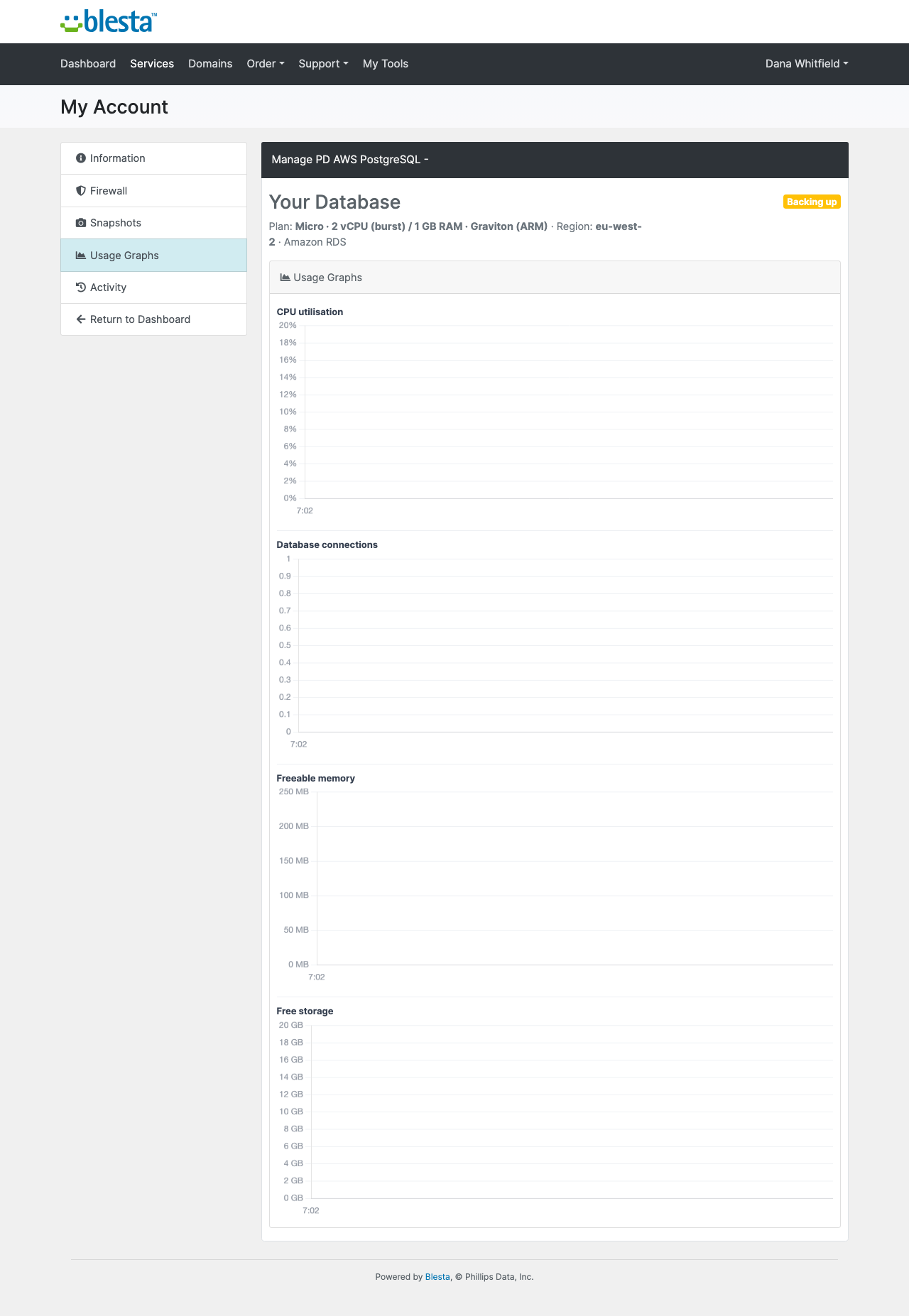
Usage graphs for CPU, connections, freeable memory and free storage over the last 24 hours, from AWS's own metrics
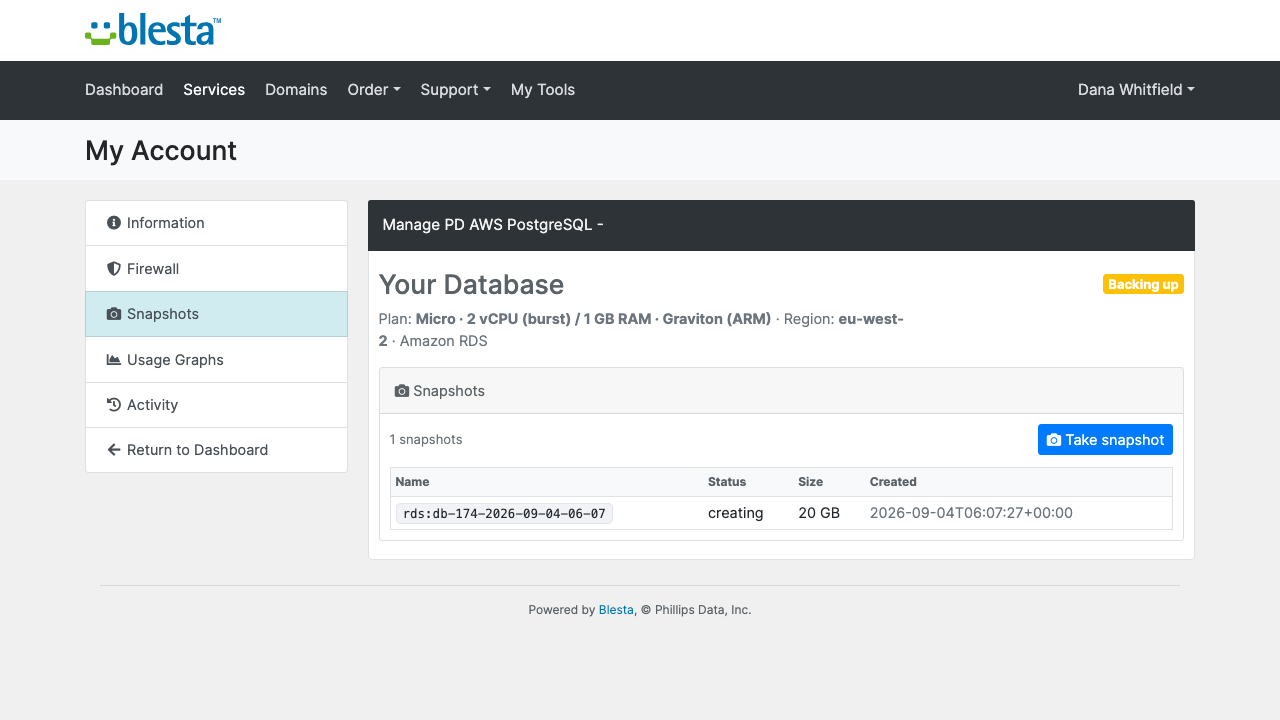
Snapshots they take and delete themselves, with the automated daily backups, kept seven days, listed beside them
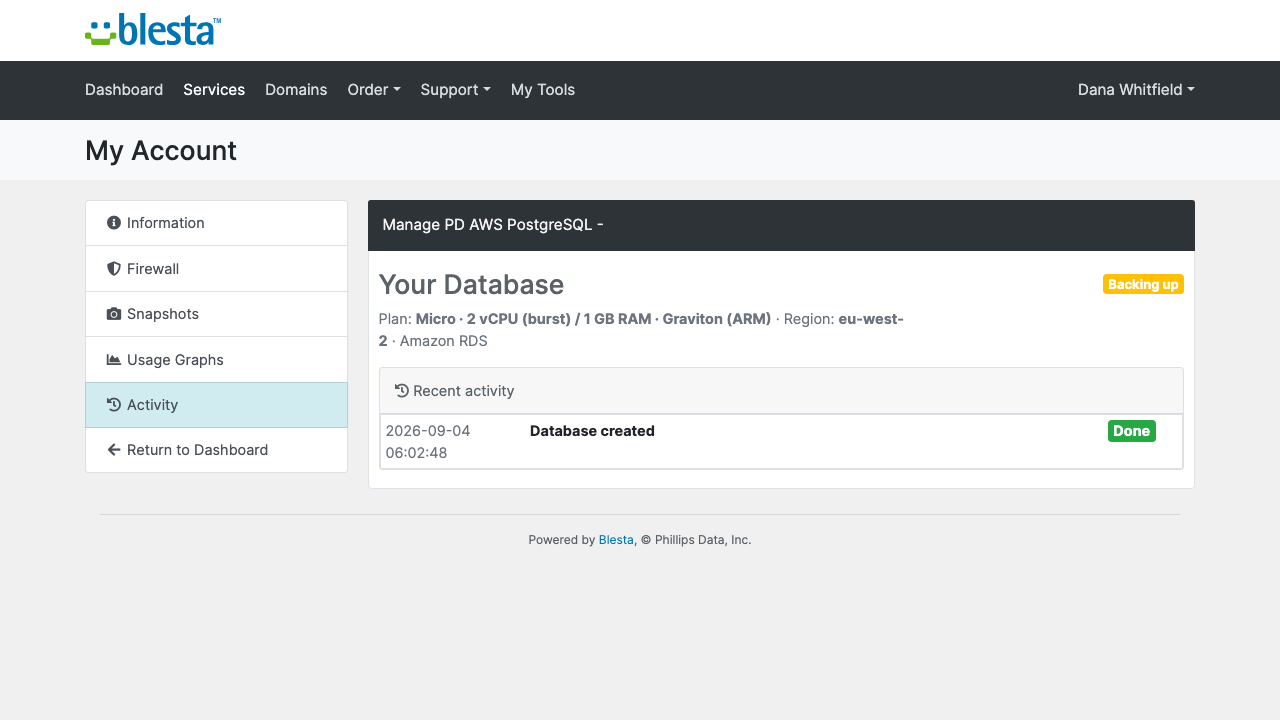
Activity in plain words, with the time and outcome of each action
The connection details window: a psql command with sslmode=verify-full and the steps to verify the server with the Amazon certificate bundleSnapshots the customer takes and deletes themselves, with name, status, size and dateActivity: the time and outcome of what happened to the database
Snapshots, Firewall, Connection details and Usage graphs are each a setting on the package. Turn one off and it disappears from the customer's page, and the request is refused however it is made. The pages render in Blesta's client portal and follow its theme, and every word can be translated or reworded with override files that survive updates. Customers see only your brand.
Security built in
Your AWS keys are stored encrypted in Blesta and never appear on a customer page, in a message or in a log.
Database passwords are stored encrypted on the service, including one the customer sets with Reset password.
Only the database's own port is opened, and only to the addresses the customer lists.
Restores stay with you: customers take and delete snapshots, and you restore from the AWS console when asked.
One product, every feature
PD AWS PostgreSQL is one paid module with everything included, bought on its own as an add-on to your PD Modules licence. There are no tiers and no per-database fee from us: you pay AWS at cost and keep the margin. Each order creates a real, billable AWS resource, so there is no free trial.
If your subscription ever lapses, customers' databases are never touched or deleted. You get a 14-day grace period with everything working and a renewal reminder, then admin management locks while customers keep being served, and only after that do customer features pause behind a neutral "temporarily unavailable, please contact support" message. Renewing restores everything at once.
Requirements
Blesta 6 or later on PHP 8.2 or later, with the ionCube Loader
An AWS account and an access key with the Amazon RDS permissions we list, plus the security group permissions every order needs (and Lightsail permissions if you sell Lightsail plans)
PD Modules, the free control panel every PD module installs into
Questions
Do I need my own AWS account?
Yes. Databases are provisioned on your own AWS account, in the region you choose, so you keep full control and the margin. Your AWS keys are stored encrypted in the Blesta module row and never appear in the client area.
Who pays for the AWS usage?
You do — the database runs on your AWS account. You set the sell price on your Blesta package and bill your client through Blesta as normal, keeping the difference as margin.
Can I offer RDS and Lightsail?
Yes. PostgreSQL can be provisioned on Amazon RDS (Graviton-powered tiers, resizable, with usage graphs and snapshots) or on the cheaper flat-priced Lightsail bundles. You choose per package when you generate the plan options.
What port do clients connect on?
PostgreSQL listens on port 5432. The client-area firewall opens that port automatically for the IPs your client allow-lists, and the ready-to-paste psql connection string uses it.
Can clients resize or add storage themselves?
Storage and plan changes are billed through Blesta Upgrade/Downgrade — never a free client button. They apply in place with an automatic safety snapshot first, so data is never lost, and storage is only ever increased.
Is it secure?
Every database sits in its own security group (clients only manage their own IP rules), all connections are TLS-encrypted with the Amazon CA bundle offered for download, and master passwords are masked until explicitly revealed.
Which Blesta templates are supported?
The client area renders natively on Six (Bootstrap 3), Twenty-One and Nexus (Bootstrap 4) with no extra CSS, and can be translated or rebranded with a language file or template override.
What happens when a client cancels?
The module deletes the database cleanly on termination — no orphaned instances and no surprise AWS charges.
What happens if my subscription lapses?
Nothing of yours is touched, and nothing is deleted. The module steps down in stages instead: a 14-day grace period where everything still works and you get a renewal reminder, then admin management locks while your customers carry on being served, and only after that do the customer-facing features stop — behind a neutral "temporarily unavailable, please contact support" message that never mentions licensing to your customer. Anything the module provisioned keeps running in your own account throughout, and your data and settings stay exactly where they are. Renewing restores everything immediately.
What’s new in 0.4.62
On Blesta, the plan options screen now says the region, plan and version are chosen on the package, instead of reporting a database error.